15-Year-Old Developer Builds LLM Weight Editing Tool: A New Approach to Low-Barrier Model Modification
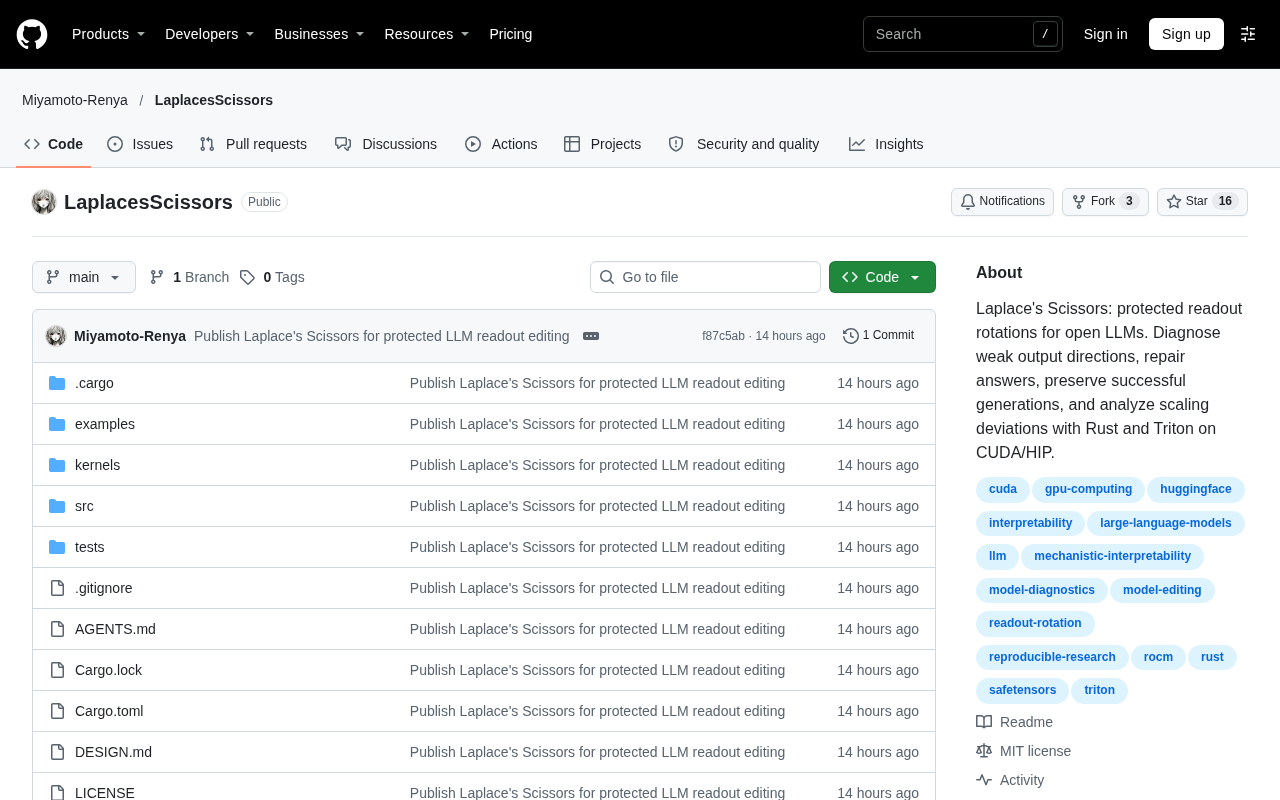
A 15-year-old developer released an LLM weight editing tool, reflecting the lowering barrier to low-level AI operations and the trend of younger developers.
A 15-year-old developer released an LLM weight editing tool on Hacker News' Show HN section, drawing attention. Weight editing is a high-barrier low-level operation in the LLM field, traditionally done by research teams. The tool is positioned as a lightweight editing tool for the developer community, with potential uses including model behavior fine-tuning, bias removal, knowledge injection and correction, and model merging experiments, while also lowering the barrier to understanding model internals in educational settings. The article notes that the prosperity of the open-source model ecosystem, mature toolchains, and accumulated community knowledge are the foundational conditions enabling young developers to enter this field. However, feature details and technical implementation information are currently limited, and its actual reliability still needs community verification. This phenomenon reflects that low-level AI operations are moving from a few laboratories to a broader developer community, with the younger generation being the most active participants in this process.
A 15-Year-Old's LLM Weight Editing Tool
A striking project appeared on Hacker News' Show HN section: an LLM weight editing tool built by a 15-year-old developer. The project's title alone conveys a wealth of information—it's not just a technical tool, but a signal that the barrier to AI development is lowering.
Weight editing is a relatively low-level and high-barrier operation in the LLM field. Traditionally, modifying model weights requires deep understanding of model architecture, training pipelines, and parameter distributions, and is usually done by research teams or senior engineers. The fact that a 15-year-old developer can enter this space and produce a demonstrable tool shows that the relevant toolchains and knowledge dissemination have reached a fairly mature stage.
LLM weights refer to the parameters a large language model learns during training, typically stored as tensors in model files (such as PyTorch's .bin or .safetensors format). These parameters determine how the model responds to inputs, and can scale to billions or even hundreds of billions of floating-point numbers. Weight editing refers to directly modifying these parameter values without going through the traditional gradient descent training process. Common methods include: targeted modification of specific neurons or layers, adjusting weights after low-rank decomposition, or combining parameters from multiple models through model merging. These operations bypass the expensive training process, but require deep understanding of parameter distributions and model behavior, otherwise model performance can easily be damaged.
Tool Positioning and Potential Value
Judging from the Show HN release format, this is a tool showcase aimed at the developer community. The Show HN audience consists mainly of technical practitioners and enthusiasts, which means the tool's positioning leans toward practicality and operability rather than pure academic research.
The practical uses of LLM weight editing span multiple directions: fine-tuning model behavior, removing specific capabilities or biases, knowledge injection and correction, and experiments such as model merging. A lightweight editing tool can lower the startup cost of these experiments, allowing more people to directly manipulate model parameters without building training pipelines from scratch.
For education and learning scenarios, the value of such tools is especially clear. Directly editing weights lets learners intuitively understand the relationship between parameters and model behavior, which builds a stronger perception of LLMs' internal mechanisms than simply reading papers or calling APIs.
Model merging is a popular branch of weight editing, referring to combining the weights of multiple fine-tuned models into a new model through arithmetic operations (such as linear interpolation, task vector addition, TIES-Merging, etc.). Its advantage is that different capabilities can be fused without additional training—for example, merging a mathematical reasoning model with a code generation model. Knowledge injection and correction refers to updating the model's factual knowledge or correcting errors by editing the weights of specific layers. A typical method such as ROME (Rank-One Model Editing) changes the model's recall of specific facts by locating and modifying key weights in the feedforward network. These techniques place high demands on tools, requiring precise weight localization and evaluation of editing effects.
Insights from the Young Developer Phenomenon
A 15-year-old developer producing an LLM weight editing tool would have been almost unimaginable a few years ago. Behind this phenomenon are several trends worth noting.
The prosperity of the open-source model ecosystem is the foundational condition. Only when model weights can be freely downloaded and used do various operations around weights become possible. Second is the maturity of toolchains—the ease of use of frameworks like PyTorch and the standardized interfaces of the Hugging Face ecosystem have greatly lowered the barrier to operation. Third is the accumulation of community knowledge: a large number of tutorials, discussions, and open-source projects allow newcomers to quickly stand on the shoulders of predecessors.
This project also suggests that the talent development path in the AI field is changing. Young developers no longer need to go through lengthy formal training to access core technologies; they can enter frontier practice directly through open-source communities. This is a positive signal for the industry's talent supply, while also raising new questions about traditional education and training models.
The Hugging Face ecosystem is the core hub of the current open-source AI toolchain, providing model hosting (Model Hub), dataset libraries (Datasets), inference APIs (Inference API), and standardized interface libraries such as transformers, peft, and accelerate. It greatly reduces the amount of code needed for model loading, fine-tuning, and deployment, so developers don't need to implement training loops from scratch. PyTorch, as a mainstream deep learning framework, makes weight operations (such as direct indexing, assignment, and pruning) intuitive through its dynamic computation graphs and rich operator libraries. A common feature of these tools is well-developed documentation and active communities, allowing newcomers to get started quickly through example code—this is precisely the technical foundation that enables young developers to quickly enter the field of low-level LLM operations.
A Side That Requires Rational Perspective
Currently, information about this tool is still fairly limited. The Show HN post only shows a basic entry, without detailed feature descriptions, technical implementation, or benchmark tests. Therefore, caution is needed when evaluating its technical depth and actual effectiveness.
There is a long distance between a tool that "runs" and one that is "reliably usable in real scenarios." Weight editing involves a series of engineering issues such as numerical stability, evaluation of post-edit model behavior, and reproducibility. The tool's performance on these dimensions will need more details and community feedback before it can be judged.
However, even if the tool's functionality remains to be verified, its sample value as a community phenomenon is already established: low-level LLM operations are moving from a few laboratories to a broader developer community, and the younger generation is one of the most active participants in this process.
Conclusion
What is most noteworthy about this 15-year-old developer's LLM weight editing tool is not its current feature completeness, but the trend it represents—the barrier to model operations is lowering, participants are getting younger, and the open-source ecosystem is putting once-closed capabilities into more people's hands. For readers interested in AI tools and the open-source ecosystem, this project is worth following.
Related articles
 Tech Frontiers
Edge AI on Microcontrollers: When Is It Actually Worth Deploying?
Drawing on Reddit discussions and Arm case studies, this article analyzes the real-world use cases for edge AI on microcontrollers: when each device needs independent inference, when a gateway or cloud is more reasonable, and the costs and boundaries of specialized hardware.
 Tech Frontiers
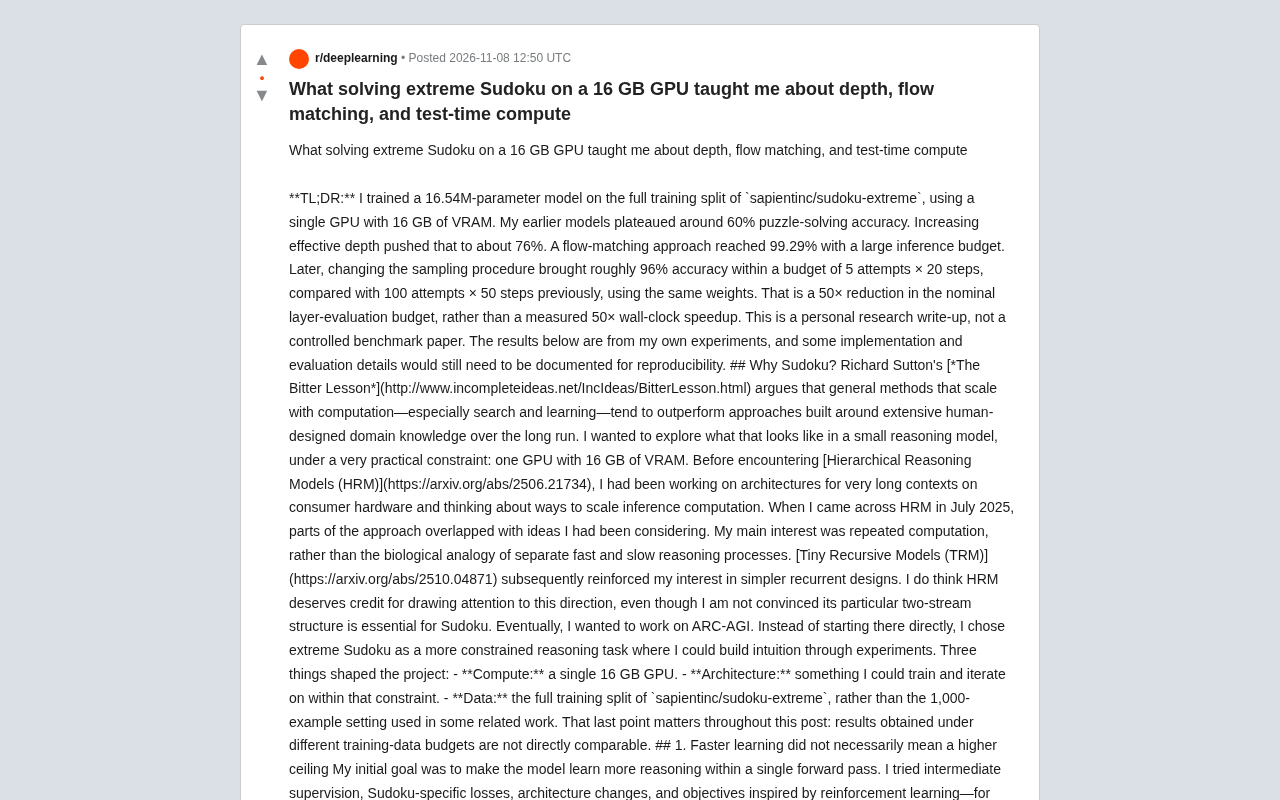
Pushing the Limits of Extreme Sudoku on a 16GB GPU: Insights from Depth and Flow Matching
A researcher trained a 16.54M-parameter model on a 16GB GPU to solve extreme Sudoku, finding effective depth breaks the 60% plateau and flow matching with improved sampling pushes accuracy past 99% with ~50× lower layer-evaluation budget.
 Tech Frontiers
AI Agent Approval Workflows: Why Human Confirmations Always Get Mindlessly Clicked
Why do AI agent approval workflows always get mindlessly clicked? A Reddit discussion shows that separating rules from keys, low-frequency high-risk approvals, and GitHub Environments-style gates are the keys to effective approvals.