16 FPS on a Single RTX 5090: Optimizing LingBot-World 2.0 for Real-Time Inference

LingBot-World 2.0 hits 16 FPS on RTX 5090 via low-precision ops, SageAttention, and custom CUDA kernels.
A developer used three combined optimizations — low-precision arithmetic, replacing FlashAttention with SageAttention, and custom CUDA kernels — to boost LingBot-World 2.0 1.3B inference from 6 FPS to 16 FPS on a single RTX 5090, outperforming SGLang Diffusion by 2.5× and NVIDIA FlashDreams by 1.9×. The project lets users upload an image with a text prompt to generate a navigable virtual world at 832×464 resolution using keyboard and mouse. Code is fully open-sourced but currently Linux-only, demonstrating that consumer GPUs can reach real-time world model interaction with solid inference engineering — no model changes or quality tradeoffs required.
The Real-Time Challenge for World Models
A wave of impressive world models has emerged recently — models that can take a single image and a text prompt, then predict and generate subsequent frames in real time, letting users navigate a generated virtual environment like a video game. But these models share a common pain point: most of them can't achieve true real-time performance on consumer-grade GPUs.
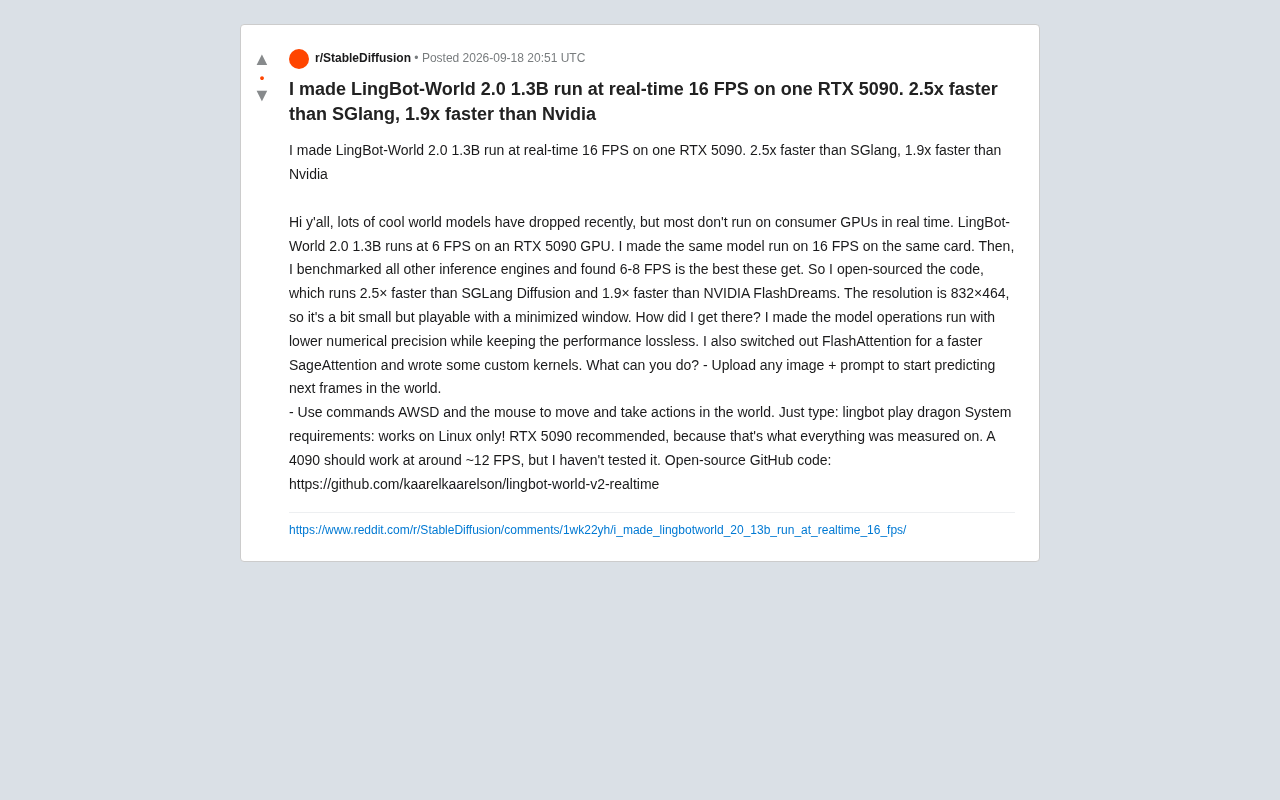
A developer shared their optimization results on Reddit: they boosted the inference speed of the LingBot-World 2.0 1.3B model on a single RTX 5090 from 6 FPS to 16 FPS, and fully open-sourced the code. This represents a significant edge over mainstream inference engines — 2.5× faster than SGLang Diffusion and 1.9× faster than NVIDIA FlashDreams.
In AI, a "world model" refers to a generative model capable of predicting and simulating environmental dynamics. The concept draws from cognitive science and reinforcement learning, with the core goal of enabling a model to "understand" physical laws, spatial relationships, and causal logic — not just fit pixel distributions. With the maturation of video diffusion models in recent years, world models have gained interactive capabilities: given an initial frame and an action command, the model can autoregressively predict subsequent frames, forming a controllable virtual environment. Google's Genie, OpenAI's exploratory work in this direction, and multiple research teams' projects all fall under this umbrella. LingBot-World is one such interactive video diffusion world model. Its 1.3B parameter count is on the lightweight end for this category, yet real-time inference remains a significant challenge — video diffusion models typically require dozens of denoising iterations per frame, compounded by the quadratic complexity of Transformer attention, making frame rate one of the hardest bottlenecks to break on consumer hardware.
Performance Comparison: The Ceiling of Mainstream Inference Engines
According to the author's benchmarks, mainstream inference engines running this model on identical hardware were consistently bottlenecked in the 6–8 FPS range with little room to improve.
Here are the specific performance numbers:
- Original LingBot-World 2.0 1.3B: 6 FPS on RTX 5090
- Optimized open-source version: 16 FPS on RTX 5090
- vs. SGLang Diffusion: 2.5× faster
- vs. NVIDIA FlashDreams: 1.9× faster
It's worth noting that 16 FPS crosses the threshold of "playable" for an interactive world model. Although the resolution is capped at 832×464 and the window needs to be minimized for comfortable viewing, this frame rate is genuinely impressive for a locally-run world model.
Under the Hood: How to Squeeze Every Drop of GPU Performance
The author briefly described three optimization techniques in their post. Combined, these methods delivered nearly a 3× speedup:
Low-Precision Arithmetic
The first optimization runs model computations at lower numerical precision while keeping quality lossless. Reducing numerical precision is a common inference acceleration technique, but doing it without degrading generation quality requires careful judgment about which operators can tolerate lower precision and which must retain full precision.
Faster Attention Mechanism
The second optimization replaces the model's FlashAttention with the faster SageAttention. Attention mechanisms are often the computational bottleneck in Transformer-based models. SageAttention achieves higher throughput for attention computation through techniques like quantization, making it an important direction in recent inference optimization work.
SageAttention was proposed by researchers at Tsinghua University and affiliated institutions. Its core idea is to quantize the Q and K matrices in the attention computation to INT8 while keeping V at higher precision, significantly reducing memory bandwidth pressure while keeping precision loss below the perceptual threshold. Unlike the FlashAttention family, which reduces HBM read/write operations through tiling, SageAttention primarily improves arithmetic intensity through mixed-precision quantization — these two approaches optimize along different dimensions. As a result, on certain model-hardware combinations, SageAttention can outperform FlashAttention 2/3 in real-world throughput. For diffusion-based world models, generating each frame requires a full pass through the Transformer's attention layers, so attention latency directly caps the frame rate — making this substitution particularly impactful.
Custom CUDA Kernels
The third optimization involves writing custom kernels. When general-purpose frameworks can't fully leverage hardware-specific features, hand-written targeted kernels often yield additional performance gains. All three optimizations together are what enabled the jump from 6 FPS to 16 FPS.
A custom CUDA kernel means the developer bypasses high-level frameworks like PyTorch or JAX and writes low-level compute programs in CUDA C/C++ or Triton that run directly on the GPU. General-purpose frameworks sacrifice deep optimization for compatibility — they can't fine-tune for specific operator shapes, data layouts, or memory access patterns. Hand-written kernels, by contrast, give precise control over warp scheduling, shared memory usage, and instruction pipelining, eliminating framework overhead and maximizing hardware utilization. Common optimization targets in inference scenarios include: kernel fusion (merging consecutive operators to reduce intermediate tensor memory reads/writes), manually tuning tile sizes for specific resolutions or batch sizes, and leveraging Tensor Core instruction sets for higher matrix multiplication throughput. For latency-sensitive applications like world models, custom kernels are often the final tool for squeezing out the last bit of hardware performance after the first two optimization layers have hit their ceilings.
How to Get Started
The project's interaction model is intuitive and faithfully recreates the experience of "playing inside a generated world":
- Starting point: Upload any image with a text prompt, and the model begins predicting subsequent frames of that world
- Real-time control: Use the WASD keys and mouse to move around and interact within the generated world
- Quick start: Simply run
lingbot play dragonin the command line to jump in
System Requirements
Note that the project currently only supports Linux. The author recommends an RTX 5090, as all performance numbers were measured on that card. They estimate an RTX 4090 would achieve around 12 FPS, though this hasn't been verified through actual testing.
The complete open-source code is available on GitHub: kaarelkaarelson/lingbot-world-v2-realtime.
A Few Observations
World models are a hot topic in AI right now, but inference cost and real-time performance have consistently been the barriers to consumer adoption. The value of this project lies not in the model itself, but in demonstrating that through a combination of low-precision arithmetic, attention optimization, and custom kernels, real-time performance can be dramatically improved without swapping out the underlying model or sacrificing generation quality.
For developers and enthusiasts looking to run world models locally, this open-source codebase is an excellent reference — it proves that consumer hardware is often just one layer of solid inference engineering away from crossing the real-time threshold. That said, the 832×464 resolution and Linux-only limitation make clear this is still an early-stage project, and real-world experience across different hardware configurations remains to be validated by the broader community.
Related articles

Gemini 4 Argon Hands-On: AI Builds Board Games, Constructs Temples, and Trains Robots Autonomously
Gemini 4 Argon hands-on roundup: AI autonomously builds a desk racetrack and temple in Blender, writes a ray tracing engine, trains a humanoid robot to sink 7 shots, plus API pricing and developer access.

The Magic Octagonal Coin: Why Only 9% of People Can Predict Its Flip?
Only 9% of people can correctly predict the Magic Octagon coin flip. This article explains its spatial rotation mechanism, common cognitive pitfalls, and a new hypothesis based on Relevance Theory, exploring the limits of human spatial reasoning.

Sam Altman: AI Is Entering the Era of Scientific Discovery — Math Breakthroughs Will Replicate in Biology and Energy
Sam Altman says AI is entering the era of scientific discovery — math breakthroughs will replicate in biology, materials science, and energy to help develop new drugs and energy sources.