16 Frontier VLMs Benchmarked for Document Parsing: Opus 5.5 Leads on Value

16-VLM document parsing benchmark: higher reasoning effort shows limited gains; Opus 5.5 tops value rankings.
A systematic benchmark (ParseBench) across 16 frontier VLMs finds that the "increase reasoning effort" strategy — highly effective for coding and math — yields limited gains in PDF document parsing, where the bottleneck is visual perception rather than logical reasoning. Opus 5.5 achieves the best price-to-performance ratio among frontier models thanks to strong table parsing; Astra matches its quality but costs more; GPT-6 Luna fits lower-budget needs. For selection strategy: large-scale batch processing favors specialized OCR like LlamaParse for cost and speed; embedded agent-loop scenarios (Codex, Claude Code) favor Opus 5.5 to minimize integration overhead.
A systematic evaluation covering 16 frontier vision-language models (VLMs) for document parsing has produced some noteworthy findings. The benchmark includes the latest flagship models such as Opus 5.5 and GPT-6 Sol/Luna, and tackles a question that has long gone unanswered: does investing more reasoning compute (higher effort) actually improve a model's ability to read PDF documents?
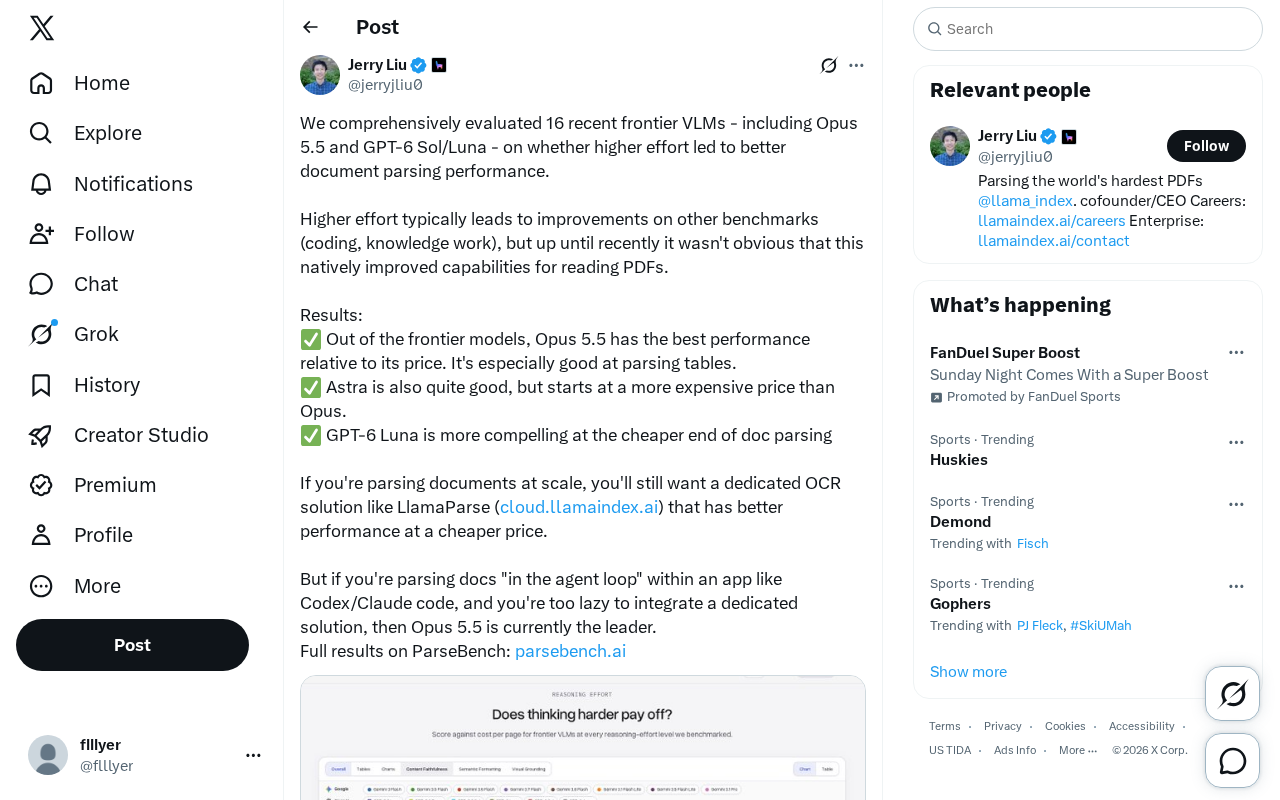
More Compute Doesn't Always Mean Better Document Parsing
Across coding and knowledge-work benchmarks, a well-established pattern holds: give a model a larger reasoning budget (effort), and performance tends to improve in lockstep. In the specific domain of document parsing, however, that rule hasn't held — simply letting a model "think longer" doesn't meaningfully improve its native ability to read PDFs.
This reflects something fundamental about document parsing as a task. Extracting information from PDFs relies far more on a model's visual understanding of layout structure, table boundaries, and multi-column arrangements than on pure chains of logical reasoning. Applying the "increase effort" strategy — which works well for math or coding tasks — doesn't yield the same returns in document contexts. The value of this evaluation lies precisely in using data from 16 models to rigorously retest the boundaries of that assumption.
Reasoning compute (Effort/Thinking Budget) refers to mechanisms that allow a model to engage in extended "internal deliberation" before producing a final answer. Common implementations include OpenAI's reasoning_effort parameter (low/medium/high) and Anthropic Claude's Extended Thinking mode. These mechanisms deliver strong gains on tasks like mathematical reasoning, competitive programming, and complex logic puzzles — because those tasks are essentially about searching for the correct reasoning path, and more thinking steps mean a larger search space. The bottleneck in PDF document parsing is fundamentally different: it's not about the length of the reasoning chain, but about whether the model can accurately perceive pixel-level visual information in an image — table lines, character layouts, and hierarchical structure. Extra reasoning budget cannot compensate for inherent limitations at the visual perception layer. This is a structural difference between the two task types.
Model Performance: Opus 5.5 Wins on Value
Looking at the benchmark results, several flagship models each have their own strengths:
- Opus 5.5: Delivers the best performance-to-price ratio among frontier models, with a particular edge in parsing table structures — making it the overall value leader.
- Astra: Parsing quality is similarly excellent, but its starting price is higher than Opus, which makes it harder to justify in cost-sensitive scenarios.
- GPT-6 Luna: More attractive at the lower-cost end of document parsing, suited for users with tighter budgets who don't require maximum accuracy.
The special callout for table parsing is an informative detail. Tables have historically been one of the hardest challenges in document parsing — merged cells, row/column spans, and implicit headers all trip up general-purpose models. Opus 5.5's advantage here suggests it may be more reliable for financial reports, invoices, and structured data documents.
ParseBench is the publicly available document parsing benchmark referenced in this evaluation. It's designed specifically for real-world PDF parsing scenarios and covers sub-tasks including table extraction, multi-column body text, and scanned document recognition. It evaluates models across multiple dimensions including precision, recall, and cost per thousand pages. Unlike general-purpose benchmarks such as MMLU or HumanEval, ParseBench's tasks closely mirror production engineering needs, making its findings more actionable for deployment decisions. Developers can view per-model breakdowns by document type on the ParseBench website to run targeted validation against the document formats most common in their own workflows.
General-Purpose VLMs vs. Specialized OCR: How to Choose
The benchmark offers a pragmatic recommendation rather than simply championing large models.
If you need large-scale batch document processing, specialized OCR solutions (such as LlamaParse, mentioned in the evaluation) remain the better choice — outperforming general-purpose VLMs on both performance and cost. This aligns with engineering intuition: a pipeline deeply optimized for a single task tends to be more efficient and cheaper than a general-purpose model.
But when the scenario shifts to use inside an agent loop, the conclusion flips. When you're building with tools like Codex or Claude Code and need an agent to handle document parsing as part of a larger task — without wanting to integrate a separate OCR service — Opus 5.5 is currently the best option. In other words, a model's value isn't just about peak accuracy on a single task; it's also about whether it can seamlessly embed into existing agentic workflows and reduce integration overhead.
This dividing line has direct implications for developers: batch, offline, cost-optimized → use specialized OCR; embedded, in-agent, convenience-first → use a general flagship like Opus 5.5.
LlamaParse is a specialized document parsing service from the LlamaIndex team, deeply optimized for formats like PDF, Word, and Excel. It supports complex table extraction, multi-column layouts, and embedded image handling. Compared to general-purpose VLMs, specialized OCR pipelines typically offer orders-of-magnitude advantages in processing speed and per-page cost, making them well-suited for production environments that handle thousands to tens of thousands of pages per day. Agent loop refers to the workflow in which an AI agent repeatedly calls tools, executes actions, and observes results while completing a composite task — for example, having Claude Code read a PDF contract and automatically generate a summary or code snippet. In such cases, document parsing is just one intermediate step in a larger pipeline, and developers typically don't want to maintain a separate external service just for that step. These two scenarios have very different tolerances for integration complexity, which is why they lead to different recommendations.
Takeaways for Developers
The most practical contribution of this evaluation is that it pulls "document parsing" out of the abstract world of benchmark scores and grounds it in real deployment decisions. Choosing a model shouldn't mean fixating on whoever tops the leaderboard — it means weighing call volume, integration cost, and use-case context together.
For teams tracking the capability boundaries of frontier models, there's one more conclusion worth noting: the gains from increasing effort in document parsing can't be assumed to mirror those in other tasks. Before allocating compute budget to PDF parsing, running a small-scale validation pass on your own real document samples is likely more reliable than trusting general rules. Full results are publicly available on ParseBench for developers who want to dig into the detailed numbers.
Note: This article is based on a single source (the benchmark's original Twitter announcement). Model names and specific scores should be verified against the primary ParseBench data.
Related articles

Gemini 4 Argon Hands-On: AI Builds Board Games, Constructs Temples, and Trains Robots Autonomously
Gemini 4 Argon hands-on roundup: AI autonomously builds a desk racetrack and temple in Blender, writes a ray tracing engine, trains a humanoid robot to sink 7 shots, plus API pricing and developer access.

The Magic Octagonal Coin: Why Only 9% of People Can Predict Its Flip?
Only 9% of people can correctly predict the Magic Octagon coin flip. This article explains its spatial rotation mechanism, common cognitive pitfalls, and a new hypothesis based on Relevance Theory, exploring the limits of human spatial reasoning.

Sam Altman: AI Is Entering the Era of Scientific Discovery — Math Breakthroughs Will Replicate in Biology and Energy
Sam Altman says AI is entering the era of scientific discovery — math breakthroughs will replicate in biology, materials science, and energy to help develop new drugs and energy sources.