16-Year-Old Builds Single-File Offline Learning Portal to Tackle Rural Education Challenges in Uganda

A 16-year-old Ugandan student built a single-file offline web app at zero cost to address exam textbook shortages and complete the learning loop.
Facing a closed school library, canceled literature classes, and most students unable to afford UNEB prescribed textbooks, 16-year-old Ugandan student Blessing Atusasibwe built a single-file, offline-capable web app—the Ngezi K.D.H.S. Study Portal—using HTML, CSS, and vanilla JavaScript. The app detects device hardware tier and dynamically adjusts animations for low-spec laptops, reflecting an offline-first approach. Its four modules address four learning barriers: an AI Study Companion using Groq and DeepSeek APIs to answer in UNEB exam style, a 20-point auto-scoring self-assessment, the Zhu V2 text-to-speech reader for students with reading difficulties, and a searchable library of seven prescribed texts. The article argues that the technical barrier to AI-assisted education is now low enough for individuals to cross independently, and what is truly scarce is accurate understanding of local problems; offline-first and low-spec adaptation should not be marginal features.
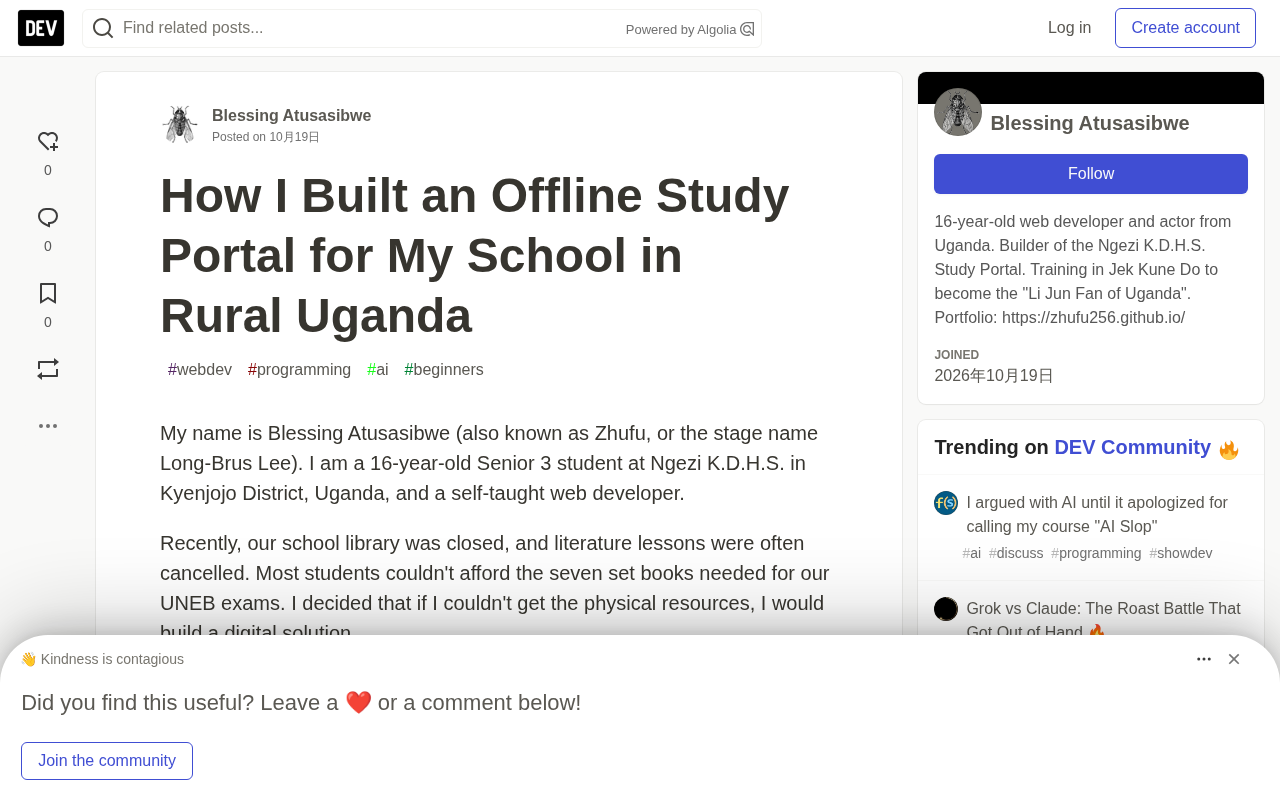
At Ngezi K.D.H.S. in the Kyenjojo district of Uganda, 16-year-old Blessing Atusasibwe faced a seemingly unsolvable dilemma: the school library was closed, literature classes were frequently canceled, and most students couldn't afford the seven prescribed textbooks required for the UNEB exams. Rather than waiting for resources to arrive, he built a single-file, offline-capable web app using HTML, CSS, and vanilla JavaScript—the Ngezi K.D.H.S. Study Portal.
Architecture Choices Driven by Hardware Realities
Nearly every technical decision in this project was reverse-defined by environmental constraints. The target devices are low-spec laptops, network connectivity is unreliable, and the development budget is zero. Instead of adopting a modern frontend framework or cloud deployment, Atusasibwe chose a single-file architecture so the entire app can load directly from local storage while offline.
One detail worth noting is how he handled hardware tiering: the app detects the laptop's hardware tier and dynamically adjusts animations to save memory. This strategy is common in resource-constrained scenarios, but the fact that a self-taught middle school student implemented it independently shows he has a clear, hands-on understanding of "performance budgets." Zero-cost development also means the entire toolchain and all API calls are built on free tiers—itself a form of design capability under engineering constraints.
Four Modules Form a Complete Learning Loop
The Study Portal's feature design revolves around the UNEB exam scenario, covering the full chain from comprehension to practice to assisted reading.
AI Study Companion calls the Groq and DeepSeekAd APIs to answer questions in the style of UNEB exams. This means students don't get generic explanations but responses aligned with exam scoring logic, reducing the conversion cost from "understanding" to "being able to pass the exam."
Self-Assessment Module scores students' answers on a 20-point scale, providing an immediate feedback loop. Without a teacher continuously present, this automatic scoring mechanism is key to sustaining practice motivation.
Zhu V2 Reader is a text-to-speech engine specifically serving students with reading difficulties. The existence of this feature shows that Atusasibwe considered learner diversity in his design, rather than only covering "standard users."
Searchable Library contains the seven prescribed texts, including Things Fall Apart and The Merchant of Venice. Converting scarce physical textbooks into searchable digital content directly removes the access barrier created by purchasing power.
The combination of these four modules is worth unpacking: AI Q&A solves "not understanding," self-assessment solves "not practicing," speech solves "can't read," and the library solves "no books." Each pathway corresponds to a specific risk point for dropping out of learning, rather than being a pile of features.
UNEB stands for the Uganda National Examinations Board, which organizes national standardized exams such as the Primary Leaving Examination (PLE), the Uganda Certificate of Education (UCE), and the Uganda Advanced Certificate of Education (UACE). The "UNEB exams" mentioned in the article specifically refer to the high school (A-Level) graduation exam, whose literature subjects typically prescribe required reading lists, and students must answer essay questions based on those texts. Exam scoring follows strict marking schemes that emphasize argument structure, textual citation, and depth of reasoning. This is precisely why the AI Study Companion answers in "UNEB exam style," and why the self-assessment module uses a 20-point simulated scoring system—directly aligned with real exam scoring logic, helping students adapt to scoring standards in advance rather than merely receiving general knowledge explanations.
Groq and DeepSeek are two platforms providing large language model inference services. Groq is known for its self-developed LPU (Language Processing Unit) hardware, focusing on extremely low-latency inference suitable for interactive applications requiring real-time responses; DeepSeek offers APIs for open-source models of various sizes at low cost and is developer-friendly. Both provide free tiers or low-cost calling options, enabling even a student developer with zero budget to integrate AI capabilities. Atusasibwe calling both APIs simultaneously may be intended to balance speed and cost, or to distribute load across different tasks. This "multi-vendor API combination" strategy is becoming common in resource-constrained personal projects; it bypasses the high computing power required to build models oneself and treats AI as public infrastructure available on demand.
The Identity Mosaic of a Rural Developer
In his project introduction, Atusasibwe spent considerable space talking about Bruce Lee. He practices Jeet Kune Do, is learning Mandarin, and aims to become "Uganda's Li Junfan," blending martial arts, acting, technology, and philosophy. His career plans are web designer, martial arts actor, and chatbot trainer.
These seemingly scattered interests are actually traceable in his project. Jeet Kune Do's "using no way as way" corresponds to the minimalist architecture of a single-file app; his identification with Bruce Lee's cross-disciplinary identity corresponds to his simultaneous work in development, training, and language learning; and his interest in chatbot training is directly reflected in the construction of the AI Study Companion. His personal signature is "Silence in the build. Noise in the result." This line itself reads like a translation of Jeet Kune Do philosophy into software engineering.
Jeet Kune Do is a martial arts philosophy and practice system founded by Bruce Lee, whose core tenet is "using no way as way, having no limitation as limitation"—abandoning fixed techniques and responding flexibly to actual situations. This idea is often extended as a critique of rigid forms and an embrace of pragmatism. Atusasibwe's interest in Jeet Kune Do is not simple idol worship but a methodology mapped onto software development: the single-file architecture rejects framework complexity, while hardware tiering reflects the pragmatism of "adapting to the enemy's changes." Additionally, his learning of Mandarin and ambition to become "Uganda's Li Junfan" (Li Junfan is a Jeet Kune Do successor and martial arts actor) reflect a cross-cultural identity construction—treating martial arts, acting, technology, and philosophy as an integrable whole rather than separate domains. This kind of cross-boundary identification is not rare in adolescent self-fashioning, but his explicit translation of it into project design language is particularly self-aware.
Big Problems in a Small Project
The easiest misreading of this project is as an inspirational story: a gifted teenager in a poor region uses AI to change his fate. But seeing only that layer misses the more important signal.
The fact that a 16-year-old student can build an offline learning tool covering exam needs using free APIs and a single-file architecture shows that the technical barrier to AI-assisted education has fallen low enough for an individual to cross independently. What is truly scarce is no longer technical capability but accurate understanding of local problems—which books can't be afforded, which classes have been canceled, which devices can't run modern web pages. Atusasibwe's advantage is not that he knows Groq or DeepSeek, but that he knows exactly where his classmates get stuck.
Another detail worth noting is hardware tiering. When mainstream AI applications assume users have stable broadband and relatively new devices, a large number of real users are excluded. This project's existence reminds developers: offline-first and low-spec adaptation should not be marginal features; they may be the only meaningful features in a certain market.
The project page is hosted on GitHub Pages, with his personal portfolio and actor profile also made public. A zero-cost single-file app solved the most specific resource gap in one school—this fact itself is more persuasive than any tech stack.
Offline-first is an application design strategy that treats offline availability as a core goal rather than an afterthought, typically implemented through single-file apps, local storage, Service Worker caching, or bundled resources. Its opposite is "online-first," which assumes users have stable networks. Offline-first is especially important in regions with weak infrastructure: network outages, expensive data, and old devices are the norm, not the exception. This project's single-file architecture is an extreme expression of offline-first—the entire app can be copied to a USB drive or local hard disk and run without a server. Hardware tiering further echoes the "low-spec adaptation" principle: dynamically reducing animation complexity by detecting device performance to avoid lag or crashes on low-memory devices. Together, these two strategies point to a market reality often overlooked by mainstream development: in some scenarios, offline capability and low barriers are the decisive factors determining whether a product can be used at all.
One-line Summary
A 16-year-old Ugandan student built a single-file offline web app at zero cost to address exam textbook shortages and complete the learning loop.
Paragraph Summary
Facing a closed school library, canceled literature classes, and most students unable to afford UNEB prescribed textbooks, 16-year-old Ugandan student Blessing Atusasibwe did not wait for resources. Instead, he built a single-file, offline-capable web app using HTML, CSS, and vanilla JavaScript—the Ngezi K.D.H.S. Study Portal. The app detects device hardware tier and dynamically adjusts animations to suit low-spec laptops, reflecting an offline-first design approach. Its four modules correspond to four types of learning barriers: an AI Study Companion calls Groq and DeepSeek APIs to answer questions in UNEB exam style, a self-assessment module provides automatic 20-point scoring, the Zhu V2 Reader offers text-to-speech for students with reading difficulties, and a searchable library contains the seven prescribed texts. The article notes that the technical barrier to AI-assisted education has fallen low enough for individuals to cross independently, and what is truly scarce is accurate understanding of local problems; offline-first and low-spec adaptation should not be marginal features.
Related articles

A Single Prompt Triggers a Global PHP Security Storm: Is AI a Savior or a Hidden Risk?
A single AI prompt triggered a global PHP security crisis affecting Wikipedia and the Internet Archive. This article reviews the incident, analyzes the OpenAI-Amazon controversy, and explores the security paradox of lowered vulnerability discovery barriers in the AI era and developer response strategies.

When AI Is Taken Away: How Reliance on Shortcuts Undermines Your Problem-Solving Resilience
A study of 1,222 people found that after using AI to answer questions, once AI was removed, people gave up on more problems than a control group that never used AI. The article analyzes the impact of AI reliance on learning resilience and metacognition, and explores design implications for AI learning tools.

Carta and NewView Partner to Let Startup Employees Cash Out Equity Early
Carta and NewView Capital partner to simplify startup tender offers, helping employees sell equity early. Analysis of the mechanism, liquidity pain points, and impact.