$20/Month vs. $1M/Year: Two Paradigms of AI Coding Agents

Same bug, two paradigms: Cursor delivers a working demo, Blitzy delivers a mergeable enterprise PR.
Tested on Grafana's ~3-million-line codebase, Cursor ($20/month) and Blitzy (enterprise, up to $1M+/year) fixed the same long-standing playlist bug — but with starkly different results. Cursor works file-by-file with a human in the loop, producing clean code that runs locally but lacks validation and integration tests. Blitzy spends days ingesting the entire codebase into a knowledge graph, then dispatches thousands of agents to produce an 83-file PR with integration tests, OpenAPI spec updates, translation strings, and user docs. They're not competitors — they serve fundamentally different stages of the development workflow.
Cursor costs just $20 a month, while some enterprise-grade AI coding tools charge companies up to $5 million a year. They sound like competitors in the same race — but they're not playing the same game at all. This article is based on a hands-on video test where both tools were put to work on Grafana, an open-source project with roughly 3 million lines of code, tasked with fixing a long-standing community feature request that had never been resolved. The experiment reveals the fundamental difference between two AI coding paradigms.
Two Fundamentally Different Units of Work
To understand this comparison, you first need a mental model. Tools like Cursor, Claude Code, and Copilot operate at the granularity of functions, files, or small features. The typical workflow is: open a session, watch it work, guide it with instructions, and iterate in real time — a highly interactive, human-in-the-loop mode.
Blitzy, demonstrated in the video, is the polar opposite. Its unit of work is the entire project. It can run continuously for days. Instead of reviewing edits line by line, you invest heavily upfront in refining your plan and prompts, clearly defining the goal, approving a course of action, and then letting it run. Days later, it hands back a nearly complete deliverable.
These two tools represent two entirely different "units of work" — one is a collaborative assistant that moves in small, fast steps; the other is an automated engineering system that front-loads planning. This also explains why the latter is primarily purchased by enterprises rather than individual developers.
Context Windows: The Root of the Divide
Why does this divide exist? The answer comes down to context. When an agent is processing your code, everything competes for the same context window: system prompts, tool definitions, skills, conversation history… By the time it actually starts editing files, it may only have room for 5,000 to 10,000 lines of code at once.
This isn't a product flaw — it's a mathematical constraint of how agents work. The largest context windows today sit at around 1 million tokens, which simply can't hold 3 million lines of code. So how do smaller agents like Cursor function on massive codebases? The answer is simple: you are the missing context. You understand the architecture, you know which three or four files matter, and you point the agent at them — then it performs well.
But that only works when it's your codebase, one you already understand. The moment you switch to a 3-million-line codebase you've never seen before, you don't know which files are important or what conventions to follow. The agent is just as blind as you are. It can't ingest the entire codebase at once, and if you don't know what to look for, it can't deliver what you need.
Context Window refers to the maximum amount of text a large language model can "see" in a single inference pass, typically measured in tokens (roughly 1–2 tokens per Chinese character, 5–15 tokens per line of code). This window must accommodate not just user input, but also system prompts, tool call records, conversation history, and model output — leaving far less room for actual code than the stated limit suggests. When an agent searches for relevant files or invokes external tools, those operations themselves consume context space, creating a "the more it works, the more crowded it gets" compression effect. This is why even models like GPT-4 with 128K token windows still struggle with large codebases — production-grade repositories routinely run into the millions of lines, far exceeding what any current model can process in a single pass.
Blitzy's Brute-Force Solution: Reverse-Engineer the Entire Codebase First
Blitzy is designed specifically to address this problem. Before writing a single line of code, it spends days ingesting the entire codebase, reverse-engineering it into a knowledge graph — understanding every service, every quirky convention, and even legacy code someone added years ago. It then runs tens of thousands of agents against this understanding, rather than working from a narrow slice of the codebase.
It begins by generating a massive technical specification document and knowledge graph. In the video, this spec runs 300 to 400 pages, covering system architecture, data flows, dependency relationships, technology stack, and a wealth of Mermaid diagrams, flowcharts, and sequence diagrams. Producing this manually would take an enormous amount of time.
Interestingly, Blitzy's own engineers use Cursor and Claude Code every day. The real difference isn't which model is more powerful — they blend multiple models, including older ones that are no longer at the frontier. The intelligence lives in the system's orchestration, not in raw "brainpower." Swapping in a different LLM won't dramatically change the outcome, because the system design itself is what matters.
Knowledge Graph, in this context, refers to a structured database representing the dependencies and call relationships between modules, functions, and services in a codebase — like drawing a "neural network map" of the entire project. Blitzy uses static code analysis, AST (Abstract Syntax Tree) parsing, and semantic understanding to explicitly encode implicit knowledge scattered across thousands of files — such as how an interface has evolved over time, or the side effects of a piece of legacy code — into this graph. Subsequent sub-agents can query the graph without re-reading the raw source each time, bypassing the capacity bottleneck of individual context windows. This "index first, then execute" architecture mirrors the logic of a search engine: crawl the web, build an inverted index, then respond to queries.
Testing on Grafana: Fixing a Long-Stalled Feature Request
The test subject was the highest-upvoted open issue in the Grafana community. Grafana is a widely used data visualization platform for viewing logs, metrics, and alerts. A contributor had responded to this request years ago: "Sounds useful, but exposing variables is quite complex and time-consuming." And so it sat, unimplemented.
The problem lies in the Playlist feature. Users want playlists to cycle through different servers (server A, B, C) and dashboards in a set order while in kiosk mode. In practice, the playlist always gets stuck on server A, fails to correctly iterate through multiple hosts in the host variable, and the switching order is inconsistent.
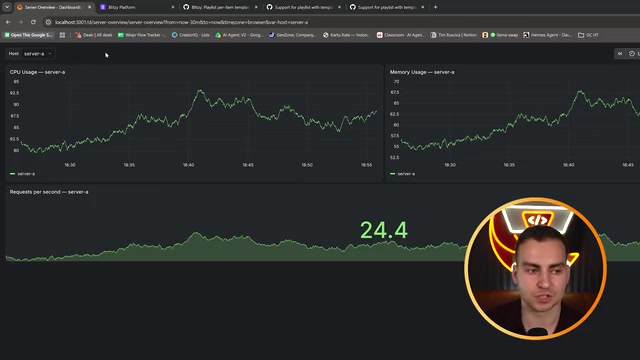
The tester acknowledged this wasn't a fair comparison — and that was precisely the point. He gave Cursor the best available model at the time with maximum thinking mode enabled, pasted in a detailed prompt and the original issue link. Cursor worked in its characteristic way: one file at a time, methodically moving forward.
Working Demo vs. Mergeable PR: The Gap Is in the Details
The result was surprising — the Cursor version actually worked. It modified roughly 26 files and around 300 lines of code, touching the schema, storage bridge, editor, playlist logic, and even wrote a few tests. It looked clean. The playlist successfully cycled from server A to B to C in kiosk mode.
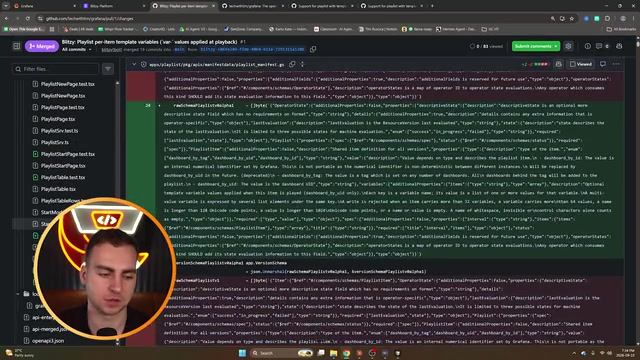
Blitzy also solved the problem, but at a completely different scale: 83 files changed, 19,000 lines added and 460 deleted (a significant portion being markdown documentation). The real gap lies in details you'd never think to include:
- Integration tests, including assertions that "old playlists can be serialized byte-for-byte identically to before," ensuring existing users aren't affected
- Updates to two versions of the OpenAPI specification
- Added translation strings, user-facing documentation, and a warning noting that variable values will appear in dashboard URLs
- Explicit limits defined: a maximum of 32 variables and 64 values per variable, with rejections that clearly identify the offending field, validated by an 11-case test suite
By contrast, the tester found that Cursor's version accepted empty variable names, allowed 500 values in a single variable, and had no field validation whatsoever. Fine locally — but push it to production, and those are the kinds of issues that cause incidents.
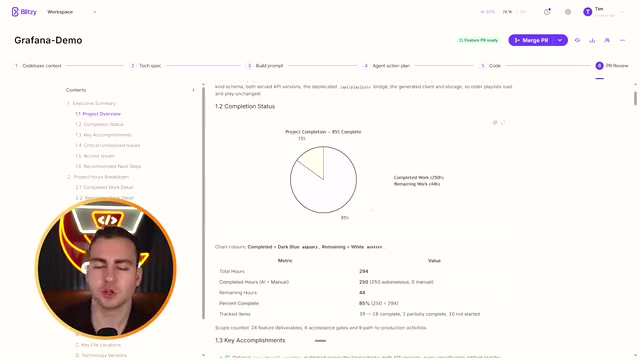
It's worth emphasizing that Blitzy doesn't replace developers. It tells you "approximately 250 hours of work completed, 44 hours remaining" — the remaining work being mostly optional validation and testing that you still need to review yourself. Once you merge the PR, the changes sync back to the git branch, and the technical specification is automatically updated, keeping the knowledge graph current.
OpenAPI Specification (formerly Swagger) is a standard format for describing RESTful API interfaces, typically in JSON or YAML, defining request parameters, response structures, and data types for each endpoint. In large team environments, the OpenAPI file is the foundational contract for frontend-backend integration, automatic SDK generation, and API testing. If code logic changes but the OpenAPI file isn't updated accordingly, downstream integration tests will fail — or worse, trigger production incidents. Blitzy's inclusion of updates to two versions of the OpenAPI spec in the PR illustrates the essential difference between "mergeable" and "working": the former considers the consistency of the entire system, not just the functional correctness of the change at hand.
Conclusion: Different Goals, Different Value
These two products have entirely different objectives — and both achieve theirs. Cursor gives you a working demo: low cost, flexible, interactive. Blitzy gives you a PR that can be merged directly into an enterprise codebase: heavy upfront investment, longer timelines, but a fundamentally different kind of value for enterprises.
A runnable demo is great. But for a 3-million-line enterprise codebase, a truly mergeable, production-ready pull request is what that million-dollar budget is actually buying. Understanding this also clarifies why these two categories of tools aren't really in direct competition — they serve different stages of the development workflow.
Related articles

The Siberian Ice Maiden and the Archaeological Mysteries of the Scythian World
The Siberian Ice Maiden is a Scythian female mummy from the Ukok Plateau. Her tattoos, silk garments, and grave goods reveal ancient nomadic art, social hierarchy, and cross-regional trade — alongside ongoing repatriation controversies.
SQL Row Pattern Matching: Implementing "Row-Level Regex" with MATCH_RECOGNIZE
MATCH_RECOGNIZE gives SQL regex-like power over row sequences. Detect brute-force attacks, fraud patterns, and user behavior flows with clean, declarative syntax — no more messy self-joins.
Hackers Break Into Flock Surveillance Cameras, Exposing the Inner Workings of License Plate Recognition Systems
Hackers breached Flock Safety's ALPR cameras, exposing how license plate recognition systems collect data and the privacy and security risks they pose.