$20/Month vs. $5M/Year: The Fundamental Difference Between Cursor and Blitzy
Cursor and Blitzy aren't rivals — one assists developers file by file, the other autonomously ships production-ready PRs.
Cursor ($20/month) and Blitzy (up to $5M/year) aren't competitors — they operate on fundamentally different units of work. Cursor works at the file or function level with the developer as the missing context; Blitzy reverse-engineers entire codebases into a knowledge graph, then orchestrates thousands of agents to deliver near-complete projects. A Grafana test (3M lines) showed both fixed the same bug, but Cursor produced a working demo (~300 lines, no input validation), while Blitzy delivered a mergeable 83-file PR with integration tests, translated strings, API spec updates, and production-ready input limits.
Two Fundamentally Different Units of Work
Cursor costs $20 per month. Blitzy, an enterprise-grade AI coding tool, can run up to $5 million per year. At first glance, the gap seems astronomical — but the author of the video makes a critical point: they're not competitors. They don't even operate in the same category.
The key to understanding the difference lies in the concept of the "unit of work." Tools like Cursor, Claude Code, and Copilot operate at the granularity of a function, a file, or a small feature. You stay in the loop throughout — iterating, editing, and interacting within a single session. Blitzy, on the other hand, works at the granularity of an entire project. It can run continuously for days. You don't need to supervise every edit — you just approve a plan.
In other words, Blitzy invests heavily in upfront planning and prompting. You tell it what you want to build, and it spends days bringing the project to a near-complete state before handing it back to you. These are two entirely different collaboration models.
The Root of the Divide: Context
This split ultimately comes down to the context window. When an agent is working on your code, system prompts, tools, skills, conversation history, and project code are all competing for space in the same context window. By the time it actually starts editing files, it can realistically only hold about 5,000 to 10,000 lines of code at once.
The author emphasizes that this isn't a product flaw — it's a mathematical reality baked into how agents work. Even the largest context windows today top out at one million tokens, which is nowhere near enough for three million lines of code.
So how do smaller agents like Cursor and Copilot work on massive codebases? The answer is simple: you are the missing context. You understand the architecture, you know which four files matter, and you point the agent at them. It performs well precisely because the code is yours — you know what's happening inside it.
Remove that prerequisite, and the picture changes entirely. Faced with three million lines of code you've never seen before, you don't know which files matter or what conventions to follow. The agent is just as lost as you are. It can't ingest the entire codebase at once, and if you don't understand it yourself, it can't deliver what you need.
Context Window is the maximum amount of text a large language model can "see" at one time, measured in tokens (roughly, 1,000 tokens ≈ 750 English words). When generating each response, the model can only reference information within the window — anything outside it simply doesn't exist. This isn't an engineering shortcut; it's a fundamental constraint of the Transformer architecture's self-attention mechanism, where computational complexity scales quadratically with sequence length, making very large contexts prohibitively expensive. Even the largest one-million-token windows (~750,000 English words) fall far short of enterprise codebases with millions of lines. What's more, the context window is shared space — system prompts, tool descriptions, conversation history, and actual code all compete for the same budget. The slice left for code itself is often a small fraction of the total, which explains the "5,000 to 10,000 lines" figure mentioned in the article.
Blitzy's Brute-Force Approach: Reverse-Engineer First, Then Build
Blitzy is purpose-built for exactly this problem. Its strategy is essentially brute force: before writing a single line of code, it spends days ingesting your entire codebase, reverse-engineering it into a knowledge graph that maps every component — every service, every contract, every quirky convention, even the random thing someone added years ago and forgot about.
It then runs thousands of agents against that understanding, rather than working from a narrow slice of the codebase. The ingestion process alone can take two to four days depending on codebase size, producing a massive specification document. When you issue a task, Blitzy again runs for days, allocates substantial compute, orchestrates thousands of agents, and hands you back something that's nearly finished.
One telling detail: Blitzy's own engineers use Claude Code and Cursor every day. Their edge lies in orchestration — weaving multiple models together, including older models that aren't state-of-the-art. The real intelligence is in the system they've designed, not the raw "brain" powering it. Swap in a different LLM and it barely matters, because what determines success is the system architecture.
Orchestration in the AI agent world refers to a system architecture that coordinates multiple AI models or agents to work together. Rather than relying on a single large model, an orchestration system breaks complex tasks into subtasks, assigns them to the most appropriate model or tool in parallel, and then aggregates the results. A Knowledge Graph is a structured data representation that stores entities (such as functions, services, and classes in a codebase) and their relationships, allowing agents to query architectural information like a database rather than re-reading raw source files from scratch. This is Blitzy's core moat: by solidifying reverse-engineering results into a queryable knowledge graph, it enables thousands of downstream agents to execute tasks without re-understanding the codebase each time — effectively breaking through the hard limits of the context window.
Head-to-Head: Grafana's Three Million Lines of Code
To illustrate the difference concretely, the author chose one of the largest open-source codebases on the planet — Grafana, at roughly three million lines of code — and picked a feature users had been requesting for years that had never been implemented.
The feature involved Grafana's Playlist functionality. Playlists cycle through different dashboards on screens like TVs. But there was a bug: when users wanted to loop through different views of multiple servers (server A, B, C), the playlist would always stay on server A, failing to rotate through the different host variable values as expected. A Grafana contributor had once noted in comments that the feature was "useful but quite complex and time-consuming" — so it had simply never been built.
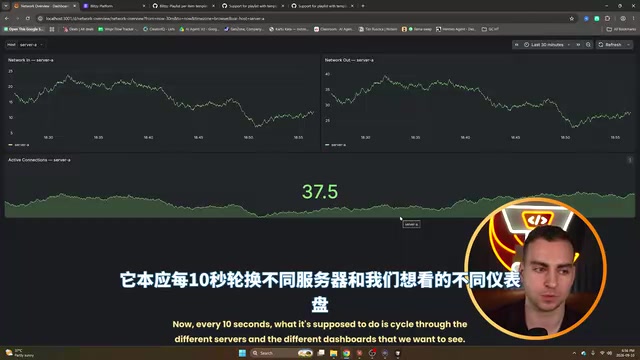
The author freely admits this wasn't a fair comparison — he deliberately gave Cursor a task it was never designed to handle. He pasted a detailed prompt into Cursor along with the original issue link, selected the strongest available model at maximum thinking level, and watched it work through the codebase file by file.
Blitzy's workflow looked different: first generate a codebase context document, then produce a deep technical specification (roughly 300–400 pages, including system architecture, dependencies, Mermaid diagrams, and sequence diagrams). You then provide a detailed build prompt, Blitzy generates an agent action plan, you approve it, and only then does it begin writing code. For this project, Blitzy took two to three days to complete.
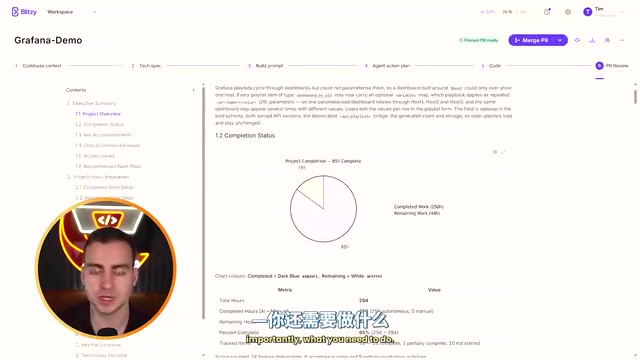
The Critical Difference: A Working Demo vs. a Mergeable PR
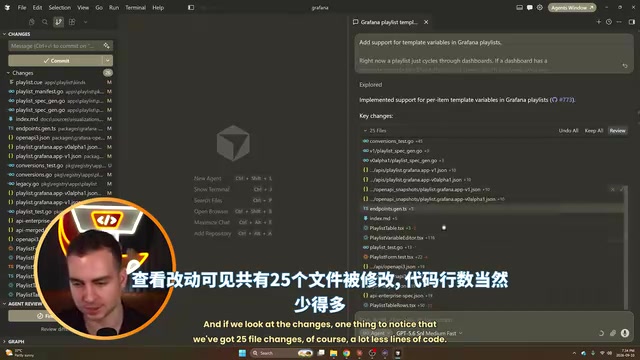
The results were surprising: Cursor actually fixed the bug. It modified around 25–26 files and roughly 300 lines of code, touching the schema, storage bridge, editor, playback logic, and a handful of tests. After validation, the playlist correctly cycled through servers A, B, and C.
Blitzy's PR touched 83 files and added 19,000 lines (many of them Markdown documentation). Both solved the problem — but the gap showed up in completeness.
Blitzy's PR included everything you'd actually need to ship this to production: integration tests, assertions that old playlist byte-for-byte serialization remained unchanged (protecting existing users), updated OpenAPI specs, translated strings, user-facing documentation with caveats, and numerous details the author hadn't even thought of. It also published explicit limits — 32 variables, 64 values per variable — with errors that report the offending field name when exceeded, validated by 11 test cases.
By contrast, when the author tested Cursor's version, he found it accepted blank variable names, allowed a single variable to have up to 500 different values, and had no field validation at all. Fine on a personal laptop — potentially catastrophic in production.
The author's conclusion: Cursor's version isn't wrong. It solved exactly what it was asked to solve. But it produced a "working demo." Blitzy produced a "PR an enterprise can merge directly." In an enterprise codebase like Grafana's, a mergeable pull request is worth substantially more.
This is precisely why Blitzy is used primarily by enterprises rather than individual developers. After merging, it also automatically syncs changes back into the technical specification, keeping the knowledge graph current. Both products achieved their respective goals — they simply shouldn't be measured against each other.
Pull Request (PR) is the standard process for submitting code changes on modern software platforms like GitHub and GitLab. A developer completes changes on a separate branch and opens a PR requesting a merge into the main branch, triggering automated tests (CI/CD), code review, and security scans before the changes go live. A "mergeable PR" in enterprise terms means a code change has satisfied all pre-production requirements: adequate test coverage, handled edge cases, updated documentation, translated internationalization strings, updated API specs — things often skipped in personal projects but non-negotiable in multi-team production environments. The reason Blitzy's 83-file, 19,000-line PR is considered higher value is precisely because it covers the "last mile" between working feature and production-ready — the gap that otherwise requires significant human effort to close.
Related articles
The Siberian Ice Maiden and the Archaeological Mysteries of the Scythian World
The Siberian Ice Maiden is a Scythian female mummy from the Ukok Plateau. Her tattoos, silk garments, and grave goods reveal ancient nomadic art, social hierarchy, and cross-regional trade — alongside ongoing repatriation controversies.
SQL Row Pattern Matching: Implementing "Row-Level Regex" with MATCH_RECOGNIZE
MATCH_RECOGNIZE gives SQL regex-like power over row sequences. Detect brute-force attacks, fraud patterns, and user behavior flows with clean, declarative syntax — no more messy self-joins.
Hackers Break Into Flock Surveillance Cameras, Exposing the Inner Workings of License Plate Recognition Systems
Hackers breached Flock Safety's ALPR cameras, exposing how license plate recognition systems collect data and the privacy and security risks they pose.