2026 AI Learning Roadmap: 3 Proven Paths + A 4-Step Action Checklist (With Complete Technical Framework)

AI learning should be problem-driven: get it running first, then iterate to perfection.
This article identifies three common traps AI learners fall into in 2026 — information hoarding, perfectionist procrastination, and fragmented learning — with the core issue being lots of studying but no real problems solved. The author proposes shifting from technology-driven to problem-driven learning, offering three implementation paths: low-barrier AI Agent customization, deep vertical domain specialization, and a systematic full-stack LLM technical framework, emphasizing "get it running first, then make it run well."
The AI Learning Anxiety Trap: Busy but Going Nowhere
2025 was called the breakout year for AI Agents, and heading into 2026, large language model technology has permeated real-world applications across every industry. Yet faced with an overwhelming flood of AI tools, tutorials, and news, the vast majority of learners find themselves stuck in a peculiar trap — seemingly learning a lot, but actually producing nothing.
You've installed 50 AI apps on your phone, bookmarked hundreds of "must-read" articles, spend an hour or two each day watching tutorials, studied prompt engineering, looked into RAG, even dabbled in fine-tuning... But ask yourself honestly: What real problem have you actually solved with AI? The answer is usually silence.
This article starts from the three major dilemmas facing today's AI learners, combined with a systematic full-stack LLM learning framework, to help you understand the right way to approach your 2026 AI learning roadmap. Whether you're a complete beginner or a developer with some foundation who can't find direction, you'll find an AI learning path that fits.
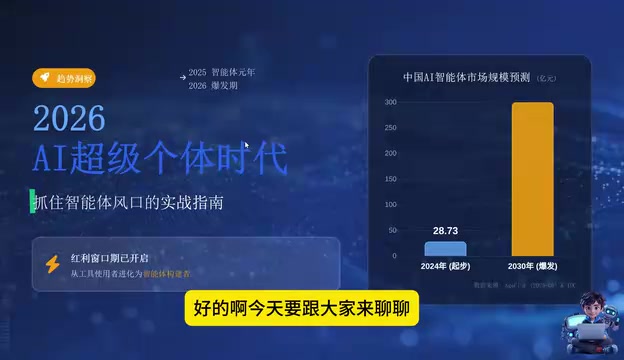
Three Types of AI Learners and Their Typical Struggles
Before creating your AI learning plan, check whether you've fallen into any of these three traps.
The Information Hoarder: The Illusion That Bookmarking Equals Learning
The first type is the "information hoarder." The symptoms are obvious: obsessively following influencers, bookmarking articles, downloading resource packs, constantly "consuming" but never "producing." On the surface, their knowledge reserves seem rich, but they've never converted a single concept into working code or a viable solution.
The root problem isn't learning too little — it's failing to close the loop from knowledge to application. You understand the Transformer architecture, but you've never run inference yourself. You know the concept of RAG (Retrieval-Augmented Generation), but you've never built a functioning RAG-based Q&A system.
The Perfectionist: Eternally Preparing, Never Starting
The second type is the "perfectionist." They always feel they're not ready — not enough fundamentals, not enough resources, not enough technical depth. They spend enormous time researching which model performs better, which framework has more potential, which moment is optimal to jump in.
The result? Others have already launched AI applications and started iterating, while they're still comparing whether GPT-4o or Claude is better for development. This kind of "preparation" is essentially avoidance behavior — using the busyness of planning to mask the absence of action.

The Lone Explorer: Collecting Parts That Never Become a Car
The third type is the "lone explorer." They are actually hands-on, but in a scattered way — a bit of prompt engineering here, some RAG there, a dabble in Agent development elsewhere, yet they can never string it all together into a complete AI solution.
It's like wanting to build a car: you've bought the wheels, the steering wheel, and the engine, but you can never assemble them. Fragmented AI learning creates knowledge without connections, making it impossible to develop systematic technical capability. This is the fundamental reason many people keep going in circles on their AI learning path.
The Real Opportunity in 2026: Solving Problems, Not Stacking Technologies
After understanding the dilemmas, we need to answer one core question: Where does the real opportunity lie in the 2026 AI era?
The answer can be summed up in one sentence: It's not about how much technology you know, but your ability to solve real problems using AI. AI is ultimately just a tool, and a tool's value depends on whether the person using it can produce results.
This means your AI learning path needs to shift from "technology-driven" to "problem-driven" — instead of learning all the technology first and then looking for applications, find a real business pain point first, then work backward to determine what technology you need. This is also the most overlooked key principle when creating a 2026 AI learning plan.
Put simply, your AI learning roadmap should revolve around "what problem to solve," not "what technology to master."
Three Proven AI Implementation Paths
Based on the above principle, the following three AI implementation paths have been validated by numerous practitioners. Choose the one that best fits your background.
Path One: AI Agent Customization — The Technical Bar Is Lower Than You Think
Many people assume that working with AI or building an AI side project requires high technical expertise. But the reality is quite the opposite — real business needs often don't require complex technology.

Here's a concrete example: A short-video e-commerce team needs to write large volumes of copy daily, perhaps drafting 20 versions just to find one they're happy with, often working until 2 AM. What's the solution? It's essentially a copywriting Agent built with solid prompt engineering.
The key is whether you can understand the client's product characteristics and business needs, then use AI tools to precisely solve that problem. The value of Agent development isn't in how deep or broad your learning goes, but in whether you can deliver results. For those looking to quickly enter the AI space, this path offers the highest ROI.
Path Two: Deep Vertical AI Specialization — Extreme Niching Is Your Moat
The second AI implementation path is becoming an AI expert in a vertical domain. The core strategy is niche down, niche down, and niche down again.
For example, in beauty and skincare, you need to understand industry characteristics, audience personas, and product differentiation; in health and wellness, you need to know target users' health concerns and product features; even in the pet niche, you need to go as granular as "what are common cat illness symptoms" or "what types of toys do cats prefer."
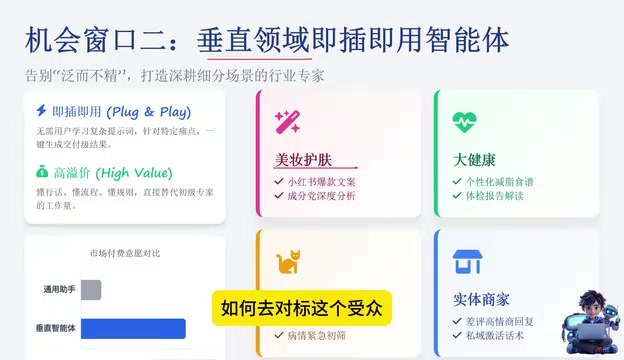
You need to become an industry expert in your niche, understanding the business down to the finest detail, then combining AI technology at that deepest, most specific entry point. The success rate of this vertical AI approach far exceeds broadly learning various technologies. The combination of domain knowledge + AI capability is the scarcest compound talent profile in 2026.
Path Three: Full-Stack LLM Technical System — From Fragments to Framework
For those who genuinely want to take the technical route, what you need is a complete full-stack LLM development knowledge system, not a fragmented puzzle of knowledge. A sound AI learning path should include these three stages:
Foundations: Building the Cognitive Framework
Python quick start, AI development environment setup, prompt engineering, core LLM principles (Transformer architecture, pre-training, SFT — Supervised Fine-Tuning, RLHF — Reinforcement Learning from Human Feedback, and other key concepts). The goal of this stage is to establish correct technical understanding, laying the groundwork for hands-on AI projects.
Intermediate: Mastering Core Practical Skills
Dive deep into RAG (Retrieval-Augmented Generation), Agent development, the LangChain framework, and other practical technologies. Master LLM fine-tuning and private deployment, build enterprise-grade RAG knowledge bases. Combined with real business scenarios, learn to select base models, process datasets, and execute the full fine-tuning pipeline. This stage is the critical dividing line in full-stack LLM development capability.
Advanced: Project-Driven Skill Internalization
Build enterprise-level AI projects hands-on — RAG medical Q&A systems, intelligent e-commerce customer service, digital human applications, AI teaching assistants for education, and more. Only by actually completing projects can knowledge internalize into capability — this is the core gap between full-stack LLM developers and ordinary learners.
A 4-Step Action Checklist Starting Today
Based on the analysis above, here's an immediately actionable AI implementation plan to turn your AI learning roadmap into concrete steps:
- Pick one specific vertical domain and business pain point. Don't be greedy — one is enough. The more specific, the better. For example, "help local restaurants generate Xiaohongshu (Little Red Book) food review copy using AI" is ten times better than "learn AI for content creation."
- Build your first AI Agent. It doesn't need to be perfect or feature-rich, but it needs to run through a complete business workflow. One working Agent is worth more than a hundred bookmarked tutorials.
- Find your first few real users. Let your AI solution run in a real business scenario and collect firsthand user feedback. This step is the litmus test of your AI learning outcomes.
- Collect feedback during operation and iterate continuously. Go from imperfect to perfect, using real data to guide optimization.
The progress these four steps bring will far exceed continuing to plan on paper or hoard in your bookmarks.
Conclusion: From Imperfect to Perfect Is the Right Approach
In 2026, AI technology is no longer some unreachable frontier concept — it's a productivity tool within arm's reach. The real gap isn't about who took more courses or who follows more influencers, but about who got their first AI application running first, who got real-world feedback first.
Stop watching from the sidelines. Stop hoarding. Stop waiting for the perfect moment. Identify the domain you're good at, choose one AI learning path, and start building today. Going from imperfect to perfect — that's the right way to embrace the AI era in 2026.
Whether you choose AI Agent customization, vertical domain AI implementation, or full-stack LLM development, the core logic is the same: Get it running first, then make it run well. Your 2026 AI learning roadmap starts executing right now.
Related articles
 Tutorials
ChatGPT Plus Subscription Guide: Are GPT-5.5, image-2, and Codex Worth the Upgrade?
A detailed look at ChatGPT Plus features — GPT-5.5, image-2, and Codex — with a Plus vs Pro comparison and a complete step-by-step subscription guide for users outside the US.
 Tutorials
Harness AI Engineering in Practice: Using Claude Code to Master Enterprise-Level E-Commerce Development
Deep dive into Harness AI Engineering: master enterprise e-commerce development with Claude Code using the Rules, Skills, Wiki, and Changes framework.
 Tutorials
Cursor + Codex Dual-IDE Collaboration: A Practical Methodology for Open-Source Project Customization
A complete methodology for open-source project customization based on real-world experience, detailing the Cursor+Codex dual-IDE workflow, seven-stage process, MVP validation, and AI source code reading techniques.