2026 Nobel Prize in Chemistry Explained: The Chemical Revolution Behind Chiral Amplification

2026 Nobel Chemistry Prize awarded for nonlinear effects and autocatalytic chiral amplification in asymmetric synthesis.
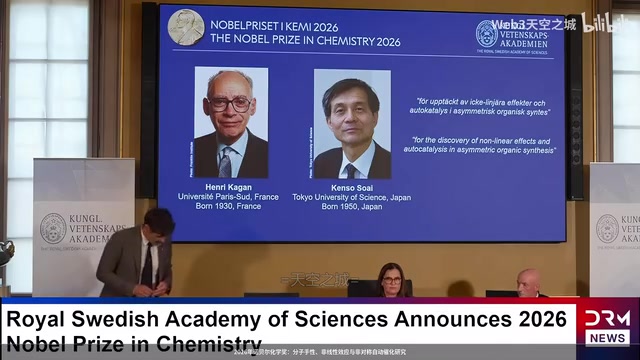
The 2026 Nobel Prize in Chemistry was awarded to French chemist Henri Kagan and Japanese chemist Kenso Soai for two landmark discoveries in asymmetric organic synthesis. Chiral molecules are mirror images that cannot be superimposed, and their two enantiomers can produce dramatically different — even opposite — effects in drug applications, making precise single-enantiomer synthesis critically important. Kagan overturned the traditional assumption that catalyst and product chiral purity must be linearly correlated, proposing and experimentally verifying the "positive nonlinear effect" — lower-purity chiral catalysts can yield higher-purity products. Soai discovered asymmetric autocatalysis: starting from achiral materials, the reaction product acts as its own catalyst and amplifies a tiny random chiral imbalance up to 630,000-fold, ultimately producing a near-perfect single enantiomer. Together, these discoveries address the fundamental question of life's chiral origins while providing powerful tools for the pharmaceutical industry.
The Royal Swedish Academy of Sciences has announced that the 2026 Nobel Prize in Chemistry has been awarded to French chemist Henri Kagan and Japanese chemist Kenso Soai, in recognition of their pioneering contributions to the discovery of nonlinear effects and autocatalysis in asymmetric organic synthesis. Their work has fundamentally reshaped our understanding of how molecular chirality originates and operates.
What Is Chirality: From Hands to Mint and Caraway
The Nobel Committee opened with a vivid analogy — many molecules are like human hands, mirror images of each other that look similar yet cannot be perfectly superimposed. These are called chiral molecules (from the Greek word for "hand").
A classic example is carvone: the right-handed form smells like spearmint, while the left-handed form smells like caraway. The reason the same molecule in two different versions registers as distinct scents is that the receptors in our nasal passages — which are responsible for recognizing molecules — are themselves built from chiral structures (chiral amino acids).
In fact, all proteins in the human body are composed exclusively of left-handed amino acids; right-handed ones are virtually absent. In other words, life as we know it is homochiral. This fundamental fact leads directly to the world of pharmaceuticals.
Why Chirality Matters in Medicine
Many pharmacologically active molecules are also chiral, and the two mirror-image versions can have dramatically different physiological effects — one "hand" may deliver the intended therapeutic benefit, while the other may be inert or, in the worst case, harmful.
The lecture offered a darkly humorous example: one pair of enantiomers has a left-handed cough suppressant and a right-handed painkiller, with the two drug names even being mirror-image spellings of each other. Organic chemists used this to gently poke fun at their field's sense of humor, while highlighting the very real need to precisely prepare a single enantiomer.
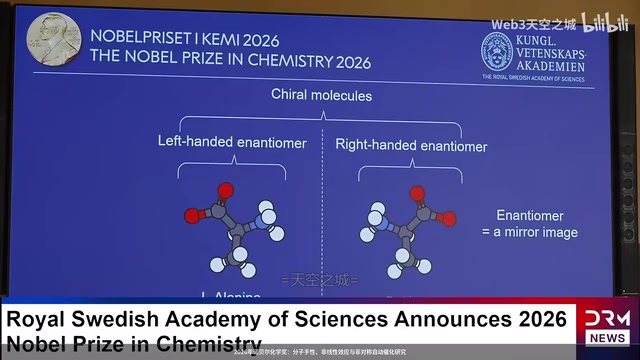
When two enantiomers produce different effects, chemists must have efficient methods for preparing single chiral molecules. Asymmetric catalysis is one such method: a molecule known as a chiral ligand binds to a metal to form a chiral catalyst, which then reacts with substrates and reagents to produce — and is subsequently released from — a product, causing one handedness to predominate.
The most devastating lesson in chiral drug history came from the thalidomide tragedy of the 1950s and 60s: the drug was sold as a racemate (an equal mixture of both enantiomers). One enantiomer had genuine sedative and anti-nausea properties and was widely prescribed to relieve morning sickness in pregnant women, but the other was severely teratogenic, causing thousands of babies to be born with serious limb deformities. This tragedy directly prompted regulatory agencies worldwide to require that new drug applications explicitly characterize the biological activity and toxicity of each enantiomer. The modern pharmaceutical industry thus developed an urgent demand for enantiopure active pharmaceutical ingredients, making asymmetric synthesis one of the central research directions in organic chemistry.
Kagan's Breakthrough: Shattering the Dogma of Linearity
For a long time, the field of chemistry held a deeply ingrained belief: if you mix left- and right-handed catalysts, the ratio of enantiomers in the product should have a linear relationship with the ratio in the catalyst.
Kagan challenged this dogma. He hypothesized that two or more chiral ligands could simultaneously bind to the metal center of a catalyst. To illustrate: suppose you have 75% right-handed ligand and 25% left-handed ligand. Following statistical rules for binding to the metal, you would expect roughly 56% "right-right" catalyst, 6% "left-left," and 38% "left-right" combinations.
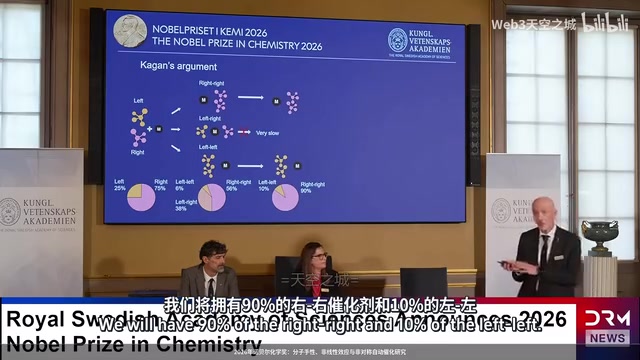
The key insight is that the "right-right" and "left-left" species are mirror images with identical behavior, while the "left-right" combination behaves differently. If the "left-right" catalyst has far lower reactivity than the other two, the entire reaction no longer follows a linear relationship — the enantiomeric purity of the product actually exceeds that of the ligands themselves. This is known as the positive nonlinear effect.
Kagan confirmed this model through experiments (such as the Sharpless epoxidation): the experimentally measured curve deviated significantly from the expected straight line, displaying a positive nonlinear effect. This demonstrated not only that lower-purity catalysts could yield higher-purity products, but also provided a powerful analytical tool for studying asymmetric catalysis.
Understanding the positive nonlinear effect requires two key metrics. Enantiomeric excess (ee) is the standard measure of chiral purity: if a product contains 90% right-handed and 10% left-handed molecules, then ee = (90−10)% = 80%. Turnover frequency (TOF) describes the activity level of a catalyst. Kagan's model predicts that when the "left-right" heterochiral catalyst has a far lower TOF than the homochiral "right-right" and "left-left" catalysts, the heterochiral species is effectively "frozen out" of the reaction. The catalysis is dominated by the two homochiral forms, whose net effect more closely resembles that of a high-purity catalyst — pushing the product ee above the linear prediction on a graph, i.e., asymmetric amplification (positive nonlinear effect). Conversely, if the heterochiral catalyst is more active, the product ee falls below the ligand ee, which is called a negative nonlinear effect.
Creating Chirality from Nothing: The Marvel of Autocatalysis
Kagan then pushed further: if chirality can be amplified, can it be created from scratch? The answer came from a class of asymmetric autocatalytic reactions — where the reaction product itself serves as its own catalyst.
Starting from a symmetric (achiral) starting material and without using any chiral catalyst, the catalyst formed initially is a mixture. But within any mixture, there will always be a tiny, random imbalance between the two enantiomers — and this autocatalytic reaction is remarkably "forceful," selectively amplifying and biasing toward either the right- or left-handed product.
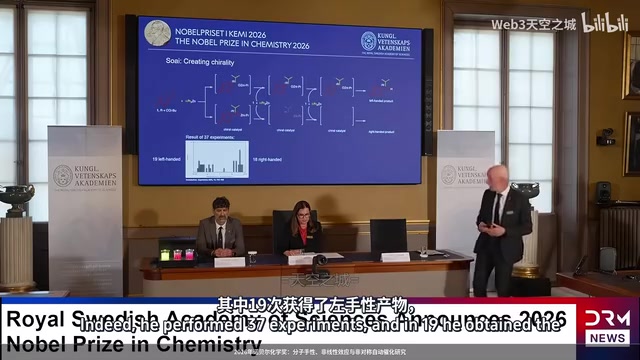
The lecture noted that researchers conducted 37 experiments, sometimes obtaining the left-handed product and sometimes the right-handed product, but never a perfectly equal mixture. This proved that chiral imbalance can be generated by autocatalysis alone.
Even more astonishing was the amplification experiment: starting with a catalyst of very low enantiomeric purity, the reaction produced a product of noticeably higher purity; using that product as the catalyst for a second round, then a third, ultimately yielded a nearly perfect single enantiomer. The Nobel Committee described this chiral amplification as reaching a factor of 630,000-fold, calling it outright "probably the coolest experiment in organic chemistry."
The specific reaction system discovered by Kenso Soai is known as the Soai reaction: a pyrimidinyl aldehyde reacts with a dialkylzinc reagent to produce the corresponding chiral alcohol, which itself serves as the catalyst for the reaction. It is one of the very few genuine asymmetric autocatalytic reactions known to date. The amplification mechanism is believed to involve dimers formed by catalyst molecules in solution — homochiral dimers (right-right or left-left) are far more active than heterochiral dimers (right-left). Therefore, once one handedness gains even a slight statistical edge through random fluctuation, it expands that advantage exponentially through the autocatalytic cycle, eventually overwhelming the other handedness — exhibiting a "winner-takes-all" nonlinear kinetic character. This mechanism aligns closely with theories in origin-of-life research regarding "chiral symmetry breaking."
Significance: Recreating the Chemical Logic of Life's Origins
The Committee emphasized that, for the first time since those processes billions of years ago that led to the chiral origins of life, humans have made a chemical reaction spontaneously produce only one mirror-image molecule without the involvement of any other chiral molecules.
In other words, the work of Kagan and Soai not only provides a practical route for preparing single chiral molecules, but also touches on an ultimate question — why life "chose" a single handedness. Their discoveries have fundamentally reshaped our understanding of how molecular chirality is born and how it operates, and this is the core value of this year's Nobel Prize in Chemistry.
Related articles

A Single Prompt Triggers a Global PHP Security Storm: Is AI a Savior or a Hidden Risk?
A single AI prompt triggered a global PHP security crisis affecting Wikipedia and the Internet Archive. This article reviews the incident, analyzes the OpenAI-Amazon controversy, and explores the security paradox of lowered vulnerability discovery barriers in the AI era and developer response strategies.

When AI Is Taken Away: How Reliance on Shortcuts Undermines Your Problem-Solving Resilience
A study of 1,222 people found that after using AI to answer questions, once AI was removed, people gave up on more problems than a control group that never used AI. The article analyzes the impact of AI reliance on learning resilience and metacognition, and explores design implications for AI learning tools.

Carta and NewView Partner to Let Startup Employees Cash Out Equity Early
Carta and NewView Capital partner to simplify startup tender offers, helping employees sell equity early. Analysis of the mechanism, liquidity pain points, and impact.