2026 Nobel Prize in Chemistry: Why Does Life Use Only One Hand?

2026 Nobel Chemistry Prize honors Kagan and Soai for explaining life's homochirality.
The 2026 Nobel Prize in Chemistry was awarded to Henri Kagan and Kenzo Soai for discovering nonlinear effects and autocatalysis in asymmetric organic synthesis. Chiral molecules mirror left and right hands, and life uses almost only one handedness. Kagan showed tiny chiral advantages can become huge product purity gains, while Soai amplified a 2% bias to 87% and even found reactions that spontaneously choose a side.
Hold up your hands, palms facing each other. They look identical, yet you can never fit your left hand into a right-hand glove, and they can never fully overlap. This "mirrored but non-superimposable" property also exists in many molecules—chemists call it chirality, from the Greek word for "hand." Life on Earth uses almost exclusively one handedness, a puzzle that has baffled chemists for over a century. The 2026 Nobel Prize in Chemistry was awarded to two scientists who found the answer.
A Century-Old Chemistry Puzzle
According to the official Nobel Prize announcement, on October 7, 2026, the Royal Swedish Academy of Sciences announced that the Chemistry Prize would be awarded to French chemist Henri Kagan and Japanese chemist Kenzo Soai for their discovery of nonlinear effects and autocatalysis in asymmetric organic synthesis. Kagan, 95, is a professor emeritus at Paris-Saclay University, and Soai, 76, is from Tokyo University of Science. The two share a prize of 12 million Swedish kronor.
Heiner Link, chairman of the Nobel Committee for Chemistry, commented that the two laureates solved a "more than century-old chemistry puzzle": homochirality—how a world built on just one hand could emerge on its own. The story begins in 1848.
Pasteur's Tweezers and Life's Preference
In 1848, a young Louis Pasteur observed tartrate crystals under a microscope and found they came in two shapes, like a left hand and a right hand. Using tweezers, he sorted them one by one. When dissolved in water, one rotated polarized light to the left and the other to the right. Pasteur realized that molecules themselves also have left and right forms, which chemists later called enantiomers.
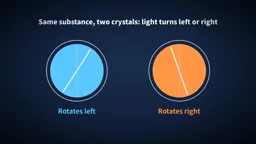
In 1857, Pasteur also discovered that microorganisms during fermentation consume only one form, leaving the other behind. Life seems to have a "preferred hand": human proteins are almost entirely made of left-handed amino acids, while the sugars in DNA are all right-handed. This preference is everywhere—one enantiomer of carvone smells like spearmint, while the other smells like caraway.
Enantiomers are a core concept in stereochemistry: when a molecule contains a chiral center (most commonly a carbon atom bonded to four different groups), that molecule and its mirror image cannot be superimposed by rotation or translation, making them enantiomers of each other. Enantiomers have almost identical physical properties in achiral environments—melting point, boiling point, solubility, and ordinary spectra are hard to distinguish—and differ only in chiral environments such as polarized light, chiral chromatography columns, or biological receptors. This property gives rise to optical activity: a pair of enantiomers rotates the plane of polarized light in opposite directions, hence the distinction between levorotatory and dextrorotatory forms. It was precisely with a polarimeter and crystal morphology that Pasteur first linked macroscopic crystal chirality to microscopic molecular chirality, laying the foundation for van 't Hoff and Le Bel's later tetrahedral carbon configuration. Understanding enantiomers is the prerequisite for understanding all the chiral amplification phenomena in this article.
From the Thalidomide Tragedy to Asymmetric Synthesis
Chirality is not just an academic curiosity. The human body itself is chiral, and the left- and right-handed versions of a drug can behave completely differently once inside the body. In the late 1950s and early 1960s, the sedative thalidomide was used to relieve morning sickness in pregnant women, causing severe limb defects in more than 10,000 infants. This tragedy made the world realize that pharmaceutical production must control molecular chirality.
But the challenge is that ordinary chemical reactions produce a 50/50 mixture of left and right. How can we make only the desired hand? The key tool is the chiral catalyst—if the catalyst itself is "left-handed," it can act like a mold to guide the reaction toward left-handed molecules. The 2001 Nobel Prize in Chemistry honored three pioneers in this field, but Kagan's name was not among them.
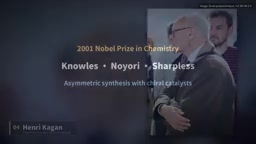
Kagan was born in 1930 in the western suburbs of Paris. Around 1971, he designed a chiral ligand called Diop, which attaches to metal catalysts and efficiently produces single-enantiomer molecules. Fittingly, it was made from the very tartaric acid Pasteur had sorted with tweezers, opening an entirely new path in catalyst design.
Thalidomide is the most painful case in the history of chiral drugs. The thalidomide molecule contains a chiral center, and therefore exists as two enantiomers, R and S. At the time, it was marketed as a racemate (a 50/50 mixture) to relieve pregnancy-related nausea. Later research showed that the R configuration has sedative effects, while the S configuration and its metabolites are teratogenic, interfering with fetal blood vessel development and causing severe malformations such as phocomelia. About 12,000 infants were affected. This tragedy directly spurred global drug regulatory reform, requiring that both enantiomers of chiral drugs be evaluated separately for pharmacology and toxicology, and gave rise to the asymmetric synthesis industry. Notably, the two enantiomers of thalidomide interconvert spontaneously in the body, so even administering a single enantiomer cannot avoid the risk—highlighting the complexity of precisely controlling chirality.
Nonlinear Effects: How a Small Advantage Gets Amplified
In the 1980s, Kagan noticed an anomalous phenomenon. Normally, catalyst purity and product purity should be directly proportional, following a straight line. But in 1986, Kagan's team reported three reactions whose results were not a straight line at all, but a curve—sometimes a catalyst with only half purity produced products of far higher purity.
The reason lies in the catalyst structure. Many metal catalysts carry two chiral components at once, producing three combinations: left-left, right-right, and left-right. The mixed left-right pairing is "lazy" and barely works. It's like a dance: as soon as a minority appears, the majority pulls it away into a slow dance, and both drop out of the competition, leaving almost only the majority doing the work.
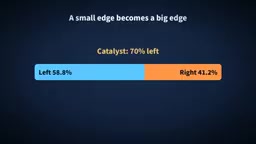
A tiny advantage in the catalyst is thus amplified into a huge advantage in the product. Kagan also built a mathematical model for this effect, and nonlinear effects have since become a standard tool for studying reaction mechanisms.
Chiral catalysts typically consist of a transition metal center and chiral ligands. The ligands act like molds, creating a chiral spatial environment around the metal so that substrates can approach the metal center only in a specific orientation, thereby preferentially generating one enantiomer. Kagan's Diop is a bisphosphine ligand whose chiral backbone comes from tartaric acid derivatives. When a metal catalyst binds two chiral ligands at once, three combinations can occur: left-left, right-right, and left-right. Heterochiral (left-right) pairings often form inactive or low-activity species, while homochiral pairings are the truly active catalysts. This "selection" between ligands is the molecular root of the nonlinear effect (NLE): when the ligand itself is not enantiopure, heterochiral pairings are preferentially consumed or deactivated, leaving a relatively enriched homochiral active species, so product purity exceeds ligand purity. Kagan's NLE mathematical model uses kinetic equations to describe this process and has become an important diagnostic tool for determining whether multi-ligand active species are involved in a reaction mechanism.
The Soai Reaction: Self-Replication from 2% to 87%
More importantly, these findings proved that a tiny difference in chirality can be amplified. As early as 1953, University of Bristol theoretical physicist Charles Frank proposed a bold idea: if the reaction product itself is also a catalyst for the reaction, and the left-handed product inhibits the right-handed product, then even the smallest initial imbalance would grow like a snowball. The model was elegant, but for decades no one achieved it experimentally.
Then came Japanese chemist Kenzo Soai. Born in Japan in 1950, he earned his doctorate at the University of Tokyo in 1979 and taught at Tokyo University of Science for more than forty years starting in 1981. His goal was exceptionally focused: to find a molecule that could replicate its own chirality. In 1995, Soai published a discovery in Nature: he reacted a pyrimidine-ring-containing aldehyde with an organozinc reagent to produce a chiral alcohol, and this alcohol itself was a catalyst that helped make only molecules of the same chirality as itself—left-handed molecules made more left-handed molecules, and right-handed ones likewise.
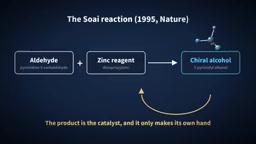
In experiments, Soai started from an advantage of only 2% and amplified it all the way to 87%. Repeated over and over, the product became almost entirely single-handed. He later found that the reaction was astonishingly sensitive: a small piece of left- or right-handed quartz crystal, a beam of circularly polarized light, or even a tiny difference caused by carbon isotopes could determine which hand ultimately won. Even more striking, with no chiral substance added at all, the reaction still spontaneously leaned to one side—each experiment was like a coin toss, yet the result was always imbalanced. For the first time, humans watched "a single hand" arise from nothing in the laboratory.
Autocatalysis refers to a process in which the reaction product itself acts as a catalyst to accelerate its own formation, and it is highly significant in the chemistry of the origin of life. In the Soai reaction, the chiral alcohol product is both catalyst and product, forming a positive feedback loop: the left-handed alcohol produced catalyzes the formation of more left-handed alcohol, and similarly for the right-handed alcohol. If the catalytic efficiencies of the two enantiomers were perfectly symmetric, the reaction could still randomly lean to one side; but once a tiny random fluctuation appears, autocatalysis rapidly amplifies it. Frank's 1953 model further required enantiomeric inhibition: one enantiomer inhibits the formation of the other, thereby breaking symmetry. The Soai reaction is widely regarded as realizing this theoretical prediction and has been called "the first experimental validation of the Frank model." The reaction is extremely sensitive to temperature, solvent, and impurities, showing that chiral amplification can occur under mild conditions. It provides an experimental paradigm for understanding the origin of homochirality and has also inspired research in chiral resolution, chiral amplification, and supramolecular self-assembly.
A Window into the Origin of Life
This discovery opens a window into the origin of life. In the Murchison meteorite, scientists found that certain amino acids show a slight excess of the left-handed form. Perhaps on early Earth, a tiny random imbalance was continuously amplified by a similar mechanism, until life ultimately chose one hand. The Soai reaction itself requires an anhydrous environment and special zinc reagents, so it could not have occurred directly on early Earth, but it proved a principle: a single chirality can arise and grow on its own through chemistry.
In everyday life, nonlinear effects and autocatalytic principles are helping chemists design better reactions for pharmaceuticals, fragrances, crop protection, and new materials. Kagan, 95, waited another 25 years after missing the 2001 Nobel Prize; Soai, 76, spent most of his life searching for a molecule that could replicate itself. After winning the prize, Soai said that chirality is the prerequisite for the origin of life. Perhaps every molecule in our bodies tells the same story: it began with a tiny imbalance, was amplified again and again, until it changed the entire world.
One-line Summary
2026 Nobel Prize in Chemistry awarded to Kagan and Kenzo Soai for discovering chiral nonlinear effects and autocatalysis, explaining the origin of life's homochirality.
Paragraph Summary
The 2026 Nobel Prize in Chemistry was awarded to French chemist Henri Kagan and Japanese chemist Kenzo Soai for their discovery of nonlinear effects and autocatalysis in asymmetric organic synthesis. Chiral molecules, like left and right hands, are mirror images that cannot be superimposed, and life on Earth uses almost exclusively a single chirality—a homochirality puzzle that has baffled chemists for a century. In the 1980s, Kagan discovered that tiny chiral advantages in catalysts can be amplified into huge purity advantages in products, and built a mathematical model; Soai, through an autocatalytic reaction, amplified an initial advantage of only 2% to 87%, and the reaction could even spontaneously lean to one side without any chiral substance. This discovery not only explains why life chose one hand, but also advances reaction design in pharmaceuticals, fragrances, and new materials.
Related articles

AgentCore in Practice: Connecting Custom Tools and MCP Servers to Agents
DebuggerCafe tutorial shows how to connect custom tools and MCP servers to Amazon Bedrock AgentCore agents, covering tool contract design, MCP reuse, and production concerns.

816B Parameters Scores Only 39? The Real Cost-Effectiveness of the Open-Source LLM Parameter Race
Meta's 816B Muse Spark Open scores just 39 on Artificial Analysis, while 180B Qwen3.8-Flash-Next scores 40. This article analyzes 11 open-weight models' parameters vs. scores, exploring the real impact of activated parameters, quantized size, and deployment cost.

Aerial Manipulators: The Next Step for Drones from 'Seeing' to 'Changing'
Starting from a Reddit discussion, this article analyzes the technical challenges, potential applications, and deployment bottlenecks of aerial manipulators, exploring the key challenges for drones moving from environmental perception to physical manipulation.