3 Must-Have DeepSeek Skills Collection Sites to Double Your Productivity

Three curated AI Skills collection sites to unlock DeepSeek V4 Pro's full potential.
This article explains AI Skills—modular tools that extend LLM capabilities for specialized tasks—and recommends three collection sites: a massive open-source repository with 1.46 million Skills offering broad coverage but inconsistent quality; a curated Skills Store with fewer but reviewed and reliable plugins; and a leaderboard site that ranks Skills by popularity and quality scores for quick discovery. Each serves different user needs from DIY power users to efficiency-focused professionals.
Introduction
Since the release of DeepSeekAd V4 Pro, its powerful capabilities have quickly won over countless fans. But what many people might not realize is that the model alone is far from enough—Skills (plugin extensions) are the real key to unlocking its full potential. As one blogger put it: "Using DeepSeek without Skills is like buying a Ferrari and only driving it around town without ever hitting the highway."
What Are AI Skills (Plugin Extensions)?
Skills are essentially modular tools that extend the specific capabilities of large language models. From a technical architecture perspective, Skills typically exist in the form of System Prompts, Function Calling, or external API integrations—they tell the model "in what scenario, using what method, and calling which resources to complete a task." This concept first emerged with OpenAI's ChatGPT plugin ecosystem and has since been widely adopted by major AI platforms.
The core value of Skills lies in "specialization"—while general-purpose LLMs have broad knowledge, they often lack targeted execution logic for specific vertical tasks (such as legal document formatting, code review, or SEO optimization). Skills fill this gap. Think of it like the app ecosystem on smartphones: the phone itself provides computing power and an operating system, while apps are what actually help users get specific work done.
So the question is: Where do you find Skills? Which ones are reliable? This article presents the 3 most bookmark-worthy Skills collection sites after screening the entire web, covering different use cases from massive repositories to curated recommendations to leaderboards.
The Largest Skills Repository Online: 1.46 Million Open-Source Skills
The first recommendation is currently the largest open-source Skills repository on the internet, containing over 1.46 million Skills. What does that number mean? Essentially, any use case you can think of—translation, writing, coding assistance, data analysis, format conversion—has a corresponding Skill available.
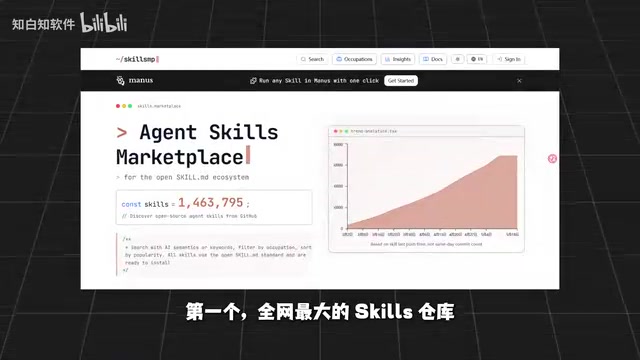
Strengths and Weaknesses: Understanding Quality Tiers in Open-Source Repositories
The biggest advantage of this repository is its extremely broad coverage—no matter how niche your needs are, you'll likely find something. But "big" also brings an obvious problem: wildly inconsistent quality. The blogger shared a personal experience—when looking for a translation Skill, they tried five different ones before finding one that actually worked well.
This reflects the "long tail effect" and "quality stratification" issues that are pervasive in AI tool ecosystems. On open-source platforms like GitHub, many Skills are contributed by individual developers without unified testing standards or maintenance mechanisms. Research shows that in large open-source AI prompt repositories, those that are actually used frequently often account for less than 5% of the total—the rest are mostly in a "zombie state," either with outdated logic or optimized for older model versions, performing poorly on newer ones.
The core trick for filtering through massive repositories is: prioritize checking the Star count, recent update time, and whether there are actual usage examples (feedback in Issues or Discussion sections). These three dimensions can quickly filter out most low-quality Skills.
Who Is This For?
- Suitable for: Users who know exactly what functionality they need and are willing to spend time filtering and testing
- Not suitable for: Users who want "plug and play" without any hassle
If you're the type who enjoys picking and comparing on your own, this repository is your treasure trove. But if you prioritize efficiency and don't want to spend too much time screening, the next two sites will be better suited for you.
Skills Store: A Curated Quality Shop
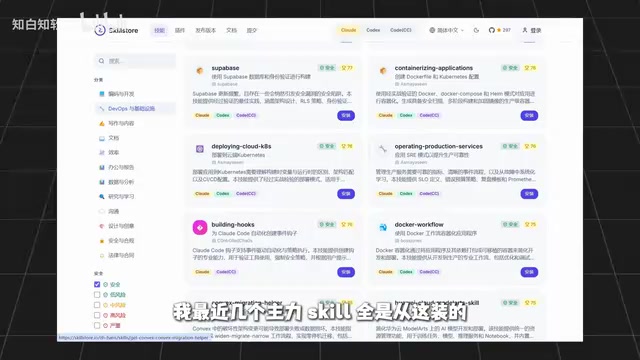
The second recommendation is the Skills Store, which can be understood as a "boutique shop" model for Skills platforms. Unlike the first repository's "large and comprehensive" approach, this one takes the refined and precise route.

Core Features and Review Mechanism
- All Skills are reviewed: No need to worry about installing something that doesn't work or performs poorly
- Standardized installation process: Unified installation standards lower the barrier to entry
- Fewer in quantity, but quality is guaranteed: Every listed Skill is functional
The Skills Store adopts a "Curated" platform model, sharing the same closed-review logic as Apple's App Store while also drawing from the community-driven discovery approach of platforms like Product Hunt. The review mechanism typically covers several dimensions: functional usability testing (whether the Skill can stably execute its intended task), security review (whether there are prompt injection risks or data leakage concerns), and user experience standards (whether the installation process is clear and output formats are standardized).
The trade-off of this model is longer listing cycles and limited quantity, but what it gains is a significant reduction in user trust costs—while the number isn't as large as the open-source repository, the average quality is higher, and users are far less likely to encounter duds.
Real-World Usage Experience
The blogger mentioned that several of their most-used daily Skills all come from this platform. This shows that for high-frequency daily use cases, reviewed and curated Skills are indeed more stable and reliable. For enterprise users or professionals with high stability requirements, reliability often takes priority over feature richness in high-frequency scenarios. For most regular users, this is probably the highest value-for-effort choice—no time spent filtering, just install and use.
Leaderboard Site: When You Don't Know What to Install, Check the Rankings
The third recommendation is a Skills leaderboard website—essentially a "copy someone else's homework" tool. If you don't want to sift through a million-level repository yourself and aren't sure what functionality you actually need, this site is the best entry point.
Leaderboard Mechanisms and AI Tool Discoverability
The leaderboard site addresses a long-overlooked core pain point in the AI tool ecosystem: Discoverability. As the AI plugin ecosystem explodes in growth, users no longer face the problem of "can't find tools" but rather the information overload dilemma of "don't know which tool to use." This closely mirrors the evolution of app stores in the early mobile internet era—once app numbers broke the million mark, the value of charts and recommendation algorithms actually surpassed that of the search function itself.
This leaderboard site provides multiple sorting dimensions:
- Popularity ranking: See what everyone else is using (reflects mainstream preferences)
- Quality score: Comprehensive assessment of a Skill's actual performance (compensates for potential "chart manipulation" in crowd-based ratings)
Related articles
 Tutorials
ChatGPT Plus Subscription Guide: Are GPT-5.5, image-2, and Codex Worth the Upgrade?
A detailed look at ChatGPT Plus features — GPT-5.5, image-2, and Codex — with a Plus vs Pro comparison and a complete step-by-step subscription guide for users outside the US.
 Tutorials
Harness AI Engineering in Practice: Using Claude Code to Master Enterprise-Level E-Commerce Development
Deep dive into Harness AI Engineering: master enterprise e-commerce development with Claude Code using the Rules, Skills, Wiki, and Changes framework.
 Tutorials
Cursor + Codex Dual-IDE Collaboration: A Practical Methodology for Open-Source Project Customization
A complete methodology for open-source project customization based on real-world experience, detailing the Cursor+Codex dual-IDE workflow, seven-stage process, MVP validation, and AI source code reading techniques.