31 Companies Sign Agent Privacy Pact: Industry Self-Regulation Framework Goes into Effect

31 firms sign China's first AI agent privacy pact as the industry races to balance capability with compliance.
China's first AI agent privacy self-regulation pact, signed by 31 companies, establishes rules on screen-reading authorization, prohibiting private data for commercial training, and daily payment caps. The piece also covers Tencent Hunyuan topping OpenRouter's neutral leaderboard, Meta's $40B compute expansion, Apple's M7 NPU push, open-source efficiency breakthroughs, and the mixed fortunes of agent commercialization.
Agent Privacy Self-Regulation: China's First Industry Pact Takes Effect
As AI agents move from concept to large-scale deployment, their potential privacy risks are raising serious alarm across the industry. AI agents are AI systems capable of perceiving their environment, planning autonomously, and executing multi-step tasks — distinct from traditional single-turn Q&A models. Their core capability lies in "Tool Use": agents can invoke external tools such as browsers, file systems, payment interfaces, and cameras, forming a closed loop of "perception–decision–execution." This architecture allows them to perform complex cross-application operations on behalf of users, but it also means they inherently hold system permissions far exceeding those of ordinary apps. Their data exposure surface is vastly larger than any single app, and if vulnerabilities emerge or the technology is abused, the amount of information and operational space available to an attacker grows exponentially. Recently, 31 domestic companies jointly signed China's first AI agent privacy self-regulation pact, marking the beginning of a self-imposed governance framework for this emerging technology.
The pact's three core clauses target the most contested risk areas: silent screen reading must require physical authorization, using private data for commercial model training is strictly prohibited, and a single-day spending cap is established for autonomous agent payments. These three rules precisely address the pain points of screen data collection, training data misuse, and uncontrolled autonomous spending.
The timing of this pact is no coincidence. Once agents gain the ability to "act on behalf of users" — reading screen content, accessing accounts, executing payments — any abuse of these permissions would be far more damaging than a conventional app privacy breach. The industry establishing norms early is, in some sense, paving a compliant road for large-scale commercialization.
Data Sovereignty: Europe's Differentiated Path
In parallel with this domestic self-regulation approach, a German government-funded team has open-sourced Sophie S, the first bilingual German-English large language model. The model uses a hybrid Mixture-of-Experts (MoE) and Mamba architecture — the former splits the model into multiple "expert" sub-networks through sparse activation, routing only a small number of experts per inference pass, dramatically reducing per-inference compute while maintaining a very large total parameter count; the latter is a recently emerged state-space model variant that processes long sequences with linear complexity, offering significant advantages over Transformer's quadratic attention complexity in ultra-long-context scenarios. Training data is fully compliant with European GDPR regulations, with "data sovereignty" as its central proposition.
This development reflects a clear trend: outside the U.S.-China race to dominate compute and model scale, Europe is carving out a differentiated AI development path centered on compliance and data sovereignty. European enterprises and government institutions with high sensitivity to data compliance will be the primary audience for such models.
Model Capability Race: Ultra-Long Context and a Domestic Model Tops the Charts
The frontier of model capabilities continues to expand rapidly. According to industry insiders, OpenAI is secretly testing its next-generation flagship model, set for imminent release, with a default context window of 1.5 million tokens — roughly equivalent to over one million Chinese characters, or hundreds of books. Reasoning and alignment capabilities are also set for a comprehensive upgrade, though the company has remained silent officially.
However, amid all the hype around ultra-long context, sober voices have emerged. Rumors that a new GPT version supports over 27 million Chinese characters of context were officially denied, with the research team acknowledging serious "attention diffusion" problems in long texts. This phenomenon, known academically as "Lost in the Middle," describes how models pay significantly more attention to content at the beginning and end of an input sequence than to the middle, causing vast amounts of information in ultra-long texts to be effectively "ignored." This is a reminder that bigger context window numbers aren't always better — the actual effective attention density across ultra-long texts is the key metric.
A Domestic LLM Tops a Neutral Third-Party Platform for the First Time
Domestic models have reached a landmark moment. Tencent's Hunyuan model topped the global performance leaderboard on OpenRouter — a neutral routing platform that aggregates API access to multiple AI models. Its rankings are derived from real user requests in production environments, covering hard engineering metrics such as throughput, time-to-first-token, and request success rate, rather than closed benchmarks designed by model vendors themselves. This kind of real-load testing is far more valuable than internal evaluations, as it reflects a model's overall service capability under real global concurrent pressure and is difficult to game through dataset contamination or targeted training. This marks the first time a domestic large model has topped a neutral third-party platform, carrying far more weight than self-published evaluation results.
Meanwhile, ByteDance's C-Dream 5.0 Pro made its debut in a global blind evaluation arena, taking second place on the multi-image editing leaderboard and receiving high scores from human judges in tests including cross-image color alignment and local refinement. In specialized capabilities, domestic models have demonstrated the ability to compete head-to-head with the world's top products.
Compute Arms Race and Accelerating Chip Iteration
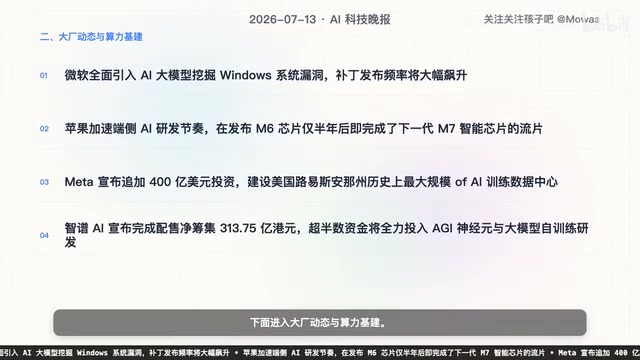
Investment in compute infrastructure continues to escalate. Meta has reportedly committed an additional $40 billion to build the largest compute center in history, planning full deployment of Blackwell Ultra hardware within six months while securing gigawatt-scale clean energy allocations — placing enormous pressure on local power grids. Electricity is becoming a scarcer resource in the AI race than chips themselves.
The pace of chip development is equally breathtaking. Apple is accelerating its chip roadmap: just six months after M6 launched, M7 has already completed tape-out, will adopt a 2-nanometer process for the first time, and will increase the Neural Processing Unit (NPU) area share to over 40% of the chip. NPUs are specialized processor cores optimized for AI inference operations such as matrix multiplication and convolution; compared to general-purpose CPUs and GPUs, NPUs can improve energy efficiency by tens of times when executing AI tasks. The core driver behind continuously expanding NPU share is to push AI inference from the cloud down to local devices, addressing privacy protection, latency elimination, and offline use cases simultaneously. As large model quantization and compression techniques mature, on-device AI is moving from a marketing buzzword to a genuine user experience differentiator. The dramatic increase in NPU share clearly signals Apple's strategic bet on on-device AI capabilities.
Capital Markets Send Steady Signals
Zhipu completed a placement on the Hong Kong Stock Exchange, raising over HK$31.3 billion, with more than half earmarked for frontier research. More notably, its share price rose rather than fell following the lock-up expiry — a strong vote of confidence from capital markets in the moat of leading AI companies.

Open Source Ecosystem: Efficiency Optimization Becomes the Theme
The defining keyword of this round of open-source developments is "efficiency." Google open-sourced a lossless compression algorithm for inference, capable of cutting inter-cluster transmission bandwidth directly in half — with a significant impact on reducing time-to-first-token latency for large models. In an era of high compute costs, the value of this kind of low-level optimization should not be underestimated.
Tencent Hunyuan open-sourced an OCR text recognition model that, after full-stack operator optimization, achieves a 6.8× inference speedup with zero degradation in handwriting recognition accuracy. SenseTime open-sourced a unified vision model that uses a single architecture to bridge autonomous driving and warehouse robotics control, substantially reducing cross-scenario development complexity.
These open-source contributions share a common characteristic: rather than simply pursuing parameter scale, they focus on inference efficiency, deployment cost, and cross-scenario versatility — a necessary shift as AI moves from "lab showpieces" to "production engineering."
Products and Ecosystem: The Promises and Growing Pains of Agent Commercialization
The path to commercializing agent products is far from smooth. Atla, the AI-powered browser that once generated significant excitement, has announced its shutdown, with the entire team disbanded. The cause: underlying security red lines and interface lockdowns — a subtle echo of the privacy pact discussed at the opening of this piece, and a reminder that deploying agents in high-permission scenarios like browsers still faces enormous obstacles.

Meanwhile, Elon Musk has confirmed that xAI is internally testing a Grok background agent capable of autonomously executing tasks for weeks at a time in the system background. However, it is prone to being flagged as a backdoor by firewalls — a detail that once again highlights the inherent conflict between autonomous agents and existing security systems. The behavioral pattern of an autonomous agent running continuously in the background is highly similar in characteristics to traditional malware, and existing behavior-based security detection mechanisms cannot yet effectively distinguish between the two. This is a foundational infrastructure problem the entire agent industry urgently needs to solve.
The E-Commerce Monetization Loop Is Now Complete
On the monetization front, Douyin has integrated Doubao's large model shopping recommendation capabilities into Douyin Shop's settlement attribution system, officially closing the e-commerce monetization loop through GEO (Generative Engine Optimization). GEO is a new marketing concept counterpart to traditional SEO: while SEO optimizes web pages to rank higher in search results pages, GEO optimizes content to make it more likely to be cited, recommended, or generated as a shopping answer by large language models, targeting semantic comprehension and content credibility rather than keyword indexing algorithms. This means merchants now need to think not about "how to be crawled by search engines," but about "how to get models to preferentially recommend their products when answering user questions" — an entirely new marketing arena is taking shape.

In addition, a wave of AI companionship products has appeared in quick succession: miHoYo's virtual companion app combines top-tier anime aesthetics with a local large model; Nubia's companion robot has confirmed its launch date; and a campus social product uses large model analysis of user habits to enable personalized matching. AI is extending from a tool paradigm into the realm of emotional companionship, and the imaginative scope of this sector is being fully opened up.
Conclusion
From 31 companies signing an agent privacy pact to an AI browser shutting down over security red lines, this round of developments repeatedly confirms a central contradiction: the more capable an agent becomes, the more intensely it conflicts with existing privacy and security systems. The emergence of an industry self-regulation pact is precisely the product of this tension. Whoever can find the balance between capability expansion and security compliance will be first to claim their ticket to the age of AI agents.
Key Takeaways
Related articles

Poison-Resistant Concept Anchoring: A New Approach to Defending Against AI Data Poisoning
Deep dive into Poison-Resistant Concept Anchoring, defending against data poisoning via signed anchors and bounded updates. Experiments show 62% poison isolation with 0% false rejection rate.

Hungarian Algorithm Explained: Principles, Complexity, and Engineering Implementation Guide
In-depth explanation of the Hungarian Algorithm: core principles, O(N³) time complexity advantages, and engineering implementation. Covers assignment problem definition, step-by-step algorithm walkthrough, Python/C++ libraries, and applications in multi-object tracking and resource scheduling.
OpenAI's First Enterprise AI Report: H…
OpenAI's First Enterprise AI Report: How ChatGPT Is Changing the Way Organizations Work
OpenAI's first enterprise AI report reveals three key traits of ChatGPT Enterprise adoption: the shift from novelty to necessity, writing and coding as top use cases, and data governance as a core prerequisite.