31B Video-Audio Diffusion Model Compressed to 14B: 6-Step INT8 Inference

Team compresses a joint video-audio diffusion model from 31B to 14B with 6-step sampling and INT8 quantization, greatly lowering deployment barriers.
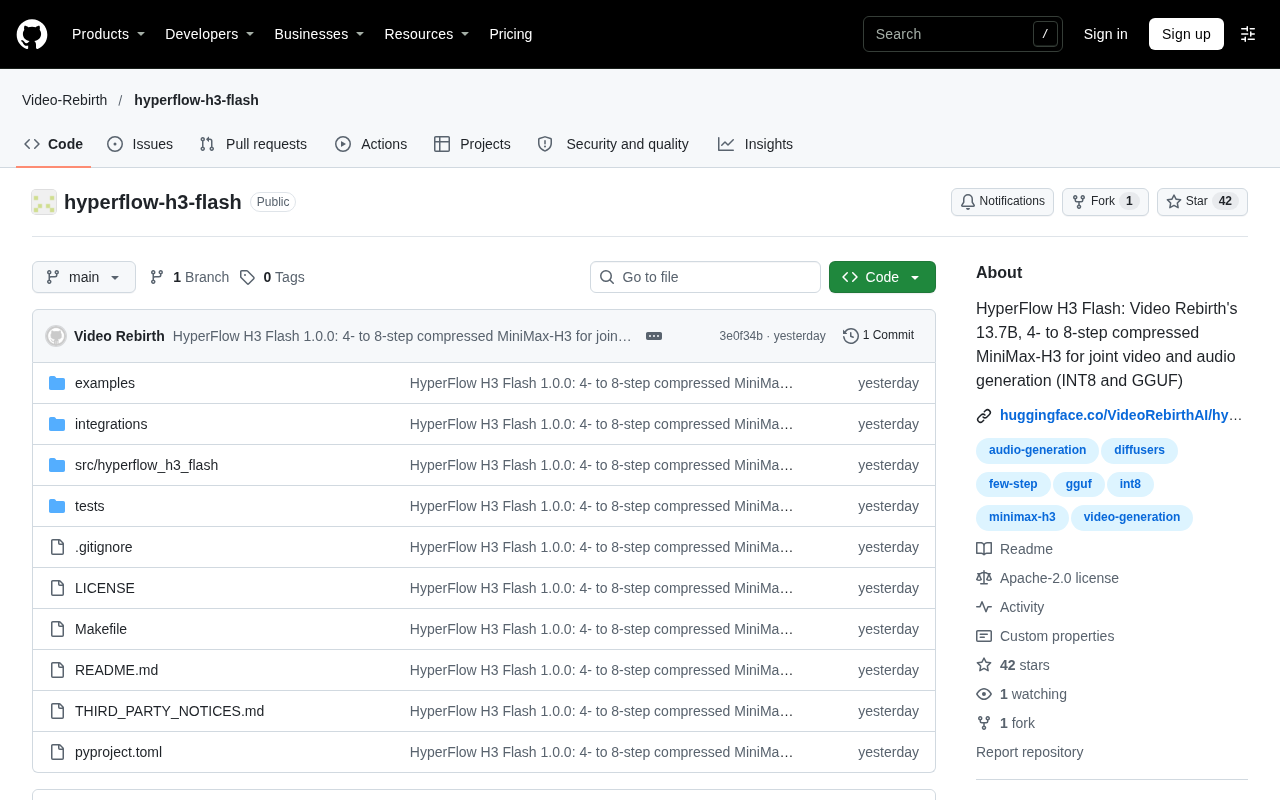
In the Show HN section of Hacker News, a team showcased compression results for a joint video-audio diffusion model: parameters reduced from 31B to 14B, inference steps compressed to 6, and INT8 quantization applied. This addresses two major pain points of diffusion models in video generation—excessively large model size and too many inference steps. Halving parameters directly lowers memory footprint and loading costs; 6-step sampling dramatically reduces iterative denoising latency; INT8 quantization further reduces memory bandwidth and computational overhead, though controlling quantization errors for the audio modality is challenging. The compressed model is easier to deploy on single GPUs or edge devices, lowering the economic cost of batch video generation. However, the original post did not disclose specific compression methods, quality comparisons, or benchmark data, and whether generation quality under 6-step INT8 is comparable to the original model remains to be verified.
From 31B to 14B: An Engineering Breakthrough in Diffusion Model Compression
In the Show HN section of Hacker News, a team showcased their compression results for a joint video-audio diffusion model: reducing parameter count from 31B to 14B, compressing inference steps to 6, and applying INT8 quantization. This progress directly addresses two major pain points of diffusion models in video generation—excessively large model size and too many inference steps.
According to the team's description on Hacker News, they compressed an original 31B model down to 14B, requiring only 6 steps to complete sampling, with the model running at INT8 precision. This means the model size was reduced by more than half, while inference steps are far below the dozens or even hundreds typically required by traditional diffusion models. For computation-intensive tasks like joint video-audio generation, this compression magnitude is quite remarkable from an engineering standpoint.
Three Dimensions of Compression: Parameters, Steps, and Quantization
This compression effort tackled three dimensions simultaneously, each corresponding to different technical challenges.
Halving Parameters: From 31B to 14B
Compressing 31B parameters to 14B represents a reduction of more than half. Typically, such compression would employ pruning, knowledge distillation, or low-rank decomposition, but the original post did not disclose the specific methods used. What is certain is that parameter reduction directly lowers memory footprint and loading costs, making it more feasible to run the model on consumer-grade or single-GPU workstations.
Knowledge distillation is a model compression technique that transfers knowledge by having a small "student model" mimic the output distribution or intermediate features of a large "teacher model." In diffusion models, distillation is commonly used to compress multi-step sampling into fewer steps—for example, progressive distillation teaches the model to reproduce the teacher's denoising trajectory with fewer steps. Pruning reduces parameter count by removing redundant weights or structures (such as attention heads or channels), and can be categorized as unstructured pruning (sparsification) or structured pruning (directly removing entire neurons or layers). Low-rank decomposition approximates large weight matrices as the product of two smaller matrices, thereby reducing storage and computation. Each method has trade-offs: distillation maintains good performance but requires a teacher model and training costs; pruning may damage model structure; low-rank decomposition is hardware-friendly but offers limited compression ratios. In practice, these methods are often combined.
Step Compression: 6-Step Sampling
One of the core costs of diffusion models lies in the number of iterative denoising steps. Traditional text-to-video models often require dozens of sampling steps, whereas 6 steps means inference latency drops dramatically. Step compression typically relies on distillation or more efficient sampler designs, and when combined with parameter compression, the throughput improvement is multiplicative.
The sampling process of diffusion models is essentially solving a stochastic differential equation or ordinary differential equation (ODE). Traditional samplers (such as DDPM) require hundreds of steps to approximate this continuous process, while higher-order ODE solvers (such as DPM-Solver and Heun solvers) can achieve comparable quality within 20-50 steps through more accurate numerical integration. Distillation methods train a student model to directly predict results multiple steps ahead—for example, Consistency Models map noise at any time step directly to clean data, achieving 1-4 step sampling; progressive distillation gradually halves the number of steps. 6-step sampling typically combines distillation with efficient solvers, but fewer steps place higher demands on model capacity and training data, and may sacrifice diversity. The audio modality is sensitive to high-frequency details, making step compression more challenging.
INT8 Quantization: Balancing Precision and Efficiency
INT8 quantization compresses weights and activations from higher precision to 8-bit integers, further reducing memory bandwidth pressure and computational overhead. Video-audio dual-modality models are particularly sensitive to quantization errors because audio has lower tolerance for subtle noise than images. The team claims they can still maintain usable quality under INT8, which is one of the most noteworthy technical points of this release.
INT8 quantization linearly maps floating-point weights and activations to 8-bit integers (range -128 to 127), and replaces floating-point operations with integer operations during inference, significantly improving throughput and reducing memory footprint. Common approaches include post-training quantization (PTQ) and quantization-aware training (QAT): PTQ directly calibrates a trained model—simple but potentially lossy; QAT simulates quantization errors during training—higher precision but more costly. For diffusion models, activation values have large dynamic ranges that vary across time steps, and quantization errors accumulate in the generated output. Audio is particularly sensitive to quantization noise because the human ear is highly attuned to subtle distortion. The team's claim of maintaining usable quality under INT8 may involve techniques such as per-channel quantization, mixed precision (keeping sensitive layers in FP16), or QAT, but the original post did not disclose details.
Practical Implications for the Video Generation Field
Joint video-audio diffusion models are one of the most resource-intensive areas in generative AI. A 31B model is quite expensive to train and run even in high-end multi-GPU environments, and the combination of 14B, 6 steps, and INT8 lowers the barrier by a significant margin.
This compression approach has direct implications for deployment scenarios: smaller models are easier to deploy on edge devices or single-GPU servers, and fewer steps mean lower per-generation costs and shorter waiting times. For pipelines that need to generate video content in batches, the reduction in inference costs directly changes the economics.
However, caution is warranted. The Hacker News post itself contains limited information—the team did not publicly share specific quality comparison data, compression method details, or benchmark results. Whether generation quality under 6-step INT8 is comparable to the original 31B model currently relies solely on the team's claims. Community comments number only 3, and substantive technical discussion has yet to develop.
A Direction Worth Tracking
Compressing large models to be smaller, faster, and lower-precision while maintaining generation quality is an essential path toward practical diffusion models. The 31B→14B, 6-step, INT8 combination showcased in this Show HN post presents a clear engineering pathway. What's worth watching next is whether the team will release weights, inference code, and quantitative comparisons with the original model—that will be the key to judging the true value of this compression.
Related articles
 Tech Frontiers
GitHub Daily · November 8: Agent Infrastructure Blooms Across the Board
GitHub Daily Nov 8: agent infrastructure dominates Trending—browser automation, design systems, skill libraries, VM runtimes, and context compression—while veteran tools warm up.
 Tech Frontiers
Comparing Routing Mechanisms of 10 Open-Source MoE Models: DeepSeek, Qwen, Mixtral, Llama 4, gpt-oss
A configuration-based comparison of routing mechanisms in 10 open-source MoE models, analyzing DeepSeek, Qwen, Mixtral, Llama 4, and gpt-oss on expert count, top-k, shared experts, gating, and load balancing.
 Tech Frontiers
Vibe Coding Step-by-Step Guide: Learn to Build Products with AI in Six Steps
Breaking down the six-step methodology of Bilibili's 748-episode Vibe Coding course, analyzing the usage boundaries and prompt techniques of Codex, Claude Code, and Cursor, and discussing who this AI coding course suits, who it doesn't, and how to avoid the trap of watching without acting.