34 AI Coding Assistants Battle It Out in the Terminal — How to Avoid Picking Wrong

34 AI coding agents are battling it out in the terminal — developers should keep a neutral workflow rather than betting on a single tool.
Using Orca's support for 34 AI coding agents as a starting point, the article argues that the terminal is becoming the platform battleground of 2026, but 34 entry points don't make a mature market — it's gold-rush-style overcrowding where most agents won't survive and consolidation is inevitable. It analyzes the double-edged nature of multi-agent parallelism: parallel exploration on independent code copies boosts efficiency but linearly amplifies token costs and adds coordination overhead. The core advice is to stay agent-neutral — stick to plain git, plain tests, and self-maintained prompts to reduce migration costs and lock-in risk. Judging whether an agent can survive long-term requires examining business model sustainability, workflow integration, and differentiation beyond model capability.
34 AI Coding Assistants Battle It Out in the Terminal — How to Avoid Picking Wrong
The AI coding assistant space is getting extraordinarily crowded. A free tool called Orca already lists the 34 agents it supports, from Plod Code, Codex, Cursor, and Copilot to Devon, Kiro, Quencode, and more. The tool only launched this March, yet its GitHub star count has already surpassed 100,000 — a staggering pace. It lets you run multiple agents simultaneously, each working on its own copy of your code, and at the end you simply merge the winning version.
This sounds like a developer's paradise, but there's a real problem lurking underneath: when you're staring down 34 options, the risk of choosing wrong is far greater than the chance of choosing right.
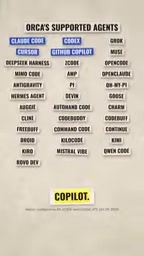
The Terminal Is the New Battleground, but 34 Entry Points Don't Make a Market
The video's author makes a clear point: the terminal is the platform war of 2026. But the influx of 34 agents isn't a sign of a mature market — it looks more like a gold rush. And the historical pattern of gold rushes is that they always end in consolidation.
Most of these names won't survive to next year. This isn't alarmism; it's the normal trajectory of technical tools. When a crowd of players rushes into a low-barrier, high-attention space, homogeneous competition rapidly burns through resources, and only a few end up building a sustainable moat.

What really matters isn't which agent will win, but which category of tool can stay neutral amid the chaos. Orca's positioning itself hints at the answer: tools that don't pick sides may end up having the last laugh.
"Terminal" here doesn't refer to the traditional command-line window itself, but to an AI coding paradigm centered on CLI (command-line interface) interaction. Over the past two years, products like Anthropic's Claude Code and OpenAI's Codex CLI have embedded AI agents directly into developers' shell environments, letting agents read and write files, execute commands, and run tests without relying on IDE plugins or web chat boxes. Compared with graphical interfaces, the terminal approach wins on composability, scriptability, and seamless integration with the existing command-line ecosystem like git and build tools. That's why the article calls the terminal the battleground of a "platform war": whoever occupies the developer's command-line entry point controls the distribution of agent invocations.
Multi-Agent Parallelism: Efficiency Gains and Cost Traps Coexist
Orca's core capability is letting multiple agents work at once, each with its own copy of your code. That means you can have five agents each try a different implementation, then merge the best one. From a workflow perspective, this genuinely boosts exploration efficiency, especially when facing ill-defined problems.

But the video raises a key warning: five agents running the same task could mean paying five bills for the same answer. Large model calls aren't free, and running multiple agents in parallel scales token consumption linearly. If the task doesn't actually require multi-path exploration, that overhead is pure waste.
The more insidious cost is time. Managing the output of multiple agents, comparing differences, and deciding on a merge strategy all require human intervention. The more agents, the higher the coordination cost. For everyday coding tasks, a single agent with clear instructions is often more efficient than five agents competing against each other.
Tokens are the basic unit of measurement for text processing in large models; the number of input and output tokens together determines the cost of a single API call. Mainstream models are currently priced per million tokens, with different prices for input and output — output typically costs more. Multi-agent parallelism means the same code context gets fed into the model multiple times, and if each agent also makes multiple rounds of tool calls (reading files, running tests, fixing errors), cumulative consumption can reach several times or even dozens of times that of a single agent. Understanding this is crucial: the root of cost amplification isn't just "running a few more agents," but that each agent independently generates a complete context-reading and reasoning chain. So before deciding to parallelize, evaluating whether a task needs multi-path exploration is the first checkpoint for cost control.
Stay Neutral: Don't Marry Any Single Agent
The video's advice is direct: don't marry any single agent, keep your setup neutral. Specifically, stick to plain git, plain tests, and your own prompts.
The underlying logic is to minimize migration costs. If you tie your workflow deeply to one agent's proprietary features, then if that agent shuts down, changes its pricing, or drifts in a different direction, your entire development process takes a hit. Git and tests are universal and portable — any agent can plug into them.

Your own prompts matter just as much. An agent's prompt templates may be convenient, but they also create lock-in. Keeping a prompt library you maintain yourself means you can switch quickly between agents without having to relearn each tool's prompting style.
"Agent lock-in" is a new form of vendor lock-in in the AI coding era. Traditional lock-in mostly comes from proprietary file formats or cloud service APIs, while agent lock-in manifests more as dependence on specific prompt templates, proprietary config files (like each vendor's rules files and memory files), and agent-exclusive workflows. Once deeply bound, migration requires not just rewriting configs but recalibrating your prompting strategy — with high hidden costs. Concrete ways to stay neutral include: capturing project rules in version-controlled plain text, verifying behavior with standardized test suites rather than agents' built-in validation mechanisms, and maintaining prompts as part of the codebase. This way, agents are just a replaceable execution layer, not the skeleton of your workflow.
Who Will Still Be Standing Next Year?
The video ends with an open question: which agent will still be standing next year? No one can give a definitive answer, but you can judge along a few dimensions.
First, whether there's a sustainable business model behind it. Free tools and open-source projects can acquire users quickly early on, but long-term maintenance requires resources. Second, whether it's deeply integrated with mainstream development workflows rather than creating silos. Third, whether it offers genuine differentiation beyond model capability — better context management, more reliable code understanding, or a smoother human-AI collaboration experience.
For developers, the most pragmatic strategy isn't betting on one agent but building an agent-agnostic workflow. Manage code with git, verify behavior with tests, express intent with your own prompts. That way, no matter how many agents are standing in the terminal, you keep the upper hand.
Orca's 100,000 stars says one thing clearly: developers want the power to choose, not to be held hostage by any single tool. The 34-agent scuffle will eventually converge, but a neutral workflow never goes out of style.
One-line Summary
34 AI coding agents are battling it out in the terminal — developers should keep a neutral workflow rather than betting on a single tool.
Paragraph Summary
Using Orca's support for 34 AI coding agents as a starting point, the article argues that the terminal is becoming the platform battleground of 2026, but 34 entry points don't make a mature market — it's gold-rush-style overcrowding where most agents won't survive and consolidation is inevitable. It analyzes the double-edged nature of multi-agent parallelism: parallel exploration on independent code copies boosts efficiency but linearly amplifies token costs and adds coordination overhead. The core advice is to stay agent-neutral — stick to plain git, plain tests, and self-maintained prompts to reduce migration costs and lock-in risk. Judging whether an agent can survive long-term requires examining business model sustainability, workflow integration, and differentiation beyond model capability.
Related articles

VERS: Editing Activation Explanations to Halve Reasoning Model Tokens
VERS guides reasoning models by editing activation explanations, cutting 45.8% of tokens on GSM8K with only a 0.82 pp accuracy drop and transferring to larger models, but losing accuracy on competition problems.

Finding Errors Is Not Enough: Selective Model Escalation for Entity-Targeted Sentiment Analysis
This study explores selective model escalation for entity-targeted sentiment analysis, comparing data collection ordering, uncertainty-driven re-examination, and model routing—finding that minority-class priority only helps at very small data volumes, the oracle upper bound far exceeds actual gains, and escalation must be tailored to each dataset.

WAS-PO: Using Whitened Advantages to Solve the Correlation Trap in Multi-Reward Reinforcement Learning
WAS-PO paper proposes whitening advantages to correct correlation bias in multi-reward RL: when rewards are correlated, naive weighted summation effectively applies Σ^{1/2}w instead of w. Experiments show training reward improves steadily, but held-out accuracy does not improve in sync, and under two rewards it actually falls behind.