44 Seconds to Read a Complaint: How n8n + LexSelect Build a Legal Document Automation Pipeline

n8n + LexSelect pipeline turns a legal complaint into a verified case record in 44 seconds.
Praxisflow demonstrates a four-step automation pipeline — orchestrated by n8n, parsed by LexSelect, and extracted by AI — that converts a legal complaint into a fully structured Airtable case record in roughly one minute. The standout design is verifiability: every extracted detail must include a page number and exact source language, with the system mechanically checking each citation. Unverifiable items trigger human review rather than a best guess, transforming AI from a hallucination-prone black box into a traceable production tool for high-stakes legal work.
The Hidden Cost of Legal Document Processing
When a complaint lands at a law firm, it typically triggers a cascade of repetitive, tedious work. Javier from automation services provider Praxisflow illustrated this with a telling example: a 15-page complaint requires someone to read the entire document, manually extract the parties, causes of action, and every individual count, then create a matter in the firm's system. It sounds straightforward, but it's enormously time-consuming and error-prone — attorneys and paralegals burn significant billable hours just converting documents into structured data.
The solution Praxisflow demonstrated centers on an automated pipeline built on n8n workflows combined with LexSelect — a tool purpose-built to read legal documents and transform them into structured data. The pipeline's goal is simple: take a raw complaint and turn it into a work-ready case record in roughly one minute.
A Four-Step Pipeline: From Upload to Case Creation
The entire workflow breaks down into four clear stages. In step one, the complaint enters the system — the attorney or paralegal simply uploads the file, or pastes a document link as shown in the demo. That's the only manual action required. In step two, LexSelect reads the PDF page by page, identifying headings, paragraph numbers, individual counts, and the prayer for relief, tagging each segment with its exact page number.
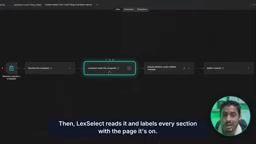
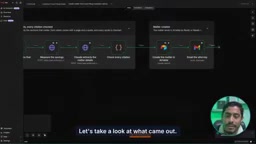
In step three, the AI takes over. One notable design choice: the AI doesn't read the entire document — it reads only the important sections, roughly half the document. This reduces both cost and processing time. In step four, the case is automatically created and written to the database.
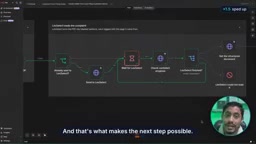
This division of labor is worth noting: LexSelect handles the conversion of unstructured documents into page-anchored structured segments, while the AI performs semantic information extraction on top of that foundation. The former ensures locatability; the latter ensures comprehension.
n8n is an open-source workflow automation platform similar to Zapier or Make (formerly Integromat), but with self-hosting support that allows organizations to keep their data on their own servers. It connects services — file storage, AI models, databases, email, and more — through visual nodes, turning multi-step manual processes into fully automated pipelines. In legal contexts, self-hosting is especially important: complaint files containing client information are typically subject to confidentiality obligations, and most firms are reluctant to route raw documents through third-party cloud services. n8n's self-hosting capability means compliance and automation efficiency don't have to be traded off against each other.
Verifiability: Every Conclusion Traces Back to the Source
What's most impressive about this workflow isn't the speed — it's the commitment to verifiability. When extracting each piece of information, the AI must "show its work" by providing a page number and the exact language from the document for every conclusion. The system then runs a verification pass: it checks each extracted citation against the document, and if a quoted passage can't be found on the cited page, that item fails.
The demo results, shown in Airtable, display a newly created case record flagged as "ready" — containing parties, court, case number, each count, the prayer for relief, whether a jury trial is demanded, and a brief summary. Every row includes its page citation, and all 16 references passed verification. The handling attorney also receives an email summary listing all citation sources, making it easy to spot-check any piece of information in seconds.
Given the well-known hallucination problem in AI, this hard-validation mechanism — where citations only count if they actually appear on the referenced page — is especially critical in high-stakes domains like law. It transforms the AI from a "black box that might fabricate answers" into an "assistant where every statement can be traced back to the source."
The "hallucination" problem in large language models (LLMs) refers to the tendency of models to generate text that sounds plausible but doesn't actually exist in the source material — including fabricated citations, incorrect dates, or invented statutory provisions. In general-purpose contexts, this might just be a quality issue, but in legal document processing it can directly lead to missed claims, misidentified parties, or even professional liability exposure. This is why demand is high for RAG + citation grounding approaches (Retrieval-Augmented Generation with citation anchoring) — requiring every AI output to be traceable to a specific passage in the source document rather than generated from thin air. The page-citation verification mechanism described here is a concrete production implementation of exactly that approach.
Handling Uncertainty: When to Hand It Back to Humans
The demo also deliberately showed a failure case — a separate 30-page complaint where the title of one count couldn't be matched against the document content. Rather than guessing, the system flagged that case for human review and annotated the exact reason on the spot.
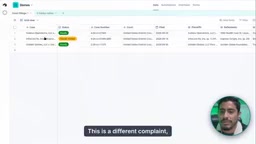
This design reflects a responsible automation philosophy: when confidence is insufficient, the pipeline actively returns the decision to a human rather than outputting something that looks complete but might be wrong. For law firms, this means automation isn't about replacing professional judgment — it's about freeing human effort from mechanical extraction and concentrating it on the edge cases that genuinely require judgment.
Implications for Legal Tech Automation
This combination — n8n for orchestration, LexSelect for parsing, and AI for extraction — offers a replicable model for law and other document-intensive professional sectors. Javier noted that if a firm is spending significant time converting documents into matters, contracts into checklists, or filings into deadlines, that's exactly the type of work that can be automated.
Three core lessons emerge: use specialized tools for document structure parsing rather than asking an LLM to brute-force read an entire document; require AI outputs to include traceable citations and apply mechanical verification; and trigger human review when confidence is insufficient. Only when all three are combined does "processing a complaint in 44 seconds" move from a marketing claim to a genuinely trustworthy production tool.
Of course, as a vendor-produced demo, the presentation naturally focuses on the happy path — it doesn't dwell on accuracy ceilings for complex document formats or adaptability across varying complaint structures. Real-world performance still needs validation across a broader set of cases. But the design thinking around verifiability and the human-machine collaboration boundary is worth studying for any team building AI automation in specialized professional domains.
The core challenge of automation in document-intensive industries is the inherent gap between unstructured text and the structured data downstream systems require. Traditional rule-based parsing (regex, template matching) works reasonably well for highly consistent document formats, but complaints produced by different courts and different firms vary enormously in structure, making rule maintenance prohibitively expensive. LLMs have made semantic-level information extraction possible, but relying solely on LLMs to handle long documents end-to-end runs into context window limits, high costs, and hallucination risks. The "pre-parsing layer" approach represented by LexSelect — using a specialized tool to segment documents into coordinate-tagged structured chunks before feeding smaller pieces to the LLM — is currently one of the mainstream engineering practices for balancing accuracy, cost, and speed. It's also known as a chunk-level RAG architecture.
Related articles

iPhone Duo Battery Life Tested: One Charge a Day Is Unavoidable, and the Large Screen Is the Culprit
iPhone Duo battery test: heavy use needs at least one charge a day, and about 30% remains after 6.5 hours of screen-on time. How often the large screen is unfolded is key; a MagSafe battery pack helps, and long-term degradation is also worth watching.

Kimi K3.1 Pro Open-Sourced: 2.8 Trillion Parameters Close In on Opus
Moonshot releases the open-source MoE model Kimi K3.1 Pro, with 2.8T total parameters and 104B activated, trailing Opus 5.5 by under 1 point on Terminal Bench 4.0.

Costco Tech Price Guessing: Are Monitors, Keyboards, Mice, and Bose Speakers Worth It?
A YouTube blogger guesses prices of Costco tech products: 2K 180Hz monitor, Logitech keyboard and mouse, Bose speaker, and CyberPower UPS, revealing warehouse-store selection and brand premium.