48 AI Agents Found a Maya Pyramid in 72 Hours: How Google SWE Pulled It Off

48 AI agents analyzed NASA LiDAR data and found an unmapped Maya pyramid in 72 hours.
A Google software engineering team used 48 AI agents to process NASA's public LiDAR data in parallel, locating a previously unmapped Maya pyramid within 72 hours. The case shows multi-agent systems at work on a real scientific task: agents split labor by data slice and detection strategy, with engineered orchestration handling large-scale remote sensing screening. LiDAR penetrates vegetation to capture micro-topography, making it a high-value archaeological resource; AI acts as a screening accelerator, while final confirmation still requires field surveys. The paradigm highlights task decomposition, concurrent scheduling, and result aggregation as engineering lessons for AI deployment.
When AI Agents Set Their Sights on NASA LiDAR Data
A team of Google software engineers (SWE) pointed 48 AI agents at NASA's public LiDAR data and, within 72 hours, found a previously unmapped Maya pyramid. The story earned 45 points on Hacker News and sparked discussion about the collaborative capabilities of AI agents.
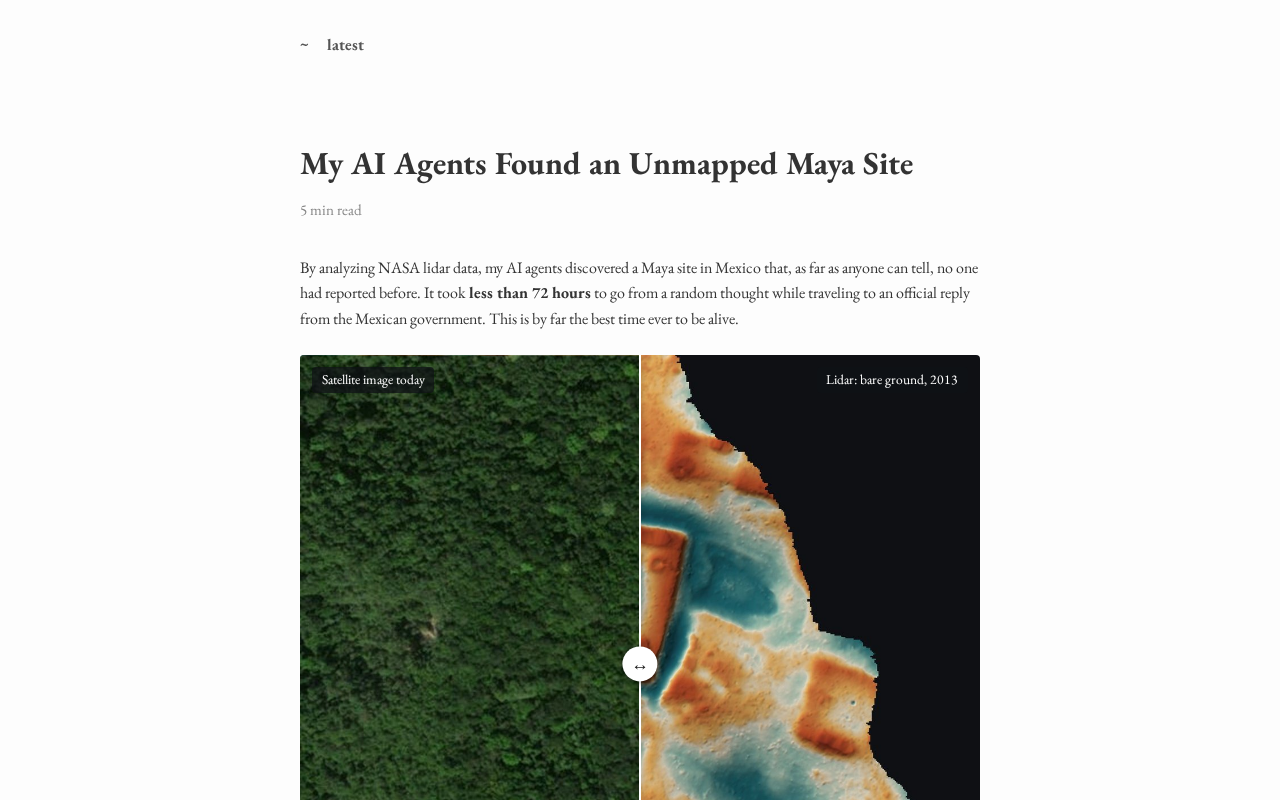
What makes this case noteworthy isn't the novelty of "AI discovers a pyramid," but the new working paradigm it demonstrates: multiple AI agents processing geospatial data in parallel, completing in a very short time the kind of screening work that would previously take an archaeology team months or even years.
How the 48 Agents Divided the Work
According to the original post, the 48 AI agents weren't simply executing the same task repeatedly; they divided responsibilities around the LiDAR data. LiDAR can penetrate dense vegetation and capture micro-topographic changes beneath the surface, and structures like Maya pyramids tend to leave identifiable geometric signatures in point cloud data.
The agents' roles likely included data preprocessing, feature scanning, anomaly detection, and cross-validation of results. Each agent handled a different data slice or detection strategy, ultimately converging on candidate targets. This "swarm search" approach is fundamentally different from traditional single-model inference—it's more like a programmed digital archaeology team than a single AI model running one pass of inference.
The 72-hour window implies a highly automated pipeline, with human involvement mainly at the result-confirmation stage. The Google SWE background also hints at how much weight engineering capability carried in this project: building the data pipeline, concurrent scheduling, and result aggregation may have been no less difficult than the detection algorithms themselves.
LiDAR point clouds and micro-topographic features: LiDAR (Light Detection and Ranging) generates high-density 3D point cloud data by emitting laser pulses and measuring return times. In archaeology, airborne LiDAR is typically used; its pulses can penetrate rainforest canopy, reach the ground, and reflect back. After filtering out vegetation points, the remaining ground points can produce a "bare-earth" digital elevation model (DEM), revealing man-made structures beneath the canopy such as platforms, causeways, and pyramids. Maya pyramids appear in DEMs as regular geometric shapes (e.g., square or stepped protrusions), and these micro-topographic features are exactly what the agents' detection algorithms look for. Point cloud data is enormous (up to millions of points per square kilometer), so efficient data slicing and parallel processing strategies are essential.
NASA LiDAR Data: An Underappreciated Archaeological Resource
NASA's LiDAR data was originally intended for topographic mapping and Earth science research, but it's a goldmine of information for archaeology. The rainforest cover of Mesoamerica makes traditional ground surveys extremely difficult, while LiDAR can "peel away" the canopy and reveal ground structures.
In recent years, LiDAR has led to multiple major discoveries in Maya lowland archaeology, including large-scale settlements and water management systems. The significance of this project lies in extending screening work from a handful of experts to a scalable AI pipeline. Public data plus agent swarms lowers the barrier to discovery and gives more independent researchers a chance to participate.
Sources of NASA LiDAR data: NASA has released large amounts of LiDAR data through missions such as GEDI (Global Ecosystem Dynamics Investigation) and through collaborations with other agencies (e.g., airborne topographic mappers). This data was originally used for forest biomass, topography, and glacier research, but its high-resolution ground models are equally applicable to archaeology. For example, GEDI provides spaceborne LiDAR waveform data, while airborne LiDAR (such as NASA's ATM) provides higher-density point clouds. Public data platforms (such as LP DAAC) allow researchers to download it for free, providing a scalable data foundation for AI agent swarms. However, data preprocessing (denoising, classification, DEM generation) still requires domain knowledge, and agents need to integrate these steps to screen effectively.
The Multi-Agent Paradigm Is Leaving the Lab
According to discussions in the Hacker News community and among project participants, this case is seen as a real-world validation of multi-agent systems on a genuine scientific task. Unlike chatbot-style multi-agent demos, the agents here faced real, noisy, massive remote sensing data—and had a clear success criterion: finding a previously unrecorded structure.
Some analyses note that this kind of task is naturally suited to parallelization: data can be split, detection strategies can be diversified, and validation can be cross-checked. The agents don't need complex conversations—only clear task boundaries and a result aggregation mechanism—which actually makes the system more stable and easier to debug.
Of course, some commenters caution that finding a pyramid isn't the same as completing archaeological verification. AI produces candidate anomalies; final confirmation still requires field surveys and expert judgment. Framing AI as a "screening accelerator" rather than a "replacement for archaeologists" is the more accurate framing.
Multi-agent systems (MAS): A multi-agent system is a computing system composed of multiple autonomous agents, each with local perception, decision-making, and execution capabilities, working together or competing to accomplish an overall task. Unlike a single large model, MAS emphasizes task decomposition, distributed problem solving, and result aggregation. In remote sensing data analysis, the advantage of MAS is that it's naturally suited to parallelization: different agents can process different geographic regions, adopt different detection algorithms or parameters, and finally reduce false positives through voting or confidence fusion. This architecture has low communication requirements and places more emphasis on clear task boundaries and result aggregation mechanisms, making it more stable and easier to debug than conversational multi-agent demos.
Implications for Deploying AI Applications
This case offers several lessons for AI application developers. Data and compute aren't the only bottlenecks—engineered task decomposition and result aggregation matter just as much. The number of agents isn't the goal; designing a division of labor around a specific task is what gives it meaning. High-value public data in vertical domains (such as NASA remote sensing data) is an ideal testing ground for AI agents.
From the perspective of AI coding and AI applications, orchestrating 48 agents is itself a software system that requires careful design. How to schedule, how to avoid redundant computation, and how to merge confidence scores—these engineering problems determine whether the entire pipeline can converge within 72 hours. The Google SWE team's approach was essentially to build the "agent swarm" as a distributed system, rather than using it as a smarter model.
Currently, the publicly available information about the project is limited; the specific agent architecture and detection pipeline haven't been fully disclosed. But it already makes one thing clear: when AI agents are organized into a disciplined team rather than a collection of toys each fighting its own battle, they can take on substantive work in real-world scientific discovery.
One-line Summary
48 AI agents collaboratively analyzed NASA LiDAR data and found an unmapped Maya pyramid in 72 hours.
Paragraph Summary
A team of Google software engineers used 48 AI agents to process NASA's public LiDAR data in parallel, locating a previously unmapped Maya pyramid within 72 hours. The case demonstrates multi-agent systems at work on a real scientific task: agents divide labor by data slice and detection strategy, and an engineered orchestration pipeline completes large-scale remote sensing screening. The article notes that LiDAR can penetrate vegetation to capture micro-topography, making it a high-value archaeological resource; AI's role is as a screening accelerator for candidate anomalies, with final confirmation still requiring field surveys. This paradigm emphasizes task decomposition, concurrent scheduling, and result aggregation, offering engineering lessons for deploying AI applications.
Related articles

Gemini 4 Neon Leak: A Potential Strong Contender Against Opus 5.5
A Hacker News thread suggests Gemini 4 Neon looks like an Opus 5.5 competitor. This article unpacks the product positioning behind this community signal, shifts in the top-model competitive landscape, and what it means for developers' model selection strategy.

Claude Fable 5.2's Self-Authored Short Film 'Fable' Sparks Discussion
A short film 'Fable,' credited to Claude Fable 5.2 for script, visuals, and directing, appears on Hacker News. This article analyzes the significance of full-pipeline AI creation, community reactions, and what it means for content creators.

Anthropic IPO Pricing: A Signal of AI Giants Going Public
Anthropic's IPO pricing draws attention. This article analyzes its potential impact on AI industry valuation, commercialization paths, and the competitive landscape, and highlights public-market expectations and challenges for AI companies.