480+ Robotics Papers, One Open Index: VLA, Embodied Manipulation & Sim-to-Real in One Place

A daily-updated curated index of 480+ robotics papers, each paired with an open-source code repository.
Robotics research moves fast, and the gap between papers and runnable code is a persistent pain point. This open-source project bridges that gap with a curated index of 480+ papers — each linking to its arXiv page, full PDF, and code repository, with plain-language summaries and key takeaways. Coverage spans VLA models, manipulation, Sim-to-Real, humanoids, navigation, and RL, with topic-tag filtering, daily automatic updates, and a historical archive back to 2017.
An Open-Source Paper Index Focused on Robotics Research
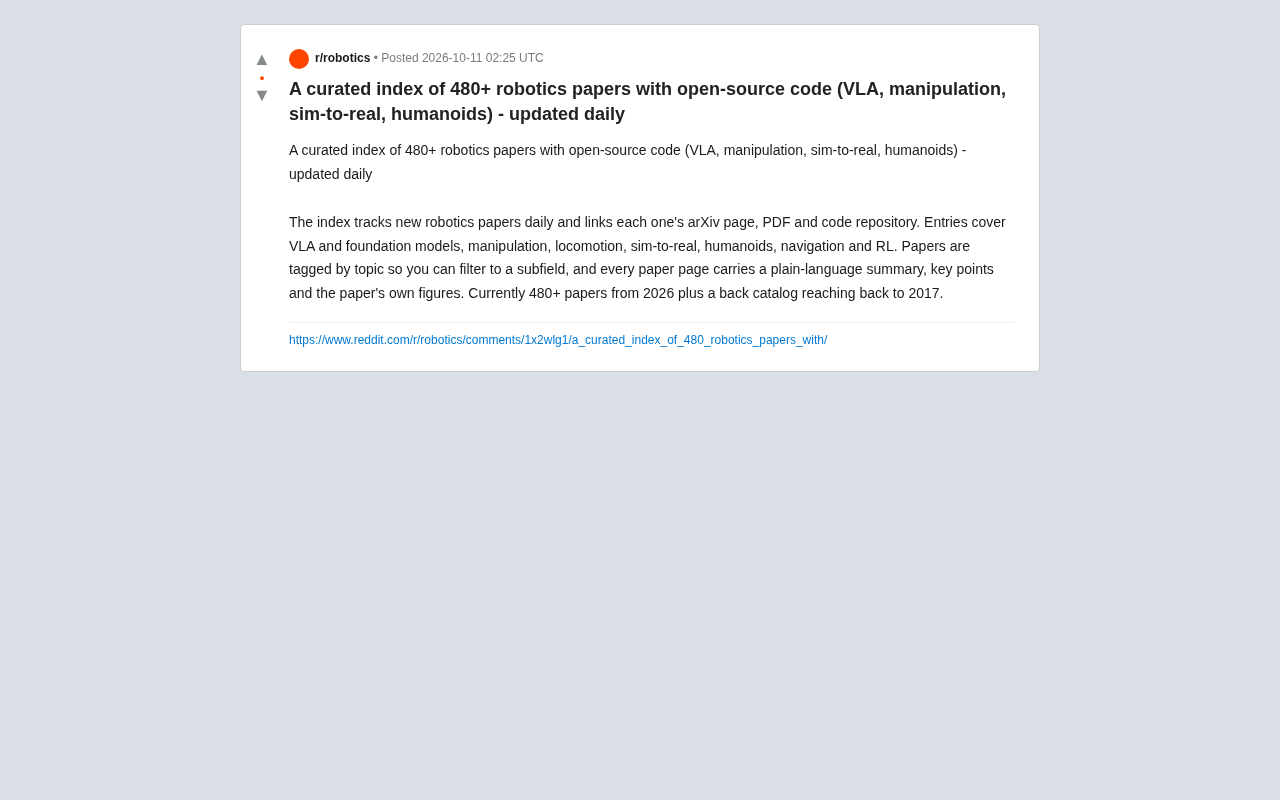
Robotics is in the midst of an explosion. Papers on VLA (Vision-Language-Action) models, robotic arm manipulation, humanoid robots, and more are dropping every single day. But for researchers and engineers, the real pain point often isn't finding papers — it's finding code that actually runs. An open-source project circulating on Reddit targets exactly this problem: it maintains a curated index of over 480 robotics papers, each paired with a runnable open-source code repository.
The index automatically tracks newly published robotics papers daily, linking each one to its arXiv page, full PDF, and corresponding code repository. In other words, it merges "reading papers" and "running code" — two things that are usually disconnected — into a single entry point.
Coverage: From VLA to Humanoid Robots
The index covers a remarkably broad scope, encompassing virtually all the major hot topics in current robotics research:
- VLA & Foundation Models: Vision-Language-Action models are among the most closely watched directions in recent years, aiming to give robots the ability to understand physical manipulation tasks the way large models understand text.
- Manipulation: Classic yet persistently challenging tasks like grasping, placing, and assembly.
- Locomotion: Gait and balance for mobile platforms including quadrupeds and bipeds.
- Sim-to-Real: Transferring policies trained in simulation to real-world deployment — one of the core bottlenecks for robotics in production.
- Humanoid Robots: The track attracting the most intense capital and industry investment right now.
- Navigation & Reinforcement Learning (RL): Foundational methods for mobile autonomy and policy learning.
Every paper is tagged by topic, so users can filter by sub-field and zero in on what they care about without scrolling through hundreds of entries.
VLA (Vision-Language-Action) models represent a new paradigm that extends the perception and reasoning capabilities of large language models / vision-language models into robot control. The core idea: use a pretrained visual encoder to process camera images, a language model to understand instruction semantics, and an action decoder to output control commands for a robotic arm or mobile platform. Representative works include Google's RT-2, OpenVLA, and π0. Compared to traditional end-to-end imitation learning, VLA models offer stronger generalization and can theoretically handle novel compositional tasks via natural language instructions — but high inference latency, demanding data diversity requirements, and challenges deploying on real-time control systems and low-cost hardware remain key obstacles. Sim-to-Real refers to the approach of training policies in physics simulators like MuJoCo or Isaac Sim and then transferring them to real robots. The "Reality Gap" — differences in contact dynamics, sensor noise, and actuator response between simulation and the physical world — is the central challenge, and domain randomization is currently the most widely used mitigation strategy.
Every Paper Gets a Plain-Language Summary
One practical design choice in this index: each paper page doesn't just pile up links. It also provides a plain-language summary, key takeaways, and figures from the paper itself.
For researchers outside a given sub-field, or students just getting started, these accessible summaries significantly lower the reading barrier — spend two or three minutes deciding whether a paper is worth a deep dive before opening the PDF and code. The "summary + figures + code" combination is essentially doing upfront information triage on behalf of the user.
Time Span and Update Frequency
The index currently includes 480+ papers from 2026, alongside a historical archive stretching back to 2017. This means it can keep pace with the latest developments while preserving the lineage of how the field has evolved — useful for literature reviews or tracing the origins of a particular technical direction.
"Daily updates" is what sets it apart from a one-time curated list. Robotics iterates at a furious pace, and a static Awesome List often goes stale within months. An automated daily tracking mechanism keeps the index fresh.
In the academic paper tracking space, "Awesome Lists" have long been a popular community-driven format on GitHub — manually maintained, periodically committed, with the advantage of human-curated quality and the downside of depending on a maintainer's time. The typical failure mode is a repository going months without updates and slowly losing relevance. By contrast, automated daily tracking via the arXiv API or Semantic Scholar API can ingest papers within hours of upload, at the cost of needing additional filtering and classification to control noise. The hybrid approach this index uses — automated tracking plus human-curated tags — attempts to balance timeliness and quality, a common evolutionary direction for academic search tools in recent years. Similar projects include the Papers With Code daily paper leaderboard.
Value for Researchers and Engineers
The value of tools like this isn't in creating new knowledge — it's in reducing the friction of accessing existing knowledge. For different audiences:
- Researchers can quickly benchmark against SOTA work and confirm whether reproducible baseline code exists.
- Engineers can go straight to the code repository and assess the engineering maturity of a given approach.
- Students and newcomers can use the plain-language summaries and topic tags to build an overall map of the robotics research landscape.
One important caveat: this is a community-driven curation project, and the paper selection criteria, code quality, and long-term maintenance all require users to exercise their own judgment. Having a code link doesn't mean the code runs out of the box or that results are fully reproducible — a persistent reality in robotics research. But as a searchable entry point with code links, topic-based filtering, and daily updates, it offers a genuinely efficient starting point for tracking a rapidly evolving field.
Related articles

A Single Prompt Triggers a Global PHP Security Storm: Is AI a Savior or a Hidden Risk?
A single AI prompt triggered a global PHP security crisis affecting Wikipedia and the Internet Archive. This article reviews the incident, analyzes the OpenAI-Amazon controversy, and explores the security paradox of lowered vulnerability discovery barriers in the AI era and developer response strategies.

When AI Is Taken Away: How Reliance on Shortcuts Undermines Your Problem-Solving Resilience
A study of 1,222 people found that after using AI to answer questions, once AI was removed, people gave up on more problems than a control group that never used AI. The article analyzes the impact of AI reliance on learning resilience and metacognition, and explores design implications for AI learning tools.

Carta and NewView Partner to Let Startup Employees Cash Out Equity Early
Carta and NewView Capital partner to simplify startup tender offers, helping employees sell equity early. Analysis of the mechanism, liquidity pain points, and impact.