5 Real Cases of Ordinary People Making Money with AI: A Replicable Path to $2,000+/Month

5 real-world cases showing how ordinary people earn $2,000+/month using AI tools.
Through 5 real cases, this article explores how ordinary people in 2025 are monetizing AI: social media writing, B2B writing services, AI-assisted design freelancing, no-code AI agent development, and leveraging policy tailwinds. The core principle is human-AI collaboration — AI drives efficiency while humans provide differentiation, emotional connection, and professional judgment.
The Personal Opportunity in the AI Era: How Can Ordinary People Make Money with AI?
By 2025, AI tools have become far more widespread than most people realize. A notable trend has emerged: a growing number of people without technical backgrounds are using AI tools to significantly boost their income.
This article examines 5 representative real-world cases, analyzes the replicable logic behind each, and helps you find an AI monetization path that fits your situation.
Case 1: AI-Assisted Content Creation — An Admin Worker Earning $2,000+/Month
Li Ting from Hangzhou was originally a company administrator earning around 7,000–8,000 RMB per month. Her transition was remarkably straightforward: she used AI writing tools to help run her Xiaohongshu (Little Red Book) accounts.
Her approach: let AI quickly generate content frameworks and first drafts, while she focused on injecting real experiences, personal feelings, and emotional warmth. This "AI drafts, human adds soul" collaboration model boosted her content output efficiency by more than tenfold.
Technical Background: How AI Writing Tools Work
The AI writing tools Li Ting uses are powered by Large Language Models (LLMs) — think GPT-4, Claude, and ERNIE Bot. These models are pre-trained on massive text datasets, learning statistical patterns and semantic relationships in language. They can generate coherent, logical article frameworks and drafts based on prompts. For everyday users, mastering Prompt Engineering — knowing how to give AI clear, specific instructions — is the key skill for improving AI writing quality. For example, specifying the target audience, emotional tone, word count, and key information points typically yields higher-quality drafts that require far less editing.

Within just three months, she was running three accounts simultaneously and had secured promotional partnerships with multiple domestic brands, with monthly income easily surpassing 20,000 RMB.
Key Takeaway: The secret to AI content creation isn't total reliance on AI — it's finding the optimal human-AI division of labor. AI handles efficiency; humans handle differentiation and emotional connection.
Case 2: Laid Off at 35, Pivoting to AI Writing — A Comeback Story Earning $3,000+/Month
"Auntie Li," 35 years old, was a senior administrative manager at a traditional company before being laid off in a round of cuts. Facing the pressure of aging parents, young children, a mortgage, and a car loan, she sent out dozens of resumes with almost no responses.
The turning point came when she started exploring AI writing. Her monetization channels are remarkably diverse:
- Writing articles for WeChat public accounts
- Writing promotional copy for businesses
- Writing application essays for students studying abroad
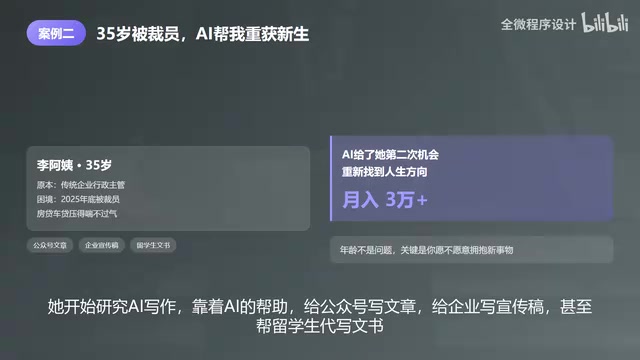
Her monthly income has now stabilized at around 30,000 RMB. This case shows that the commercial value of AI writing extends well beyond social media — B2B services (corporate copy, professional documents) are equally high-value, with relatively less competition.
Industry Background: The Market Opportunity in B2B AI Writing Services
B2B writing services command higher willingness to pay because of the scarcity and professional premium of business content. Corporate promotional materials, white papers, and overseas application essays demand far greater linguistic precision and domain expertise than typical social media content — and clients pay accordingly. AI tools shine in this context by helping writers rapidly organize research, build structure, and generate first drafts, while the writer applies their understanding of industry terminology, client needs, and genre conventions to refine the output. This division of labor allows an experienced writer to take on more projects simultaneously, enabling non-linear income growth.
Key Takeaway: Age and industry background aren't barriers. The key is combining AI tools with your existing professional experience and writing skills to find clients with strong willingness to pay.
Case 3: AI-Assisted Design Freelancing — Doubling Income as a Freelancer
Xiao Zhang, a graphic designer who left an advertising agency, chose the path of AI-assisted design combined with freelance work.
The efficiency gains were immediately visible: what used to require an all-nighter to produce one concept now yields over a dozen design options in half a day for clients to choose from. More options mean higher client satisfaction — and stronger negotiating power.
Technical Background: How AI Design Tools Are Reshaping Creative Workflows
AI design tools are primarily powered by Diffusion Models — products like Midjourney, Stable Diffusion, Adobe Firefly, and China's Jimeng AI. These models learn the relationships between billions of images and their text descriptions, enabling them to generate high-quality visuals from text prompts (Text-to-Image). For designers, the core value of AI tools is compressing the "concept exploration" phase from hours to minutes — what once required hours of hand-sketching or software tweaking can now be achieved with descriptive prompts. A designer's professional value consequently shifts from "execution" to "judgment": selecting concepts, refining details, and communicating aesthetic preferences with clients — tasks that rely on human aesthetic experience and communication skills — actually become more important, not less.
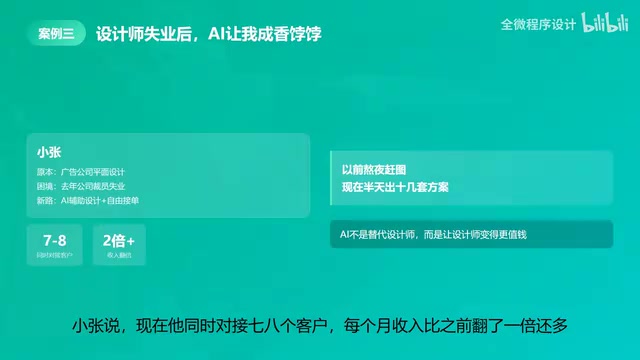
She now manages seven or eight clients simultaneously, with monthly income exceeding her previous agency salary.
Key Takeaway: For designers, AI isn't a replacement — it's an efficiency multiplier. A designer who masters AI tools can handle the workload that previously required an entire team.
Case 4: Building AI Agents — No Coding Required
Many people assume AI development is exclusively for programmers. The reality is quite different. Take Baidu's ERNIE Bot Agent platform as an example: it has attracted 150,000 businesses and 800,000 developers, a large proportion of whom are individual developers and even college students.
Technical Background: What Are AI Agents, and Why Can Non-Developers Build Them?
An AI Agent is an autonomous task-execution system built on top of large language models. It can understand user intent, call external tools (such as search engines, databases, and third-party APIs), and complete multi-step tasks — not just answer single questions. Unlike traditional software development, the "logic layer" of an AI agent is handled by the language model itself, so developers don't need to write complex conditional code. No-code/low-code platforms like Baidu's ERNIE Bot Agent and ByteDance's Coze provide visual configuration interfaces, allowing non-technical users to build custom agents by uploading knowledge base documents, designing conversation flows, and configuring tool integrations. This means an ordinary person with deep expertise in a niche domain — a seasoned chef, a travel enthusiast, an HR professional — can "package" their knowledge into an agent and deliver it as a scalable knowledge product.
The range of agent types is enormous:
- Food recommendation agents
- Travel planning agents
- Workplace Q&A agents
- Specialized assistants for vertical industries
Monetization options include enterprise licensing, ad revenue, and paid subscriptions. The real barrier isn't coding ability — it's whether you can identify a genuine use case and build an AI agent to address it.
Case 5: Riding the Policy Tailwind in AI Applications
In March 2025, China's Cyberspace Administration publicly announced the "2025 China Positive Energy Online Communication AI Excellence Cases" — a clear signal that policy is actively supporting AI application deployment.

Industry Background: China's AI Policy Support Landscape
Since 2023, China's policy support for AI has been steadily intensifying. From the national-level "Interim Measures for the Management of Generative AI Services" to local government AI industry subsidies, the policy framework is evolving along two parallel tracks: regulatory management and active promotion. For ordinary entrepreneurs and individual developers, the practical benefits of policy support include: platform traffic boosts and content recommendation weighting, government procurement projects opening up to small AI applications, startup incubation funds and subsidy application channels, and content partnership opportunities released by state media and institutions. Paying attention to officially recognized case directions often allows you to anticipate which AI application scenarios have policy backing — and to position yourself before the competitive landscape matures.
For ordinary people, policy support translates into more platform subsidies, lower barriers to entry, and more partnership opportunities. Staying attuned to policy trends and positioning yourself in supported directions often yields outsized results.
What Do These AI Monetization Cases Have in Common?
Looking across all five cases, several shared characteristics emerge:
Human-AI Collaboration, Not Total Dependence on AI
Not a single successful case involves "handing everything over to AI
Related articles
 Tutorials
ChatGPT Plus Subscription Guide: Are GPT-5.5, image-2, and Codex Worth the Upgrade?
A detailed look at ChatGPT Plus features — GPT-5.5, image-2, and Codex — with a Plus vs Pro comparison and a complete step-by-step subscription guide for users outside the US.
 Tutorials
Harness AI Engineering in Practice: Using Claude Code to Master Enterprise-Level E-Commerce Development
Deep dive into Harness AI Engineering: master enterprise e-commerce development with Claude Code using the Rules, Skills, Wiki, and Changes framework.
 Tutorials
Cursor + Codex Dual-IDE Collaboration: A Practical Methodology for Open-Source Project Customization
A complete methodology for open-source project customization based on real-world experience, detailing the Cursor+Codex dual-IDE workflow, seven-stage process, MVP validation, and AI source code reading techniques.