500K Facial Scans at UK Stations, Zero Arrests: Is Live Facial Recognition Worth It?

UK train station facial recognition scanned 500K faces, made zero arrests — raising serious questions about public surveillance ROI.
UK police deployed live facial recognition at London train stations, scanning roughly 500,000 faces with zero arrests and a single false positive. The results expose core problems with mass public biometric surveillance: the base rate fallacy makes most alerts false alarms when targets are rare; facial data as an immutable biometric raises irreversible privacy risks; and the institutional costs of deployment far outweigh a zero-result outcome. The gap between lab performance and real-world utility in target-sparse environments demands that surveillance technology be judged by actual outcomes, privacy trade-offs, and social trust — not specs alone.
UK police deployed Live Facial Recognition (LFR) trials across multiple London train stations — and the results are raising serious questions. After scanning roughly 500,000 faces, the system produced zero arrests and just one false positive. These numbers quickly ignited debate in the tech community, thrusting the justification and cost of mass biometric surveillance in public spaces back into the spotlight.
What the Trial Data Actually Shows
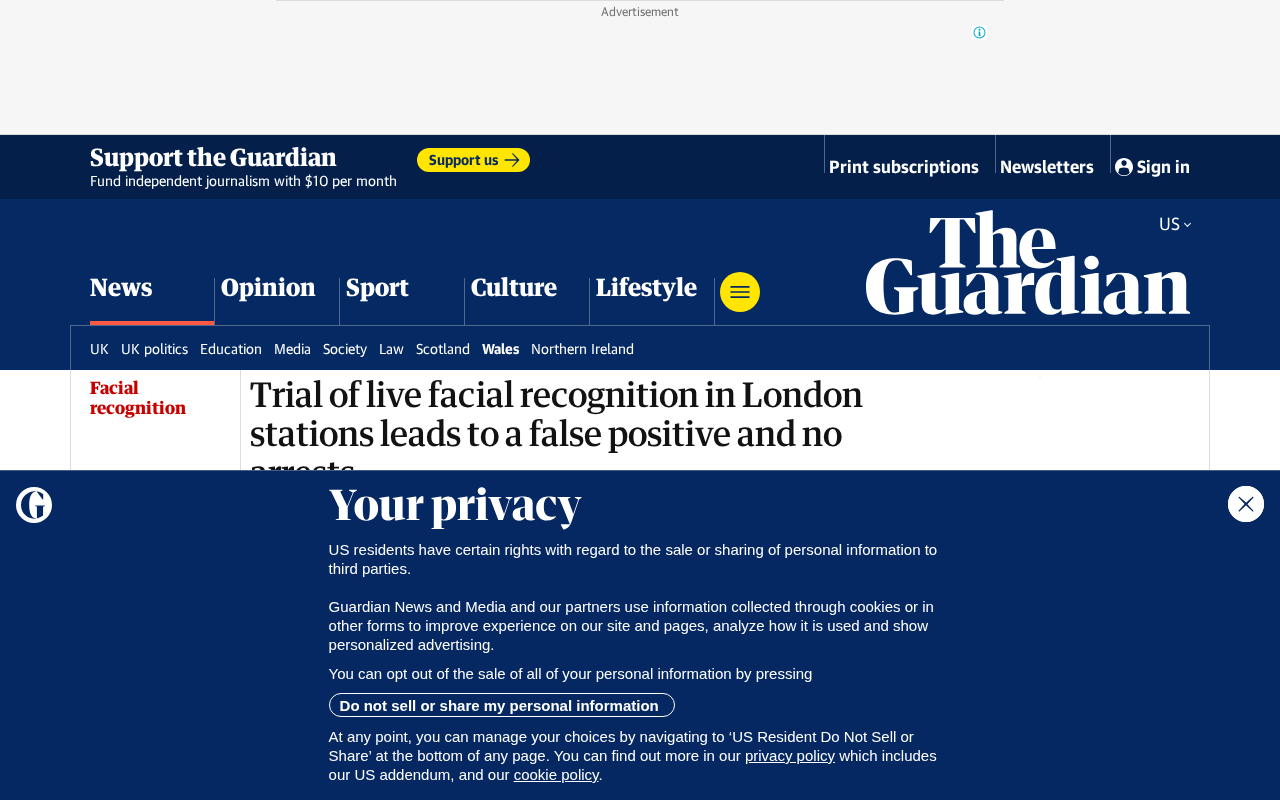
According to The Guardian, cameras at London train stations continuously compared passing faces against watchlists in real time, scanning approximately 500,000 faces in total. The outcome: zero arrests, one false positive.
On the surface, a single false positive out of 500,000 scans might seem to imply a remarkably low error rate. But the more important question is return on investment — a biometric dragnet of this scale, sweeping up hundreds of thousands of innocent commuters, ultimately yielded no actionable law enforcement result. When a surveillance technology comes up empty-handed despite an enormous sample size, its deployment rationale naturally comes under scrutiny.
This is precisely why the story scored 362 points on Hacker News and sparked over 230 comments: the tech community isn't fixating on a single data point, but on the trade-offs embedded in the underlying logic.
The Statistical Trap Behind False Positive Rates
Proponents of live facial recognition often tout its "extremely low false positive rate" as a selling point — but there's a statistical pitfall that's easy to overlook. When the scanning base reaches hundreds of thousands or more, even a tiny per-scan error probability can accumulate into a significant absolute number of false positives. And every false positive means an innocent person may be stopped, questioned, or briefly detained.
More critically, there's the base rate fallacy: among any general crowd, the proportion of actual wanted individuals is vanishingly small. When targets are this scarce, even a highly accurate system will produce alerts that are overwhelmingly false alarms. The 500,000-scan, zero-arrest result is a real-world confirmation that in practice, genuine matches are extraordinarily rare.
In other words, the question isn't just "will the system misidentify someone?" — it's "is it worth scanning everyone to catch a target that barely exists?"
The base rate fallacy has a classic quantitative illustration in the biometrics field: suppose a facial recognition system achieves 99.9% accuracy (one false positive per 1,000 comparisons), and among 1,000,000 people in a crowd, only 10 are genuine targets. The system correctly flags all 10 — but simultaneously raises false alarms on 0.1% of the remaining 999,990 innocent people, roughly 1,000 alerts. The final alert queue contains about 1,010 entries, of which approximately 99% are false positives. This mathematical phenomenon is sometimes called the "verification paradox": the more accurate the system and the sparser the targets, the less trustworthy each individual alert actually is. This is why a single false positive alongside 500,000 scans is insufficient to vouch for the system's effectiveness — in real-world scenarios where watchlists are short, officers still face enormous manual verification burdens for every alert the system generates.
The Privacy Boundary in Public Surveillance
The deeper issue this trial surfaces is whether citizens in public spaces should have their facial biometrics collected by default, indiscriminately, without cause. Unlike fingerprint or DNA collection — which require reasonable grounds — live facial recognition pulls every person who walks past a camera into the comparison process, regardless of whether they're suspected of anything.
Facial data is a biometric identifier that cannot be changed. You can reset a password; you cannot "swap out" your face. Once mass collection and comparison become routine, the potential for misuse, data retention risks, and the chilling effect on public behavior extend far beyond what any accuracy metric can measure.
Critics argue that normalizing mass surveillance without sufficient evidence of effectiveness amounts to trading everyone's privacy for security benefits that are difficult to quantify. The outcome of this trial provides a concrete, real-world footnote to that argument.
The UK's legal framework for live facial recognition remains unclear. In 2023, the UK Court of Appeal ruled in Bridges v. South Wales Police that the way South Wales Police deployed facial recognition violated the Data Protection Act and Article 8 of the European Convention on Human Rights (the right to privacy), citing insufficient specific legal authority and inadequate data protection impact assessments. This case established an important principle: technical feasibility alone does not constitute sufficient justification for lawful deployment — public bodies must be able to demonstrate legitimate purpose and proportionate means. Unlike the EU's AI Act, which explicitly prohibits most real-time public biometric identification scenarios, post-Brexit Britain is charting its own regulatory path and remains in a policy vacuum — which is the institutional backdrop that allowed the London station trials to proceed without unified regulatory footing.
Accounting for the Full Cost Beyond Technology
Evaluating systems like this requires looking beyond technical specifications to include social and institutional costs. Deploying facial recognition hardware, maintaining databases, and handling the manual investigation and appeals triggered by false positives all consume real resources. When that investment yields zero arrests, the efficiency of public resource allocation becomes a legitimate concern.
For AI practitioners and policymakers, this data is a valuable warning: a technology's performance in a controlled lab setting can diverge enormously from its real-world utility in a complex, messy public environment where targets are sparse. The fact that technology can do something does not mean it should be done — or that it's worth doing.
Conclusion
500,000 scans. Zero arrests. One false positive. These numbers alone constitute a candid report card on the cost-effectiveness of live facial recognition. They remind us that in embracing AI surveillance capabilities, we must weigh deployment decisions against real-world outcomes, privacy costs, and social trust — not just accuracy benchmarks. The data doesn't lie, and this time, the data poses a question that large-scale public facial recognition cannot easily dodge.
Related articles

iPhone Duo Battery Life Tested: One Charge a Day Is Unavoidable, and the Large Screen Is the Culprit
iPhone Duo battery test: heavy use needs at least one charge a day, and about 30% remains after 6.5 hours of screen-on time. How often the large screen is unfolded is key; a MagSafe battery pack helps, and long-term degradation is also worth watching.

Kimi K3.1 Pro Open-Sourced: 2.8 Trillion Parameters Close In on Opus
Moonshot releases the open-source MoE model Kimi K3.1 Pro, with 2.8T total parameters and 104B activated, trailing Opus 5.5 by under 1 point on Terminal Bench 4.0.

Costco Tech Price Guessing: Are Monitors, Keyboards, Mice, and Bose Speakers Worth It?
A YouTube blogger guesses prices of Costco tech products: 2K 180Hz monitor, Logitech keyboard and mouse, Bose speaker, and CyberPower UPS, revealing warehouse-store selection and brand premium.