51.8K Stars! Claude Code Best Practices: A Complete Guide from Getting Started to Agent Engineering

Deep analysis of the 51.8K Star Claude Code best practices project on GitHub
A Claude Code best practices open-source project on GitHub has earned 51.8K Stars, systematically covering a complete guide from beginner to advanced usage. The project is structured in three tiers: the beginner stage covers Prompt Engineering, context management, and code review; the intermediate stage focuses on efficient Web development practices; and the advanced stage explores frontier Agent engineering topics including multi-Agent collaboration, tool calling integration, and autonomous decision-making. Its core value lies in systematizing scattered community experiences, helping developers evolve from merely using AI programming tools to using them well.
As AI programming tools become increasingly prevalent, knowing how to use them efficiently has become a core competitive advantage for developers. Recently, an open-source project on GitHub covering Claude Code best practices went viral—skyrocketing to 51.8K Stars with a systematic guide spanning from beginner to advanced practices. This article provides an in-depth analysis of the project's core value, helping you quickly master the right way to use Claude Code.
Project Overview: Why Did It Earn 51.8K Stars?
Claude Code is an AI programming assistant from Anthropic that has become a daily tool for many developers thanks to its powerful code comprehension and generation capabilities. Unlike traditional IDE plugin-based AI assistants (such as GitHub Copilot), Claude Code runs directly in the command-line terminal, capable of perceiving the entire project's file structure, reading and writing files, and executing shell commands. It's essentially closer to an AI Agent with coding capabilities rather than a simple code completion tool. Anthropic was founded in 2021 by former OpenAI Research VP Dario Amodei and others, with "AI safety" as its core philosophy. The Claude model series excels particularly in code reasoning and long-context processing, which forms the technical foundation for Claude Code's powerful capabilities.
However, many users only scratch the surface with basic "Q&A-style" usage, far from unlocking its true potential.
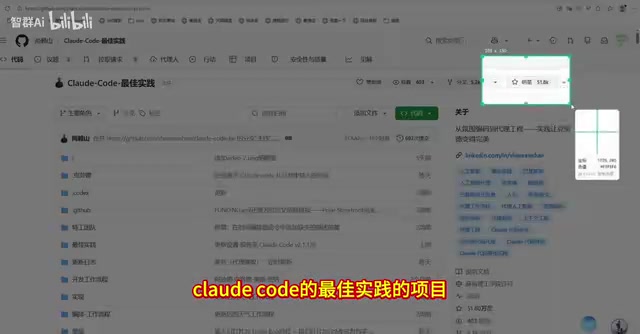
The reason this best practices project has garnered such high attention boils down to filling an important gap—official documentation tells you "what it can do," while this project tells you "how to do it best." It's not a simple feature listing but a methodology summary validated through extensive real-world practice, covering the complete chain from basic operations to complex engineering.
From Beginner to Advanced: A Systematic Learning Path
One of the project's biggest highlights is its clear layered structure, providing a progressive learning path for developers at different skill levels.
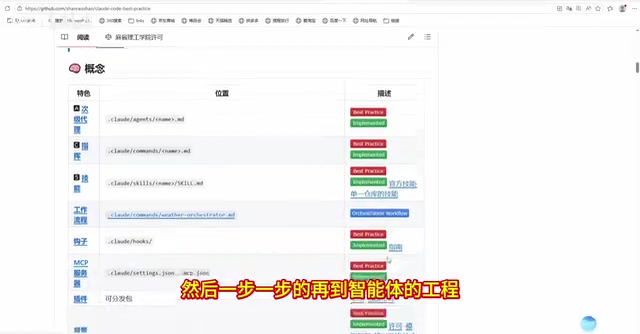
Beginner Stage: Building Correct Usage Habits
For developers new to Claude Code, the project provides fundamental yet crucial practice guidelines:
-
Prompt Engineering Basics: How to write clear, specific instructions so Claude Code accurately understands your intent. The core principle of Prompt Engineering lies in the fact that large language models generate text based on conditional probability—input quality directly determines output quality. In the context of Claude Code, this includes not only natural language instruction optimization but also system prompt configuration and writing CLAUDE.md project specification files. For example, a vague instruction like "help me write a login feature" versus a specific one like "implement GitHub OAuth login using Next.js App Router and NextAuth.js, including session management and error handling" will produce vastly different code quality. Mastering the basic principles of Prompt Engineering is the prerequisite for efficiently using any AI tool.
-
Context Management: Properly organizing conversation context to avoid output quality degradation caused by information overload. This is crucial because of the "Context Window" mechanism in large language models. The context window refers to the maximum number of tokens the model can process in a single interaction—tokens are the basic units the model uses to process text, with one English word typically corresponding to 1-2 tokens, and one Chinese character approximately 1.5-2 tokens. Although Claude's context window reaches 200K tokens, it can still hit limits when processing large codebases. More critically, when context becomes too long, models exhibit a "Lost in the Middle" phenomenon—decreased attention to information in the middle portions of input. Therefore, properly trimming and organizing context information is a key technique for maintaining high-quality output from Claude Code.
-
Code Review Habits: Establishing a review process for AI-generated code to ensure code quality and security. While AI-generated code is usually syntactically and logically correct, it may contain security vulnerabilities (such as SQL injection, XSS attacks), performance issues (such as unnecessary nested loops), or violations of team coding standards. Developing a "trust but verify" habit is essential.
These seemingly basic elements actually determine the upper limit of your subsequent usage efficiency. Many developers form bad habits early on that are difficult to correct later.
Intermediate Stage: Efficient Web Coding Practices
At the intermediate stage, the project focuses on Claude Code best practices in web development scenarios.
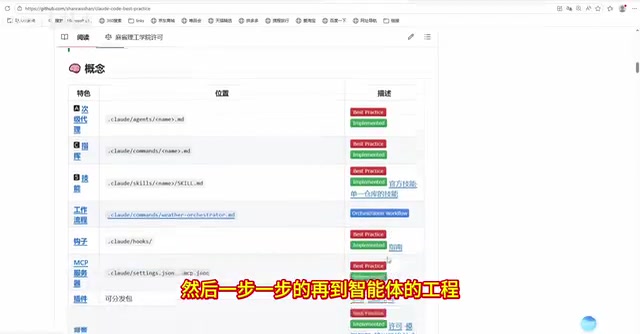
In the Web Coding domain, Claude Code's application scenarios are extremely rich: frontend component development, API design and implementation, database schema design, test case writing, and more. The project provides specific operational paradigms and considerations for each scenario:
- How to help Claude Code understand your project architecture and generate code that conforms to standards. This typically involves maintaining a CLAUDE.md file in the project root directory containing tech stack descriptions, directory structure conventions, coding standards, naming rules, and other key information, allowing Claude Code to automatically load project context at each startup.
- Step-by-step decomposition strategies for complex business logic. When facing complex requirements, breaking large tasks into multiple small steps and feeding them to Claude Code one by one produces far better results than throwing the entire requirement at once. This aligns with the classic "divide and conquer" philosophy in software engineering.
- Context organization techniques for multi-file collaborative modifications. When a feature involves coordinated changes across multiple files, you need to carefully organize the context provided to Claude Code, ensuring it understands inter-file dependencies and data flow.
These practical experiences come from real feedback from a large number of community developers and offer high reference value.
Advanced Applications: Frontier Exploration in Agent Engineering
The most exciting part of the project covers advanced practices in Agent Engineering.
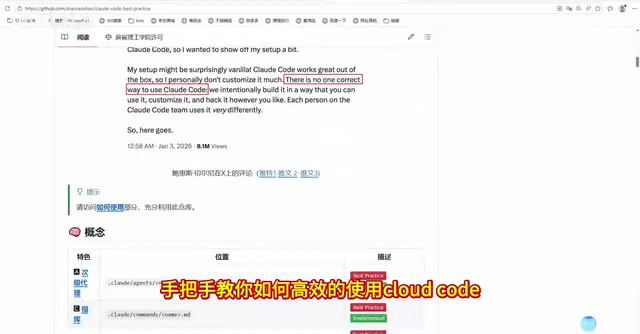
AI Agents are one of the hottest technical paradigms in the current AI field. The core idea is enabling large language models to not just generate text, but to perceive environments, formulate plans, invoke tools, and execute actions. Unlike traditional single-turn "human asks—AI answers" interactions, Agents possess autonomous loop capabilities: Observe → Think → Act → Observe results → Continue thinking. In the context of Claude Code, this means it can autonomously analyze codebase structure, identify bug root causes, formulate fix plans, modify multiple files, run test validations, and iteratively fix based on test results—all with minimal human intervention.
With the rise of the AI Agent concept, Claude Code is no longer just a code generation tool but can serve as a core component of agent systems participating in more complex engineering practices. This section of the project explores the following key topics:
-
Multi-Agent Collaboration Patterns: How to design architectures where multiple Claude Code instances work together. This draws from distributed systems and microservices architecture design principles. Common patterns include the Orchestrator-Worker pattern (one primary Agent handles task decomposition and scheduling while multiple sub-Agents handle specific execution) and the Pipeline pattern (multiple Agents process different stages of a task sequentially, such as one for code generation, one for code review, and one for test writing). Claude Code natively supports launching multiple instances via subprocesses, communicating through the file system or standard input/output. This architecture can significantly improve efficiency and reduce context pressure on individual Agents when handling large-scale refactoring, cross-module feature development, and other complex scenarios.
-
Tool Calling and Integration: Deeply integrating Claude Code with external toolchains (such as databases, APIs, file systems). Tool Use (Function Calling) is one of the core capabilities of modern large language models and the technical foundation for Agents to "act." It works like this: when the model identifies the need for external information or operations during reasoning, it generates structured tool call requests. The system executes the tool and returns results to the model, which then continues reasoning based on those results. Claude Code has a rich built-in toolset including file read/write, shell command execution, and code search. Developers can also extend custom tools through MCP (Model Context Protocol) to deeply integrate Claude Code with database queries, CI/CD pipelines, project management systems, and other external services, building highly customized AI development workflows.
-
Autonomous Decision-Making Processes: Building AI workflows with a degree of autonomous judgment capability. This involves setting clear decision boundaries and behavioral guidelines for Agents, allowing them to autonomously complete tasks within predefined safety parameters while proactively seeking human confirmation when encountering uncertain situations.
-
Error Handling and Rollback Mechanisms: Establishing robust fault tolerance in Agent engineering. Since AI output is probabilistic and uncertain, Agents may produce erroneous operations during execution. Therefore, designing comprehensive error detection, logging, and state rollback mechanisms is crucial—this parallels transaction management and exception handling in traditional software engineering.
This section represents the frontier of AI-assisted development and is particularly worth deep study for technical leaders looking to introduce AI engineering practices into their teams.
Practical Recommendations: How to Make the Most of This Project
Given such rich content, developers are advised to adopt the following strategies to maximize learning effectiveness:
- Learn on demand: You don't need to read from start to finish—choose the chapter corresponding to your current usage stage
- Learn by doing: Immediately try applying each technique in a real project after learning it. Cognitive science research shows that "Learning by Doing" has far higher knowledge retention rates than passive reading
- Engage with the community: The project's Issues and Discussions sections contain numerous valuable conversations worth following. The power of open-source communities lies in the rapid iteration of collective wisdom, and cutting-edge usage patterns often first appear in community discussions
- Stay updated: Claude Code itself is rapidly iterating, and the project content is continuously updated—periodic review is recommended. The AI programming tools landscape changes extremely fast, and best practices from a few months ago may already be superseded by better approaches
Conclusion
This 51.8K Star Claude Code best practices project is essentially a crystallization of collective community wisdom. It systematizes scattered usage experiences and standardizes individual exploration processes, dramatically reducing the learning curve for developers. Whether you're a newcomer just starting with AI programming tools or a seasoned developer looking to deeply explore Agent engineering, you can gain substantive help from it.
In today's increasingly competitive AI programming tools landscape, the gap between using a tool and using it well might just be one best practices project away. As GitHub Copilot, Cursor, Windsurf, and other tools enter the arena, what developers truly need to build is not dependency on any single tool, but a systematic methodology for collaborating with AI—and that is precisely the core value this project delivers.
Related articles
 Tutorials
ChatGPT Plus Subscription Guide: Are GPT-5.5, image-2, and Codex Worth the Upgrade?
A detailed look at ChatGPT Plus features — GPT-5.5, image-2, and Codex — with a Plus vs Pro comparison and a complete step-by-step subscription guide for users outside the US.
 Tutorials
Harness AI Engineering in Practice: Using Claude Code to Master Enterprise-Level E-Commerce Development
Deep dive into Harness AI Engineering: master enterprise e-commerce development with Claude Code using the Rules, Skills, Wiki, and Changes framework.
 Tutorials
Cursor + Codex Dual-IDE Collaboration: A Practical Methodology for Open-Source Project Customization
A complete methodology for open-source project customization based on real-world experience, detailing the Cursor+Codex dual-IDE workflow, seven-stage process, MVP validation, and AI source code reading techniques.