512GB DDR5 RAM at Just 16W: What It Could Mean for Local AI Models

512GB DDR5 at 16W sparks debate on local AI potential, but price keeps it out of consumer reach.
A screenshot of 512GB DDR5 RAM drawing just 16 watts sparked widespread discussion on Reddit, reflecting genuine demand among AI enthusiasts for high-capacity, low-power memory. Running large language models locally hinges on RAM capacity — even quantized, models with tens of billions of parameters need dozens to hundreds of gigabytes, making large system RAM a practical path for users without professional GPUs. While the low power draw makes always-on local AI inference servers more theoretically viable, these modules target server markets and are incompatible with consumer platforms. Industry history shows server specs take years to reach consumers, keeping the "1TB build with ease" vision firmly in the realm of wishful thinking for now.
One Stick of RAM Sparks a Conversation
A screenshot showing 512GB of DDR5 RAM drawing just 16 watts of power has been making waves on Reddit. The original poster's reaction was relatable: specs like these are jaw-dropping, but the price tag still puts them firmly out of reach for most everyday users.
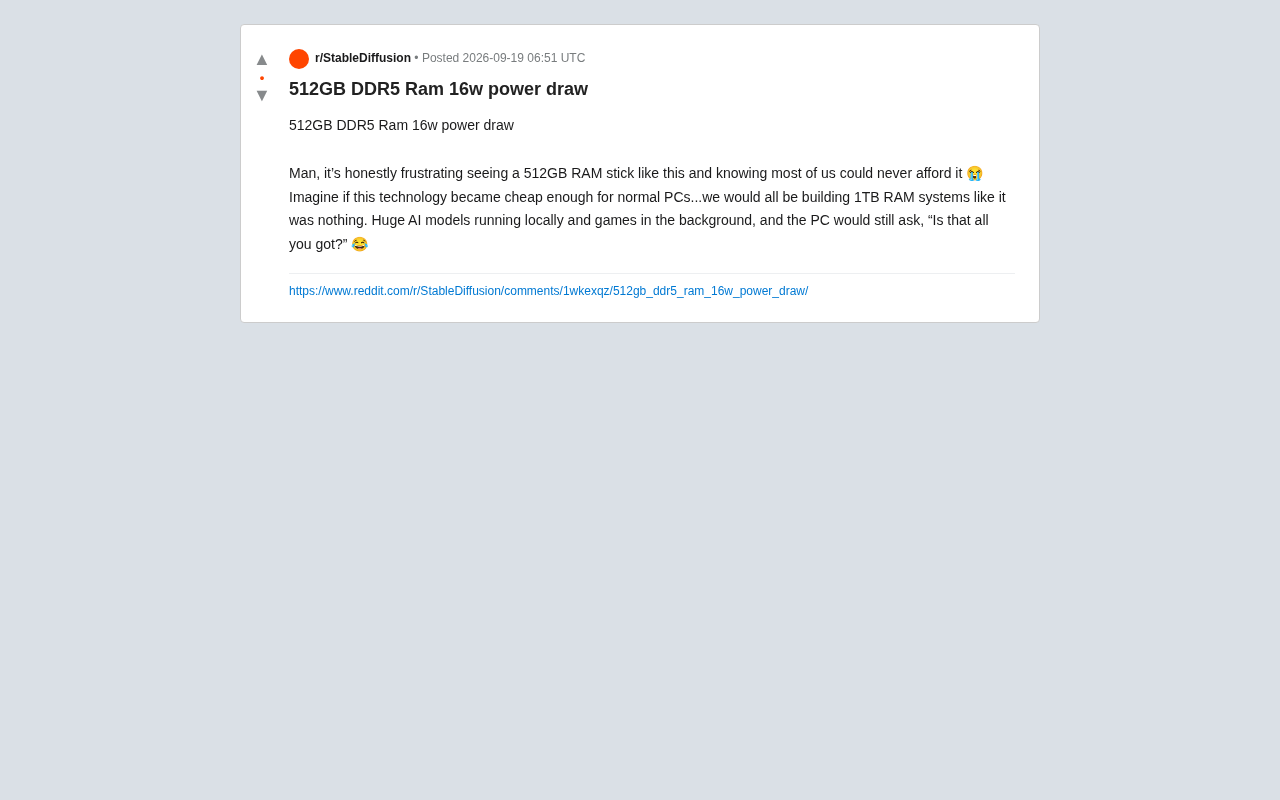
The half-joking scenario floated in the thread struck a chord — if this kind of hardware ever got cheap enough to land in a regular PC, people would casually throw together 1TB memory builds the same way they spec out any other build today, running massive AI models locally while a game idles in the background, and still feel like it wasn't enough. The hyperbole points to something real: a genuine desire for high-capacity, low-power memory that users can actually afford.
Why High-Capacity RAM Matters So Much for AI
One of the core bottlenecks in running large language models locally is memory capacity. Model weights need to be loaded into RAM (or VRAM), and the more parameters a model has — and the higher the numerical precision — the more space it demands. Even after quantization, a model with tens of billions of parameters can easily consume dozens or even hundreds of gigabytes.
For users without a professional-grade GPU, loading a model into system RAM and running inference on the CPU is a practical alternative. It's slower than GPU inference, but the capacity advantage is significant — 512GB of RAM can accommodate model sizes that far exceed what any consumer graphics card's VRAM can hold. That's the technical logic behind the post's vision of "running massive AI models locally."
Quantization is the dominant technique that makes large models viable on consumer hardware. By reducing the numerical precision of model weights — for example, compressing from 32-bit floating point (FP32) down to 8-bit integer (INT8) or even 4-bit (INT4) — it dramatically cuts memory usage and compute requirements, at the cost of a minor accuracy trade-off. A 70-billion-parameter model, for instance, requires roughly 140GB at FP16 precision but can be compressed to around 35GB with 4-bit quantization, bringing it within reach of consumer platforms. Tools like llama.cpp enable exactly this: CPU-based inference over system RAM, paired with aggressive quantization, so users can run impressively large local models without a dedicated professional GPU. This is why the upper limit of your system RAM directly determines how large a model you can run without sacrificing even more precision.
What 16W of Power Draw Actually Means
The other headline stat in that screenshot is the power consumption — just 16 watts for 512GB of capacity. For workloads that require a machine to run continuously, such as persistent local inference tasks, power draw directly affects electricity costs and thermal management.
A low-power, high-capacity combination theoretically makes something like a "24/7 local AI server at home" more feasible. But it's worth staying grounded: memory modules at this density and spec tier are built for servers and data centers, and their pricing, connector standards, and motherboard compatibility have nothing in common with consumer platforms. The power figure is attractive, but the use case it serves is fundamentally different from a desktop PC.
DDR5 offers a meaningful efficiency improvement over DDR4, dropping the standard operating voltage from 1.2V to 1.1V, which reduces power consumption at equivalent capacities. In the server space, RDIMM (Registered DIMM) and LRDIMM (Load-Reduced DIMM) formats achieve very high per-stick capacities — 128GB or even 256GB — by adding buffer chips to the module. But these require server motherboards with ECC and registered memory support, paired with processors like Intel Xeon or AMD EPYC. They are physically and electrically incompatible with consumer Z-series or X-series motherboards. This is precisely what the compatibility problem looks like in practice — even with unlimited budget, a typical DIY builder cannot simply plug these modules into a home PC.
Price Is the Real Barrier
The emotional core of the original post is straightforward: the technology exists, but cost is what keeps it out of ordinary hands. Enterprise-grade high-capacity memory has long commanded steep prices, and modules at the 512GB mark often carry four-figure or higher USD price tags — well beyond any typical PC build budget.
Industry history suggests that memory capacity trickles down from servers to consumers along a predictable path: enterprise first, then consumer; expensive first, then affordable. The specs occupying data centers today may eventually reach high-end desktop platforms in a few years. But "effortlessly building a 1TB system" remains a punchline and a daydream for the foreseeable future.
The Real Demand Behind the Community Sentiment
The reason this post resonated wasn't the technical depth — it's that it precisely hit a pain point shared across the AI enthusiast community: wanting to run your own large model locally, but being priced out by hardware costs.
As open-source models multiply and local deployment tools mature, ordinary users are developing a genuine, tangible appetite for memory capacity. Discussions like this one also signal something broader: the decline of hardware costs will be one of the decisive variables determining whether local AI can truly go mainstream. When high-capacity RAM finally becomes accessible, local large model deployment may well see a real inflection point.
The ecosystem for running large models locally has matured considerably over the past two years. Tools like Ollama, llama.cpp, and LM Studio have dramatically lowered the barrier to entry — users can now run open-source models like Llama, Mistral, and Qwen on their own machines with just a handful of commands, with data never touching a cloud service. The demand for this kind of local data control doesn't come only from privacy-conscious users; it also comes from developers and researchers who want to use AI offline, or who want complete control over model behavior. This growing user base is exactly why RAM capacity — once a parameter only professionals tracked closely — is showing up more and more in everyday PC building conversations.
Related articles

Should U.S. College Fraternities Be Banned? A Researcher's Incisive Observations
Why not just ban U.S. college fraternities? A researcher finds the key resistance comes from decision-makers' own fraternity identities and schools' "willful ignorance."

Microsoft Discovery: Accelerating Scientific Discovery with AI Agents
Microsoft's Discovery platform runs specialized AI agents to help researchers screen and prioritize the most promising compounds and experimental paths, reducing experiments and accelerating scientific discovery.

Cambridge Heavy Industries Secretly Develops Desktop-Scale Nuclear Fusion Device
Cambridge Heavy Industries is secretly developing a desktop-scale laser-driven nuclear fusion device, targeting the equipment supply market for fusion power plants. This article analyzes its miniaturization technology path, commercialization logic, and unique positioning in the fusion startup wave.