6-Month AI Engineer Learning Roadmap: A Deep Review and Pitfall Guide

A critical review of a 6-month AI learning roadmap, exposing common pitfalls and offering practical advice.
A Reddit user's 6-month AI engineer learning roadmap sparks community debate. This analysis examines its structure—from Python and ML fundamentals to LLM engineering and production projects—while identifying key weaknesses: missing math foundations, overly broad scope, and insufficient hands-on project emphasis. Core advice: prioritize depth over breadth, start building immediately, and treat roadmaps as iterative guides rather than rigid plans.
A Viral AI Learning Roadmap That Sparked Heated Discussion
Recently, a Reddit user shared an AI learning roadmap they spent over 20 hours crafting, directly challenging the community: "Don't compliment me—critique it." The plan spans six months with a clear goal—not chasing every new framework, but "becoming an engineer who can actually build ML systems and be ready for AI/ML internships before recruiting season."
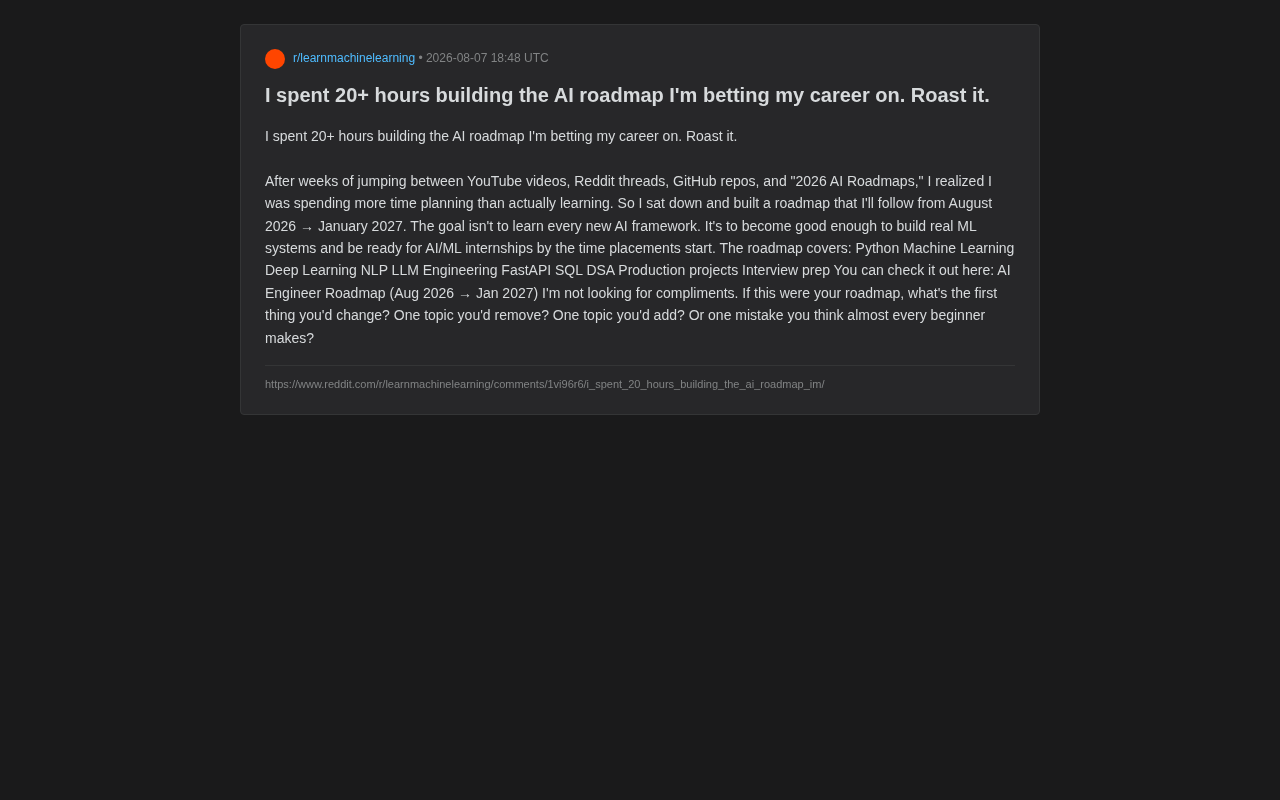
This roadmap is worth discussing not just because of its comprehensive content, but because it reflects a universal dilemma: In the age of information overload in AI learning, many people spend more time "planning what to learn" than actually learning. The author himself admitted that he kept bouncing between YouTube, Reddit, GitHub, and various AI roadmaps before realizing he'd fallen into "Analysis Paralysis."
This "analysis paralysis" is a classic concept in cognitive psychology—when faced with too many choices or too much information, decision-makers become unable to take action. This phenomenon is particularly pronounced in AI learning: GitHub has thousands of open-source projects, YouTube adds hundreds of new tutorials daily, and arXiv publishes over a hundred papers weekly. Learners repeatedly compare, filter, and plan across these resources without ever entering the actual execution phase. Psychological research shows that over-planning creates a false sense of "already making progress" in the brain, further delaying actual action.
Core Structure of the AI Learning Roadmap
This roadmap covers the following modules, essentially constituting the mainstream skill stack for today's AI engineers:
Foundation Layer
- Python: The starting point for everything and the lingua franca of AI engineering
- SQL: An indispensable skill for data processing
- DSA (Data Structures & Algorithms): Hard currency for interviews
Core Machine Learning Layer
- Machine Learning: Classical algorithms and model evaluation
- Deep Learning: Neural networks, CNNs, RNNs, etc.
- NLP: Natural language processing fundamentals
In the deep learning section, it's important to understand the positioning and evolution of several core architectures. CNN (Convolutional Neural Network) was first used by Yann LeCun in 1998 for handwritten digit recognition. Its core idea is extracting local features through convolutional kernels, then abstracting them layer by layer into high-level semantic representations, dominating visual tasks like image recognition and object detection for years. RNN (Recurrent Neural Network) was designed specifically for sequential data, passing information between time steps through hidden states, suitable for text, speech, and other temporal tasks—but suffers from the vanishing gradient problem, leading to improved architectures like LSTM and GRU. However, since Google proposed the Transformer architecture in 2017, traditional RNNs have been almost entirely replaced in NLP tasks, and Vision Transformers are also challenging CNN's dominance. Therefore, the deep learning focus in modern AI learning roadmaps has clearly shifted toward Transformers and attention mechanisms—which is why outdated roadmaps that still devote extensive coverage to LSTMs may need to be reconsidered for their relevance.
Engineering & Frontier Layer
- LLM Engineering: Building applications with large models
- FastAPI: Model serving and API deployment
- Production Projects: Real-world project delivery
- Interview Prep: Interview preparation
Among these, LLM Engineering (Large Language Model Engineering) is a rapidly emerging job direction since 2023, with significant differences from traditional ML engineering. Its core work isn't training models from scratch (which typically requires millions of dollars in compute), but building applications around existing foundation models (like GPT-4, Claude, LLaMA, etc.). The typical skill stack includes: Prompt Engineering, RAG (Retrieval-Augmented Generation—combining external knowledge bases with LLMs), Fine-tuning (adapting models on domain-specific data), Agent framework development (like LangChain, AutoGen), vector database usage (like Pinecone, Weaviate), and token cost optimization. This direction is characterized by a relatively low engineering barrier but extremely fast iteration—mainstream practices shift significantly every few months.
Structurally, this is a fairly "textbook" roadmap, progressing from language fundamentals to algorithms, then to deep learning and LLM engineering, and finally landing on projects and job search. Its logical chain is clear: Foundations → Modeling → Engineering → Job Search Closure.
What This AI Roadmap Gets Right
First, the author lists "Production Projects" as a separate module—a critical step that many beginners tend to overlook. What hiring managers truly care about isn't how many concepts you've studied, but whether you can deploy a model as a usable service. The inclusion of FastAPI confirms this—it's one of the most popular model deployment frameworks in the Python ecosystem today.
FastAPI was released by Sebastián Ramírez in 2018, built on Starlette (an async HTTP framework) and Pydantic (a data validation library). It rose rapidly in AI/ML engineering for several key reasons: native async support for efficiently handling model inference requests; auto-generated OpenAPI documentation for frontend-backend collaboration; and type-annotation-driven request validation that significantly reduces API bugs. In production environments, the typical deployment architecture is: trained models wrapped as RESTful APIs through FastAPI, containerized with Docker, and elastically scaled via Kubernetes. Compared to traditional frameworks like Flask, FastAPI delivers approximately 300% performance improvement in high-concurrency inference scenarios, making it the go-to tool for model serving.
Second, the roadmap emphasizes "good enough" rather than pursuing completeness. This pragmatic mindset is extremely valuable in AI learning. The AI field produces new frameworks and papers every week—trying to keep up with everything leads only to endless anxiety. Setting a clear endpoint (internship/recruitment), then reverse-engineering the required skills, is a more mature learning strategy.
Where the Community Would Most Likely "Open Fire"
Although the author actively invited criticism, from a more experienced perspective, this AI learning roadmap does have several debatable points.
1. The Learning Scope May Be Too Broad
Covering Python, ML, DL, NLP, LLM Engineering, FastAPI, SQL, DSA, production projects, and interview prep in six months essentially compresses an undergraduate CS degree plus graduate-level AI coursework into half a year. The biggest risk isn't failing to finish—it's learning everything too superficially. A wiser approach might be cutting some content and achieving real depth. For example, NLP and LLM Engineering have significant overlap and could be merged—traditional NLP techniques like tokenization, word embeddings, and sequence labeling have been drastically simplified in the LLM era. Focusing on how to leverage LLMs for NLP tasks is more time-efficient than re-learning the traditional pipeline from scratch.
2. The Absence of Mathematical Foundations
The roadmap shows virtually no traces of linear algebra, probability and statistics, or calculus. While "calling library functions" can get you models running quickly, when you're doing interview problems, debugging models, or understanding papers, gaps in mathematical knowledge are immediately exposed. This is perhaps the most common mistake among AI beginners—underestimating math and overestimating frameworks.
Specifically, ML mathematics rests on three pillars: linear algebra is the foundation for understanding neural network forward and backward propagation—deep learning is essentially chained combinations of large-scale matrix operations; probability and statistics are core to understanding Bayesian inference, loss function design, and model uncertainty quantification; calculus concepts like gradients and partial derivatives directly correspond to the model optimization process. For example, when a model behaves abnormally on the validation set, without understanding the statistical meaning of the bias-variance tradeoff, it's difficult to determine whether you're dealing with underfitting or overfitting. Similarly, common interview questions like "explain the mathematics behind Batch Normalization" or "derive the gradient of cross-entropy loss" require solid mathematical foundations. It's recommended to spend at least 4-6 weeks systematically studying 3Blue1Brown's linear algebra series and Stanford CS229's probability and statistics prerequisites.
3. Insufficient Emphasis on Learning by Doing
A common pitfall of many AI learning roadmaps is the "learn everything first, then build" approach. A more efficient path is to start projects as early as possible, letting projects force you to fill knowledge gaps. Rather than spending two months systematically completing deep learning before starting a project, start a small project in the first month and go back to fill gaps as you encounter unknowns. The "situated learning" theory in cognitive science supports this: knowledge acquired within specific problem contexts transfers far more effectively than abstract learning followed by application.
4. DSA Positioning Needs Balancing
DSA is indeed important for passing big tech algorithm interviews, but for AI/ML roles, its weight varies by company. If the target is an ML engineering role, perhaps more effort should go toward ML system design and projects rather than pure LeetCode grinding.
ML System Design is an interview component with steadily increasing weight at major tech companies, fundamentally different from traditional software system design interviews. It evaluates: how to convert a vague business problem into a modelable ML problem (problem framing), how to design feature engineering pipelines, how to choose evaluation metrics (offline vs. online metrics), how to handle data drift and model decay, and how to design A/B tests to validate model performance. Typical questions like "design a recommendation system" or "design a content moderation system" require candidates to complete the full process from problem definition to architecture design in 45-60 minutes. These interviews reflect an engineer's comprehensive ability to apply ML knowledge in real production environments—far more differentiating than pure LeetCode grinding. For AI/ML positions, it's recommended to limit DSA practice to under 1 hour per day and invest the saved time in learning ML system design.
Core Takeaways for All AI Learners
This roadmap and the discussion it sparked reveal several core principles in AI learning:
First, planning cannot replace execution. Spending 20 hours on a roadmap sounds diligent, but if those 20 hours were spent writing code, you might have already completed your first project. A roadmap should be lightweight and iterable, not perfect. An effective approach: spend no more than 2 hours outlining the general direction, then immediately start the first step, reviewing and adjusting the roadmap every two weeks based on actual progress.
Second, depth beats breadth. Rather than learning ten frameworks superficially, truly master Python, one ML framework (like PyTorch), and one deployment workflow. Hiring managers prefer candidates who "can independently deliver a complete system." In AI hiring, a candidate who can walk through the entire chain from data preprocessing to model training to API deployment is often more competitive than ten people who can only call sklearn interfaces.
Third, project-driven learning is king. What truly makes you stand out are those few projects on GitHub that run, can be demonstrated, and can be clearly explained—not a polished study checklist. Good projects should have three characteristics: solve a real problem (even a small one), have clear README and documentation, and include your technical decision explanations (why you chose that model, why you designed features that way).
Conclusion
This Reddit user's candid attitude deserves respect—proactively exposing your plan to criticism is itself an efficient learning method. For anyone looking to break into AI, this roadmap serves as both a solid starting reference and a mirror: It reminds us that the best AI learning roadmap isn't the most comprehensive one, but the one you can actually stick with and continuously refine along the way.
If this were your roadmap, what would you change first? Feel free to continue this "constructive interrogation" in the comments.
Related articles

Aarambha: Learning to Invest the Duolingo Way
Aarambha combines Duolingo's gamified microlearning with Spotify's personalized recommendations to create a learn-then-invest financial education app that lowers the barrier to entry for new investors.

TellIaC: Describe Cloud Infrastructure in Natural Language, Export Terraform Code with One Click
TellIaC is an open-source IaC tool that lets you describe cloud resources in plain English and auto-generates Terraform HCL code. Supports AWS, Azure, GCP, and Kubernetes with built-in cost estimation, security scanning, and architecture visualization.

Open-Source seo-agent: A Cloudflare-Based AEO Edge Engine That Helps AI Crawlers Understand Your Website
seo-agent is an open-source AEO/SEO tool built on Cloudflare's edge network. It serves Markdown to AI crawlers, renders SPAs, and helps content sites get cited by ChatGPT, Perplexity, and other AI engines.