671B Open-Source LLM + 110K Data Points: Has the AI Adoption Barrier Really Dropped?

Top LLM open-sources 671B weights and tuning data, shifting competition to application implementation.
A leading large model company open-sourced 671B-parameter model weights, training recipe, and 110,000 tuning data points, all commercially usable. The article notes the core signal isn't "everyone can run LLMs locally" but an overall lowering of barriers: enterprise competition shifts from model training to business implementation, with scarcity in people who can integrate models into business. It cites a person with no CS background who built a RAG knowledge base Q&A using a rented 4090 and 70 yuan of compute, showing the application-layer path is shorter. It also cautions that existing tutorials lack a complete zero-to-launch chain—open source lowers tool barriers but not the barriers of understanding and implementation.
One Open-Source Release, Two Kinds of Anxiety
Something that shook the AI world recently happened overseas: a leading large model company released its entire set of open-source weights and training recipe—a top-tier 671B-parameter model that can run agents and write code, directly available for commercial use. More critically, it then released all 110,000 formal tuning data points to the public.

This isn't just handing you a few APIs. In the past, open-source models often only provided weights, with training recipes and data hidden in a black box; this time it's essentially laying out "how this model was built" right in front of you. As a Bilibili creator put it, the pitfalls others burned tens of millions of dollars to discover—now the answers are handed to you.
For two types of people, the signal from this event is completely different. Those who work on training see weights and recipes—that's the main battlefield of big companies. But more ordinary developers and career-changers see another meaning—the barrier is lower.
Can't Run 671B, So What's It to Me?
Many people's first reaction is: 671B parameters, I can't even run that on my own computer, so what does this have to do with me?
A lot. The weights are for the training crowd to look at, but the real value of open source isn't "whether you can run it locally"—it's that it pushes the foundation of the entire ecosystem down a notch. When top-tier model capabilities are free for commercial use, companies no longer compete on who can train a model, but on who can connect the model to their business.

The creator's judgment is direct: what companies lack has never been people who can train models, but people who can integrate models into business. This judgment aligns with current industry observations—excess model capability, scarce implementation capability—exactly the real gap in the AI application layer.
MoE and Sparse Activation: 671B-parameter models typically use a Mixture of Experts (MoE) architecture. Although the total parameter count is huge, each inference only activates a small portion of experts (e.g., about 37B). This means actual computation and VRAM usage are far lower than the total parameter count suggests, and it's also the key to such models balancing capability and efficiency. Understanding this is necessary to realize that "can't run it" mostly refers to full training or full-precision deployment, not all usage scenarios being out of reach.
Quantization and Distillation: Even with limited local hardware, the community often compresses large models to a level runnable on consumer GPUs through 4-bit quantization, knowledge distillation, and similar methods, at the cost of some precision loss. Open-source weights make these secondary processes possible, further lowering the application barrier.
A Real Path for a Career-Changer
The most noteworthy thing in the video isn't the technical parameters, but a personal record: no CS background, never touched algorithms, using a rented 4090 and 70 yuan of compute cost, built the first deployable AI application—a RAG knowledge base Q&A.
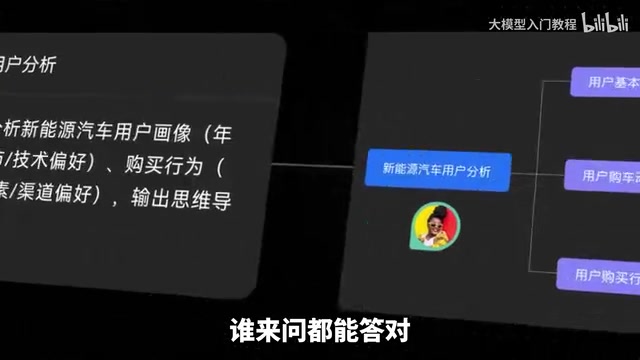
Simply put, it's about letting AI thoroughly understand the materials you have on hand, so it can answer correctly no matter who asks. This case doesn't show that "everyone can build large models," but that "everyone can build large model applications." Tech stacks like RAG don't require much algorithm background; the core capabilities lie in data organization, prompt design, and business understanding.
From a money-making logic perspective, companies wanting to use AI either spend hundreds of thousands in annual salary to hire the right person, or outsource the project to a team that can deliver. But 90% of people can't even touch the threshold—this is exactly where supply and demand are misaligned.
RAG (Retrieval-Augmented Generation): RAG is a technical paradigm that lets large models answer questions based on external knowledge bases. The process typically includes: chunking documents and vectorizing them into a vector database; retrieving the most relevant fragments when a user asks a question; feeding the fragments as context to the large model to generate an answer. It doesn't require modifying model weights, and the core work lies in data cleaning, chunking strategy, embedding model selection, and prompt design—hence low algorithm background requirements, making it one of the most mature paths for application-layer implementation.
What Tutorials Lack Is Never the Mountaintop View
The creator's criticism of existing tutorials hits the mark: all tutorials online only show the view from the mountaintop, but none draw a path to climb up. You can't find the steps, can't see the method, and no one tells you which step you'll trip on.

His solution is a complete chain from Python basics to large model implementation, with a learning roadmap, prompts, and tools organized into documents. The value of such "full-chain" content lies in filling the middle layer—not explaining principles, not showing off results, but breaking down every step from zero to launch.
Of course, what needs to be viewed calmly is: whether a 346-episode tutorial can really turn a beginner into an expert in a week depends on the learner's execution ability and foundation. Open source lowers the tool barrier, but doesn't lower the barrier of understanding and implementation.
After Open Source, Where's the Real Competition?
The deep impact of this open-source release is shifting the competitive focus from "model training" to "application implementation." When top-tier weights and tuning data are public, the model itself is no longer a moat—the moat becomes three things: understanding of business scenarios, control of data quality, and engineering delivery capability.
For individual developers, this means the career-change path is shorter—no need to start from algorithms; you can enter from the application layer. For companies, this means hiring standards must change—no longer just whether you can train models, but whether you can integrate models into business processes.
Lower barriers don't mean no barriers. Open source hands over the answers, but whether you can use them correctly still depends on the person.
The Difference Between Open Weights and Training Recipes: Opening only weights means you can do inference and fine-tuning, but cannot reproduce the training process; opening the training recipe (such as data ratios, hyperparameters, tuning data) lets the community understand where model capabilities come from, and even reproduce or improve from scratch. The latter drives the ecosystem far more than the former, because it turns the "black box" into auditable, iterable public knowledge, and directly lowers the trial-and-error cost for latecomers.
Related articles

A New Paradigm for Text Editing in Compose: TextFieldState Replaces the Old API
Jetpack Compose introduces the TextFieldState API to fix dropped characters and cursor jumps from async input. The old value/onValueChange callbacks will be deprecated in 1.13. This article covers InputTransformation, OutputTransformation, four state hoisting patterns, and new formatted text editing capabilities.

Remote Compose: A New Document-Driven Paradigm for Cross-Platform UI on Android
Remote Compose transmits compact binary documents instead of screen pixels, enabling efficient UI rendering on remote surfaces like Wear OS and widgets. This article covers its document creation API, expression animations, size optimization techniques, and Wear OS progress.

How Crashlytics Eliminates Android Memory and Responsiveness Issues
Through the Chroma Clip case study, this article explains how Firebase Crashlytics uses Application Exit Info, Profiling Manager, GWP ASAN, and ARM MTE to pinpoint ANRs, OOMs, memory limit terminations, and native memory corruption—solving the challenge of stack traces that don't point to the real culprit.