80K Text-to-Image Prompt Dataset: A Practical Approach to Testing AI Models and Character LoRAs

80K prompt dataset + ComfyUI workflow for batch evaluation of AI image models and character LoRAs.
A developer has open-sourced 80,000+ text-to-image prompts on HuggingFace, paired with a ComfyUI workflow for batch evaluation of AI models and character LoRAs. A key insight: LLMs are poor at generating diverse prompts from scratch but excel at transforming existing material — so feed them source content rather than asking them to invent. The companion workflow connects directly to the cloud dataset via a HuggingFace custom node, enabling filtered sampling with minimal setup.
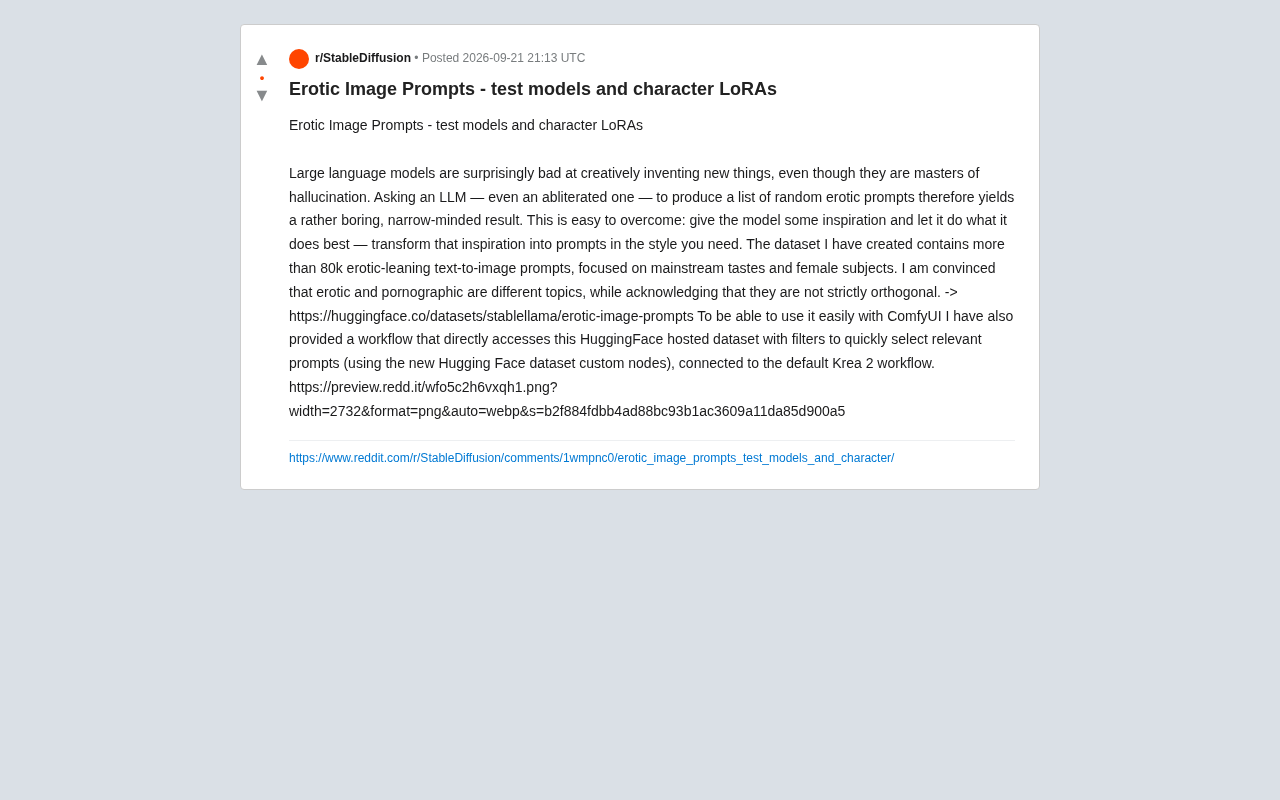
In the world of AI image generation, testing model capabilities and character LoRA performance typically requires a large and diverse pool of prompts. A developer recently open-sourced a dataset of over 80,000 text-to-image prompts on HuggingFace, along with a companion ComfyUI workflow — giving the community a practical tool for batch-scale testing.
Why LLMs Struggle to "Create from Scratch"
There's an interesting technical observation behind this project: large language models (LLMs) are masterful hallucination machines, yet surprisingly mediocre at genuine creative invention. The author notes that even models that have been "abliterated" (had their refusal behaviors surgically removed) tend to produce dull, narrow results when asked to freely generate a batch of random prompts.
This points to a fundamental limitation of current LLMs: they excel at transformation, not invention from nothing. Their strength lies in rewriting, recombining, and stylizing existing material — not expanding the imagination into uncharted territory. The natural solution, then, is to supply the model with source material and let it do what it does best: convert that material into the style of prompts you need.
This insight is useful for anyone doing prompt engineering: rather than expecting the model to "come up with" something new, prepare high-quality input material and reframe the creative task as a transformation task — something LLMs handle far more reliably.
"Abliteration" refers to a technique that edits model weights to remove content-filtering tendencies instilled during pretraining or alignment. The general approach involves identifying the internal feature directions responsible for "refusing" certain types of requests, then canceling or deleting them at the weight level so the model responds normally to previously refused content. This is distinct from "jailbreaking" via system prompts — the latter influences behavior at inference time, while abliteration directly modifies the model's weights. The author mentions abliterated models here to rule out "content filtering causing conservative outputs" as a confounding factor: even without safety restrictions, models still produce uninspired results when freely generating diverse prompts — which means the problem lies with creativity itself, not safety policy.
What the Dataset Contains
The dataset is hosted on HuggingFace (stablellama/erotic-image-prompts) and contains over 80,000 adult-oriented text-to-image prompts, primarily focused on mainstream aesthetics and female subjects.
Notably, the author draws a clear line around the content's scope. He explicitly distinguishes between "erotic" and "pornographic" as different thematic categories — while acknowledging they aren't strictly mutually exclusive. This distinction reflects a deliberate positioning of the dataset: the goal is artistically oriented, aesthetically driven prompts, not purely explicit content.
From a practical standpoint, the core value of an 80,000-prompt library lies in its breadth of coverage. When you need to evaluate the generalization capability of a new model or a character LoRA, running batch generation across a massive and varied prompt set more thoroughly surfaces how the model performs across different scenarios, poses, and styles.
LoRA (Low-Rank Adaptation) is a parameter-efficient fine-tuning technique that injects low-rank matrices alongside a pretrained model's weight matrices, enabling targeted training by updating only a tiny fraction of parameters. In AI image generation, character LoRAs are typically used to lock in the appearance of a fictional character — maintaining consistent facial features and body type across different scenes, outfits, and poses. One of the core metrics for evaluating a character LoRA's quality is "generalization" — whether it can reliably reproduce the character's features across diverse prompt combinations, not just the compositions seen during training. This is precisely the primary use case for a large-scale, diverse prompt library: stress-testing a LoRA with thousands of varied descriptions to surface failure points in specific poses, lighting conditions, or scene types.
The Companion ComfyUI Workflow
To lower the barrier to entry, the author also provides a ComfyUI workflow. It leverages HuggingFace's newly released dataset custom node to access the cloud-hosted dataset directly — no need to download the entire database locally.
The workflow includes built-in filtering, letting users quickly pull relevant prompts using filter conditions. The whole pipeline connects to a default Krea 2 workflow, meaning users can plug the prompt dataset into an existing image generation pipeline with minimal setup.
This "dataset as a service" design philosophy is worth noting. The traditional approach hardcodes prompts into a config file, but by connecting directly to cloud-hosted data via the HuggingFace dataset node, you save local storage and automatically pick up updates as the dataset grows. For model evaluation workflows that require frequent A/B testing, this kind of automated batch sampling can dramatically improve efficiency.
ComfyUI is a node-graph-based frontend for Stable Diffusion where users build image generation pipelines by connecting functional nodes rather than writing code. Compared to traditional interfaces like WebUI, ComfyUI's node-based design makes it easy to insert custom modules — community developers can publish Custom Nodes that extend functionality not natively supported. The HuggingFace dataset custom node is a prime example: it wraps the HuggingFace Datasets library into a ComfyUI-compatible node, allowing workflows to directly query and sample cloud-hosted datasets without ever leaving the ComfyUI interface. Krea 2 is a widely circulated base workflow template in the ComfyUI community, pre-configured with common samplers and model-loading logic, often used as a starting point for further customization.
Implications for Model Evaluation Workflows
Setting aside the specific content domain, this project offers several methodologically transferable lessons.
Batch testing requires large-scale corpora. Assessing the true capability of a model or LoRA with a handful of hand-picked prompts is insufficient — it's easy to fall into selection bias. A large, diverse prompt library provides a more objective evaluation foundation.
Use LLMs to augment prompts, not generate them from scratch. Feeding existing material to an LLM for style transformation and expansion is more reliable than asking it to improvise freely. This is a counterintuitive but practical trick in prompt engineering.
Seamless toolchain integration drives adoption. Even the best dataset won't see wide use if it requires complex manual configuration to get running. Connecting directly to HuggingFace via a ComfyUI custom node — minimizing friction to near zero — is what actually gets open-source tools adopted in practice.
For creators involved in AI image model development or LoRA fine-tuning, building a reusable batch testing pipeline often delivers more lasting value than any single dataset. This project is a concrete example of that engineering-first mindset.
Related articles

Why Does the Tesla Roadster Need to Fly? A Deep Dive into Musk's Wild Demo
Tesla's Roadster launch showed wall-climbing, upside-down driving, and flying stunts—but The Vergecast notes the demo car may lack a battery, the Rocket version is invite-only and not street-legal, and the website terms don't guarantee delivery. After nine years of delays, why does this car still need to exist?

AI Is Not a Replacement: Human-AI Collaboration Through the Lens of Factory Root Cause Analysis
Starting from factory root cause analysis, this article explains how AI accelerates evidence chain construction rather than replacing human experts, exploring the pragmatic implementation logic and business value of 'AI supporting people rather than replacing them.'

AI Agent Decision Auditing: Building an Evidence Chain in Regulated Workflows
Starting from a Reddit discussion, this article analyzes three core issues in AI agent decision auditing within regulated workflows: what fields audit records should contain, how to handle feedback latency for erroneous decisions, and how to continuously calibrate LLM judge consistency with human judgment.