$88 AI Smart Cane: How Offline Edge Intelligence Is Reshaping Mobility Assistance for the Visually Impaired

An $88 offline AI smart cane on Raspberry Pi fuses vision and ToF sensing to assist visually impaired users.
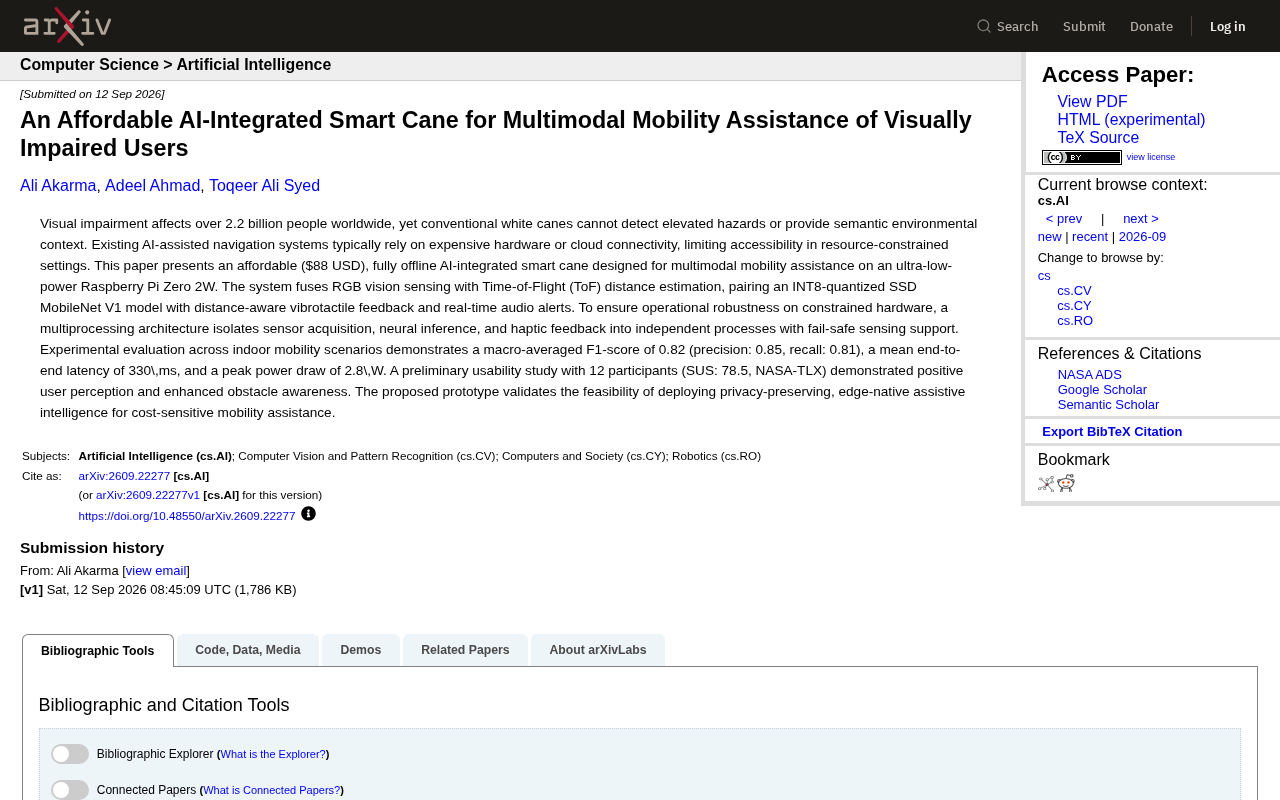
Over 2.2 billion people with visual impairments rely on white canes that can't detect overhead obstacles. This arXiv paper presents an $88 fully offline AI smart cane prototype built on a Raspberry Pi Zero 2W, fusing an RGB camera with a ToF sensor and running a quantized SSD MobileNet V1 model. The system delivers vibrotactile and audio feedback, achieving a macro-average F1 of 0.82, 330ms end-to-end latency, and 2.8W peak power. A 12-person usability study yielded a SUS score of 78.5, validating that privacy-preserving, edge-native assistive AI can be both affordable and practically useful.
More than 2.2 billion people worldwide live with some form of visual impairment, yet the traditional white cane has always had a critical blind spot: it cannot detect overhead obstacles at head height, nor can it provide users with any semantic understanding of their environment. A newly published arXiv paper proposes a solution — an AI-powered smart cane that costs just $88 and runs entirely offline, seeking a practical balance between cost and capability.
The Limitations of Traditional Aids and the Problems with Existing Solutions
The white cane has been around for decades, relying on physical contact to detect ground-level obstacles. But it is nearly useless against suspended hazards at chest or head height — overhanging branches, protruding signs, or an open car door. This overlooked "upper-body blind zone" is precisely where visually impaired individuals are most frequently injured.
AI-assisted navigation systems have emerged in recent years to offer richer environmental awareness, but they typically depend on expensive hardware or cloud connectivity. Both requirements present hard barriers in resource-limited settings: the price tag alone is prohibitive, and reliance on network access renders devices useless when offline while raising legitimate privacy concerns. This paper targets exactly that gap — how to deliver practically useful multimodal mobility assistance at low cost, without any internet connection.
System Architecture: Running AI on Ultra-Low-Power Hardware
At the heart of the system is a Raspberry Pi Zero 2W — an ultra-low-power microcomputing board. The researchers built on this foundation by fusing two sensing modalities: RGB visual perception and Time-of-Flight (ToF) distance estimation. The former identifies objects in the environment; the latter provides precise distance measurements.
On the model side, the system uses an INT8-quantized SSD MobileNet V1. Quantization is the key technique for getting neural networks to run on resource-constrained edge devices — it compresses floating-point operations into integer operations, dramatically reducing computational and memory overhead at the cost of manageable accuracy loss.
Equally noteworthy is the engineering design. To ensure stable operation on such constrained hardware, the system adopts a multi-process architecture that isolates sensor acquisition, neural network inference, and haptic feedback into separate processes, with a fail-safe mechanism built in. This isolation means that even if one component stalls or fails, it won't bring down the entire device — a critical property for any assistive tool that directly affects personal safety.
Time-of-Flight (ToF) technology calculates distance by emitting infrared light pulses and measuring the time it takes for the reflected signal to return, achieving millimeter-to-centimeter accuracy regardless of lighting conditions. Compared to stereo cameras that rely on binocular vision, ToF sensors are more power-efficient and faster to respond in low-power scenarios. In the context of a smart cane, ToF compensates for the weaknesses of purely visual models — a neural network can tell you "there's a person ahead" but struggles to precisely quantify "how far away," which is exactly where ToF excels. The two modalities complement each other, combining semantic recognition with quantitative distance measurement.
SSD MobileNet V1 is a lightweight object detection architecture designed for resource-constrained devices. SSD (Single Shot MultiBox Detector) performs object localization and classification in a single forward pass, eliminating the region proposal step of two-stage detectors and significantly reducing computational load. MobileNet replaces standard convolutions with depthwise separable convolutions, reducing parameter count and operations to a fraction of traditional architectures. INT8 quantization further compresses model weights from 32-bit floating point to 8-bit integers, improving inference speed by 2–4× and reducing memory usage by roughly 75% with minimal accuracy loss — making it feasible to run on a board like the Raspberry Pi Zero 2W with only 512MB of RAM and a 1GHz processor.
Multimodal Feedback: Vibration and Voice for Distance Awareness
Detecting an obstacle is only the first step; efficiently communicating that information to the user is what makes an assistive device truly useful. This smart cane converts ToF-measured distance into distance-aware vibrotactile feedback — the closer the obstacle, the stronger the vibration — allowing users to intuitively gauge the proximity of a hazard through touch alone.
The system also provides real-time audio alerts, paired with object category information from the visual model to deliver semantic-level cues. Vibration conveys distance; voice conveys context. The two modalities complement each other, which is the core principle behind "multimodal mobility assistance."
Results: Balancing Performance, Latency, and Power
In evaluations conducted in indoor mobile scenarios, the system achieved a macro-average F1 score of 0.82 (precision 0.85, recall 0.81). For a quantized model running on such low-end hardware, this level of detection performance is practically viable.
Two hard metrics speak even more to the engineering quality: an end-to-end average latency of 330 milliseconds, and a peak power consumption of just 2.8 watts. Low latency ensures timely warnings — for a device that needs to alert users in real time while they're moving, latency directly defines the safety margin. Sub-3-watt power consumption, meanwhile, determines battery life, enabling the offline device to support extended daily use.
In a preliminary usability study with 12 participants, the system received a SUS (System Usability Scale) score of 78.5, with workload assessed via the NASA-TLX. Participants generally reported positive perceptions and enhanced obstacle awareness.
SUS (System Usability Scale) is a standardized questionnaire developed by John Brooke in 1986, consisting of 10 alternating positively and negatively worded items on a 100-point scale. Industry convention treats 68 as the "acceptable" baseline, scores above 78 as "good," and above 85 as "excellent." NASA-TLX (Task Load Index) is a multidimensional subjective workload assessment tool developed by NASA, evaluating cognitive and physical burden across six dimensions: mental demand, physical demand, temporal demand, performance, effort, and frustration. Used together, SUS measures whether a device is "easy to use" while NASA-TLX measures whether using it is "taxing" — offering cross-validated perspectives on an assistive tool's real-world usability. A SUS score of 78.5 suggests that most participants found the cane ready for everyday use, though the 12-person sample size limits the statistical strength of that conclusion.
The Significance of Edge-Native Assistive Intelligence
The value of this work is not in topping any accuracy leaderboard — it lies in validating a pragmatic path forward: deploying privacy-preserving, edge-native assistive intelligence in cost-sensitive contexts is genuinely feasible.
Fully offline operation means data never leaves the device, naturally sidestepping the privacy risks of cloud-based solutions. The $88 price point opens the door for assistive technology to reach populations who have been priced out of expensive alternatives. As the industry chases ever-larger models and more powerful compute, research like this serves as a reminder: refining mature technology to be "good enough, affordable, and reliable" is an equally important path for AI to deliver real-world impact.
Of course, as a prototype validation, it has limitations — the 12-person usability study is a small sample, experiments were primarily conducted indoors, and performance in complex real-world outdoor environments remains to be tested. But as a proof of concept, it clearly demonstrates the potential of low-cost edge AI in the accessibility space.
Related articles

Gemini 4 Argon Hands-On: AI Builds Board Games, Constructs Temples, and Trains Robots Autonomously
Gemini 4 Argon hands-on roundup: AI autonomously builds a desk racetrack and temple in Blender, writes a ray tracing engine, trains a humanoid robot to sink 7 shots, plus API pricing and developer access.

The Magic Octagonal Coin: Why Only 9% of People Can Predict Its Flip?
Only 9% of people can correctly predict the Magic Octagon coin flip. This article explains its spatial rotation mechanism, common cognitive pitfalls, and a new hypothesis based on Relevance Theory, exploring the limits of human spatial reasoning.

Sam Altman: AI Is Entering the Era of Scientific Discovery — Math Breakthroughs Will Replicate in Biology and Energy
Sam Altman says AI is entering the era of scientific discovery — math breakthroughs will replicate in biology, materials science, and energy to help develop new drugs and energy sources.