89% of Americans Believe Government Corruption Is Widespread — How to Resolve the Trust Crisis
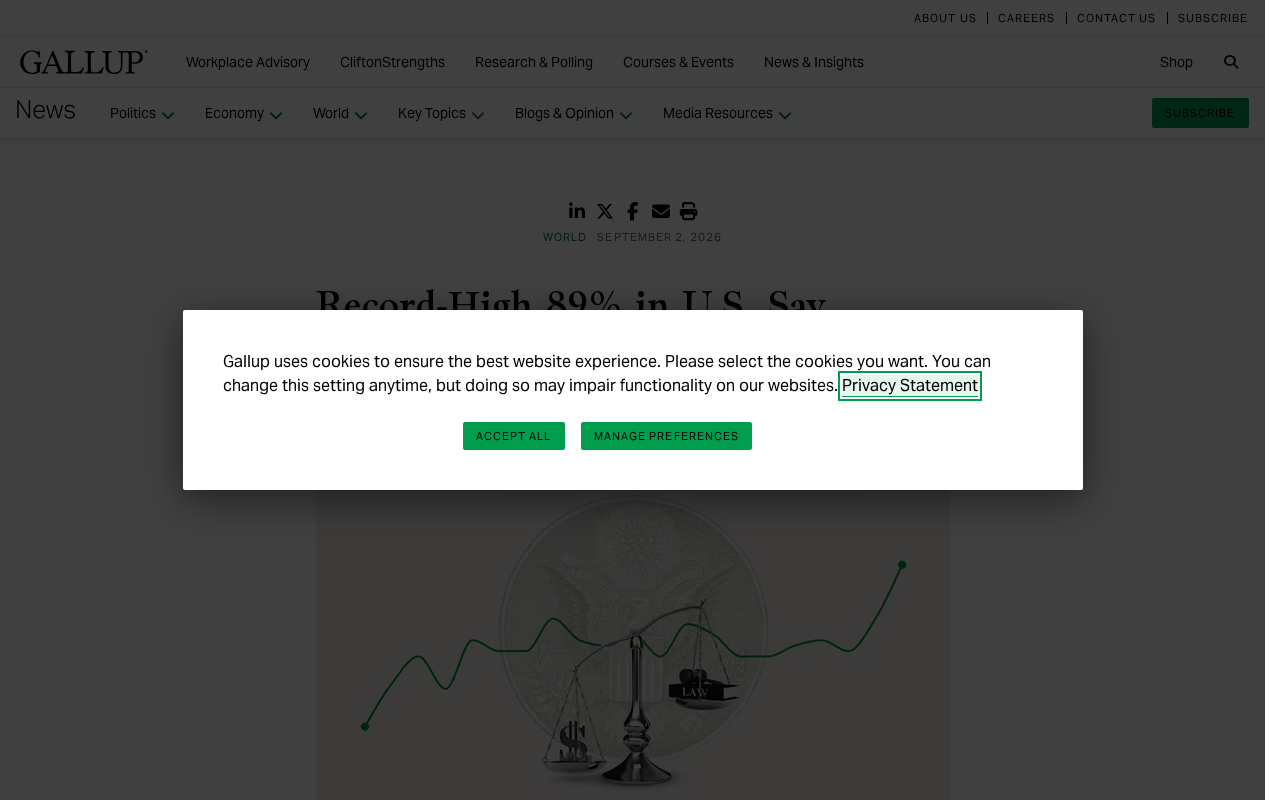
89% of Americans see widespread government corruption, signaling a historic trust crisis in U.S. democracy.
The latest Gallup poll reveals that 89% of Americans believe government corruption is widespread — a record high reflecting deepening distrust in public institutions. Driven by political polarization, opaque campaign finance, revolving-door politics, and regulatory capture, this trust deficit threatens democratic legitimacy and civic engagement. Rebuilding credibility requires systemic reforms in transparency, accountability, and campaign finance, complemented by emerging technologies like blockchain and AI — though political will remains the decisive factor.
Gallup Poll Reveals: Trust in U.S. Government Hits Historic Low
According to the latest Gallup poll data, 89% of American respondents believe government corruption is widespread — a record high. Gallup is a world-leading polling organization founded in 1935, renowned for its rigorous sampling methods and data analysis capabilities. Gallup polls typically combine random digit dialing (RDD) with online panels to ensure sample representativeness. The standard margin of error is usually within ±3–4 percentage points at a 95% confidence level. For political surveys, Gallup applies weighting adjustments based on respondents' demographic characteristics (age, gender, race, education level, etc.) to eliminate sample bias. This survey on perceptions of government corruption typically involves a sample size of 1,000–1,500 people across all 50 states, providing a reasonably accurate reflection of the American public's overall attitudes.
The findings not only reflect a continued decline in public trust in government institutions but also reveal deep-seated challenges facing the current political ecosystem. Compared to historical data, the rise in this figure is particularly striking. Public skepticism about government integrity has evolved from an isolated phenomenon into a widespread consensus, reflecting the intertwined effects of insufficient institutional transparency, dysfunctional accountability mechanisms, and intensifying political polarization.
Political polarization refers to the widening ideological gap between the two ends of the political spectrum and the gradual disappearance of moderate centrists. In the United States, polarization can be measured across multiple dimensions: Congressional voting records show that the overlap between members of the two parties has dropped from roughly 35% in the 1970s to less than 5% today. Pew Research Center data indicates that the share of voters holding "very conservative" or "very liberal" positions rose from 10% in 1994 to 38% in 2021. Polarization has made bipartisan cooperation nearly impossible, major reform legislation difficult to pass, and government shutdowns a recurring event. More seriously, polarization drives voters to demonize the opposing camp, turning every policy dispute into a moral confrontation. This zero-sum mentality further erodes trust in public institutions.
The Evolution of Americans' Perceptions of Corruption
From a historical perspective, American public perceptions of government corruption have gone through distinct cycles of fluctuation. In earlier surveys, the proportion holding this view was relatively low. However, as political scandals continued to surface, interest group influence expanded, and social media accelerated the spread of information, public vigilance and skepticism steadily intensified.
The emergence of the 89% peak is closely tied to several factors:
- High-profile corruption cases involving senior officials frequently making headlines
- Transparency of lobbying activities remaining a persistent source of controversy
- Campaign funding sources becoming increasingly complex and difficult to trace
- Special interest groups deeply embedded in the policy-making process
These phenomena are repeatedly amplified through media coverage and online discourse, further solidifying the public's negative perceptions.
The Deep Impact of the Trust Deficit on Democratic Institutions
The steep decline in government trust is producing a chain reaction that undermines the effective functioning of democratic institutions. When the vast majority of citizens believe corruption is ubiquitous, the legitimacy of policy implementation is weakened, civic participation declines, and populist and extremist political movements gain more support.
At the institutional level, this trust crisis also exposes clear shortcomings in existing oversight mechanisms. Although the United States has a relatively robust legal framework and an independent judiciary, complex campaign finance rules, the "revolving door" between government officials and corporations, and regulatory capture allow much corrupt behavior to operate in a gray zone between legal and illegal, making it difficult to effectively curb.
The "revolving door" refers to the flow of personnel between government positions and the private sector. Typical pathways include federal regulatory officials leaving to join the very companies they once regulated as executives or consultants, and corporate executives briefly serving in government before returning to their industries. This movement is entirely legal in the United States but raises serious conflict-of-interest concerns. Data shows that between 2008 and 2018, more than 5,400 former Congressional staffers became registered lobbyists, and over 50% of former members of Congress engaged in lobbying work after leaving office. The revolving door leads to "regulatory capture" — regulators, mindful of future career prospects, tend to craft lenient policies favorable to the industries they oversee. While federal law requires departing officials to observe a 1–2 year "cooling-off period," enforcement has been limited, with many former officials continuing to exert influence through informal roles such as "strategic advisor."
Possible Paths to Rebuilding Government Credibility
Addressing the trust crisis requires systemic reform across multiple dimensions:
Enhancing Government Transparency
Leverage digital technology to disclose more information about decision-making processes and funding flows, enabling the public to track in real time how policies are formed and budgets allocated.
Strengthening Accountability and Oversight Mechanisms
Ensure that violations are promptly investigated and punished, making the cost of corruption far exceed its potential rewards.
Reforming the Campaign Finance System
Limit the undue influence of large political donations on policymaking, cutting off channels for the transfer of interests at the source.
The U.S. campaign finance system has undergone several major transformations. The Federal Election Campaign Act of 1974 first established donation limits, but the Supreme Court's 2010 ruling in Citizens United v. FEC fundamentally changed the rules of the game. The Court ruled that restricting independent political spending by corporations and unions violated the First Amendment, giving birth to Super PACs (Super Political Action Committees). Super PACs can accept unlimited donations as long as they do not directly coordinate with candidates. In the 2020 presidential election, Super PAC spending exceeded $3 billion. Even more opaque are 501(c)(4) "social welfare" organizations, which are not required to disclose donor identities ("dark money") — such spending totaled approximately $750 million in 2020. This funding system allows billionaires and large corporations to influence elections on an unprecedented scale, while ordinary voters feel their voices are drowned out, deepening the perception that the political system has been "bought."
Additionally, media literacy education and improved fact-checking mechanisms cannot be overlooked. In an environment of information overload and rampant misinformation, the public needs the ability to distinguish true information from false, avoiding the formation of excessively pessimistic cognitive biases based on incomplete or inaccurate reporting.
Can Technology Help Fight Corruption?
Emerging technologies such as blockchain, AI-powered regulatory tools, and open data platforms are seen by many reform advocates as powerful instruments for enhancing government transparency and reducing corruption. Blockchain is a distributed ledger technology whose core features are decentralization, immutability, and full traceability. Government applications include: putting procurement records on-chain so that participants, amounts, and timestamps for every transaction are permanently stored and publicly accessible; land registration and property rights management to prevent ownership disputes and rent-seeking; and voting systems to ensure election results are verifiable. Estonia's e-Governance system has already partially adopted blockchain technology, enabling 99% of government services to be conducted online.
Through tamper-proof transaction records, automated anomaly detection, and publicly accessible databases, technology can indeed reduce the scope for human manipulation to some extent. But technology is no silver bullet. Blockchain has clear limitations as well: first, the authenticity of on-chain data still requires off-chain verification mechanisms (the "garbage in, garbage out" problem); second, complete transparency could violate privacy or leak sensitive information; third, implementation costs are high, requiring large-scale infrastructure upgrades; and most critically, if those in power lack the political will, even the most advanced technology will be sidelined or selectively applied.
Flawed institutional design, lack of enforcement willingness, and entrenched power structures — these fundamental issues cannot be solved through technology upgrades alone. Real change requires the combined force of political commitment, civic oversight, and cultural transformation.
The figure of 89% is a warning signal that cannot be ignored. The healthy functioning of democratic institutions depends on citizens' basic trust in the system. When that trust erodes on a massive scale, the difficulty of repairing the damage grows exponentially. Finding the right balance between technological progress, institutional reform, and cultural renewal will be an unavoidable challenge for political development in the years ahead.
Related articles

Micron's $10 Billion R&D Center in Boise: A Deep Dive into Its Strategic Significance
Micron announces a $10B R&D center in Boise focused on HBM and next-gen memory tech. We analyze the strategy, policy drivers, and impact on AI-era chip competition.

Chrome Updates Every Two Weeks: How AI is Reshaping Browser Security Strategy
Google Chrome shifts to biweekly updates to combat AI-accelerated cyberattacks. Deep dive into how AI is transforming security dynamics and the impact of faster release cycles.

reclip: Self-Hosted Video Downloader with Clean Web UI as Command-Line Alternative
reclip is a lightweight self-hosted video downloader with a clean Web UI, built on yt-dlp to support downloads from almost any website. Easy deployment, privacy control, ad-free, ideal for NAS and VPS users.