9 Observations from Anthropic's IPO Filing: Explosive Revenue Growth and a Hundred-Billion-Dollar Compute Bet

Anthropic's prospectus reveals a structural clash between explosive revenue growth and rigid hundred-billion-dollar compute commitments, forcing the market to choose between growth stock and cyclical asset narratives.
Anthropic's prospectus discloses revenue growing from $41M in 2023 to $16.286B in H1 2026, with top-five customer concentration declining while absolute revenue doubled, indicating early-stage enterprise penetration. Of the $80.7B net loss, $72.4B comes from fair value changes on convertible notes and SAFEs; actual operating loss is only $693M, and Q2 already turned profitable, with $131.65B in cash reserves. The core risk is that revenue fluctuates monthly while compute costs are locked in annually or even for five years—signed compute contracts of $780B to $810B include irrevocable and cross-default clauses. Under the public benefit structure, founders hold Class F shares with voting control, while public Class A shareholders enjoy only economic rights. The market thus has two pricing narratives: growth stock versus highly leveraged cyclical asset.
One Prospectus, Two Narratives
Anthropic's IPO prospectus is like a coin: heads shows a jaw-dropping revenue curve, tails a rigid compute commitment in the hundreds of billions of dollars. Bilibili creator Jianing broke down the document from nine angles, and the core question is singular: when an AI company simultaneously plays the role of "infrastructure growth stock" and "highly leveraged cyclical asset," which story should the market tell about it?
This article is based on the public analysis from that video, combined with key data disclosed in the prospectus, to re-examine the structural contradictions and opportunities within.
Revenue: The Steep Curve from $41 Million to $16.286 Billion
The prospectus shows Anthropic's revenue rising from $41 million in 2023 to $4.585 billion in 2025, then reaching $16.286 billion in the first half of 2026—a year-over-year increase of 1,300%. This is an almost vertical growth curve.
More noteworthy is the change in revenue structure. The top five B2B customers accounted for 36% of revenue in Q1, dropping to 21% in Q3. The declining share is not due to losing major customers—their absolute revenue actually doubled, with each hitting new highs in Q3. The real reason for the share decline is the substantial increase in revenue from other customers.
More than half of the Fortune 500 have become Claude customers spending over $100,000 annually, yet their spending on Anthropic accounts for less than 0.1% of their total expenditures. This figure means enterprise penetration is far from saturated. Anthropic itself is a heavy Claude user, with 90% of the code in its codebase completed by AI that month.
Breaking Down the Loss: What's Hidden in the $80.7 Billion Net Loss
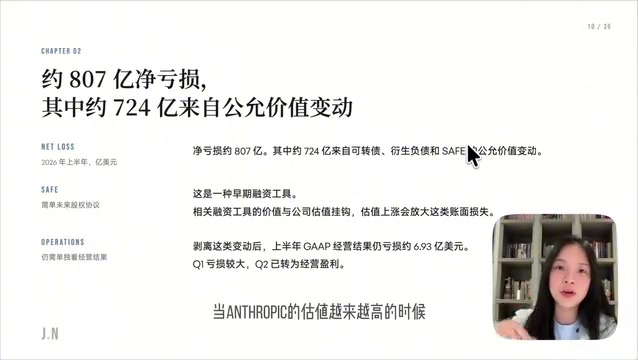
In the first half of 2026, Anthropic's net loss reached $80.7 billion. But broken down, $72.4 billion comes from fair value changes on convertible notes, derivative liabilities, and SAFEs.
This is akin to investors lending Anthropic money tied to both debt and equity—the higher the company's valuation, the more it will have to repay in the future, and this is recorded as a net loss. Stripping out these non-operating changes, the actual operating loss is only $693 million, with a larger loss in Q1 and operating profitability achieved in Q2.
Operating cash flow reached $3.447 billion in the first half. The difference between operating profit and cash flow mainly comes from two factors: depreciation and stock-based compensation not yet paid in cash; and customer prepayments and cloud provider settlements flowing in as cash before services are delivered. As of period end, cash reserves stood at $131.65 billion—according to the creator, this cash level already exceeds Amazon's.
SAFE (Simple Agreement for Future Equity) is a financing instrument commonly used by Silicon Valley startups, essentially a "simple agreement for future equity": investors give money to the company now but do not immediately receive equity, instead agreeing that upon a future trigger event (such as the next funding round or an IPO), the investment converts into shares at the then-current valuation. For the issuer, SAFEs are typically classified in accounting as a financial liability measured at fair value; each time the company's valuation rises, the liability's fair value inflates accordingly, with the difference recorded in current profit and loss, creating a book net loss that involves no actual cash outflow. The $72.4 billion fair value change loss in Anthropic's prospectus is precisely the accounting consequence of such instruments, not operational deterioration. Understanding this is essential to distinguishing the "$80.7 billion net loss" from the "$693 million actual operating loss" and avoiding being misled by surface figures.
Compute Utilization: A Misread Chart
After Q2 turned profitable, a chart circulated in the market showing "revenue per dollar of compute rising sharply," implying a leap in compute efficiency. The creator questions this: Q2 revenue more than doubled, but the compute used was likely still the batch purchased at the beginning of the year, with related costs already paid around December.
The real test lies in subsequent delivery. Existing compute orders are being signed, and larger-scale compute delivery will be provided by SpaceX AI around December. Once new capacity comes online, margins need to climb again, and the key question is whether the original compute costs can continue to be absorbed. That said, price pressure from Chinese open-source models is rising—increased compute costs push up model fees, and customers may turn to cheaper alternatives.
The timing mismatch between compute costs and revenue recognition is key to understanding this chart. Cloud providers' compute contracts typically involve annual or multi-year prepayment or minimum consumption commitments, with costs amortized on a straight-line basis as depreciation or operating expenses over the contract period; revenue, meanwhile, is recognized monthly as customers use the service. When quarterly revenue doubles while compute procurement has not yet been updated, revenue per dollar of compute naturally appears very high—but this is an accounting timing effect of "denominator unchanged, numerator larger," not a genuine improvement in the economic efficiency per unit of compute. Only after a new batch of compute is delivered and begins amortizing does the matching relationship between revenue and costs return to normal, at which point margins need to be re-validated. This is why the creator emphasizes focusing on data after new capacity comes online around December, rather than single-quarter ratios.
Run Rate Revenue and Banned-Account Revenue
Run Rate Revenue can be understood as an annualized indicator of product revenue performance—the higher it is, the more popular the product is with customers. This metric is subject to short-term fluctuations from two factors: seasonal changes around holidays, and the potential decline in annualized revenue after the end of December.
The creator specifically mentions a detail discussed by multiple bloggers: 5% to 7% of the company's revenue comes from banned accounts—no refunds after banning, and this portion is directly counted as revenue. As security checks tighten, this revenue source is expected to gradually decline.
Run Rate Revenue (annualized revenue) is a common disclosure metric for SaaS and subscription companies, typically taking the most recent month's or quarter's revenue multiplied by 12 to convert short-term data into an annual pace for horizontal comparison of growth rates. It does not equal contracted revenue, nor does it guarantee that the next 12 months will actually materialize, making it highly sensitive to seasonality (such as year-end bulk purchasing) and one-time factors. For this reason, Anthropic discloses both contracted revenue (approximately $10.8 billion) and projected certain revenue for the next 12 months (approximately $8.1 billion) in its prospectus—the former is a hard commitment, the latter depends on actual customer usage. Investors should view annualized revenue as a "speedometer" rather than an "odometer," using it to judge trends while using contracted revenue to judge certainty.
Core Operating Risk: Revenue Changes Monthly, Costs Locked Annually
This is the most noteworthy point in the entire prospectus. On the revenue side, Anthropic can lock in very little: approximately $10.8 billion in confirmed contracted revenue, plus $8.1 billion projected to be confirmed over the next 12 months, totaling about 75%—all of which depends entirely on actual customer usage.
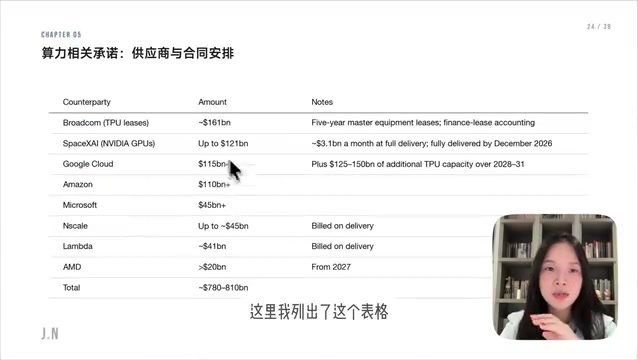
The cost side is a different picture: compute contracts worth $780 billion to $810 billion have been signed, many with irrevocable terms, including cross-default provisions. More subtly, these cloud providers are simultaneously compute suppliers, channels, and financiers—lending money to Anthropic with one hand while having Anthropic purchase their compute with the other.
The model revenue window is also very short: 80% of revenue comes from models released within the past 6 months. The possibility of user migration exists at any time.
Public Benefit Structure: What Class A Shareholders Can Do
Anthropic plans to structure the company as a public benefit organization: injecting 847 million Class N shares into a wholly-owned public benefit fund, equivalent to 5% of total shares; the board has also agreed to invest an additional 2% of funds for each step up in share price from the IPO offering price.
Class F shares are allocated to 7 co-founders and are not diluted in the ordinary way—these 7 individuals hold core voting rights over the company's future development. Public shareholders hold Class A shares, which mainly correspond to economic rights.
This means public shareholders must accept: management may, for the sake of the company's mission or foundation goals, forgo some short-term profit-maximizing behavior, or even take decisions that could affect the share price, and Class A shareholders are essentially powerless to intervene.

Public Benefit Corporation (PBC) and dual-class share structure are the two layers of institutional design here. PBC is a corporate form permitted in some U.S. states, requiring management to balance shareholder returns with the public benefit mission stated in the charter, with the board having dual fiduciary duties to both—theoretically allowing some profit to be sacrificed for the mission. Dual-class shares, meanwhile, grant founders high-voting-power shares (such as Anthropic's Class F shares), letting public shareholders (Class A shares) mainly enjoy economic benefits while ceding control. The combination means: public investors are buying something closer to "beneficiary certificates of a mission trust" rather than ordinary shares that can constrain management through voting. This is also why the prospectus requires investors to additionally consider a governance discount when pricing.
Two Narratives, Which Do You Choose
There are two narratives for how the market should price Anthropic.
Growth stock narrative: If enterprises are truly using Claude deeply, embedding it into every aspect of their workflows, Anthropic has the opportunity to become an AI infrastructure-level company, and the market will award high PS multiples.
Cyclical asset narrative: If it cannot cope with competition from Chinese open-source models, rising customer price sensitivity, and growing demand for local models, then the signed compute contracts and rigid payments will become a heavy burden, and the company could be defined as a highly leveraged, low-visibility cyclical asset.
The prospectus also contains a passage the creator calls "a brilliantly drawn pie in the sky": Anthropic states its willingness to devote more energy to the next important innovation, even if it disrupts today's successful products. This may be why Anthropic has continued to lead since 2023—willingness to cannibalize its first curve in search of a second.
The most stable moat is surpassing yourself earlier than others. But this prospectus also reminds investors: the cost of that moat is written into the rigid terms of $780 billion in compute contracts.
Related articles

Jensen Huang Returns to Nvidia: The Power Game Behind an "Aggro Reset"
Nvidia's board reappointed Jensen Huang as CEO less than two weeks after his scandal-driven resignation. This analysis explores the board's decision-making, Trump's political intervention, media power failure, and market reaction behind the dramatic return.

Why Voice AI Can't Understand Kenyans' Everyday Conversations
Swahili speech recognition hits 3.24% error on read text, but everyday Kenyan speech mixes English, Sheng slang, and accents—leaving mainstream voice AI struggling.

Data Centers Build Their Own Natural Gas Plants: AI Compute's Breakout Around a Decade-Long Grid Wait
Grid interconnection approvals can take a decade, so xAI and others are building off-grid natural gas plants to power AI clusters. This article analyzes the drivers, costs, and impact of behind-the-meter generation on AI infrastructure.