9B Model Runs 56 Layers: SenseNova-Loop Official Release Sees Major Benchmark Gains

SenseNova-Loop-9B official version uses partial layer looping and posts major benchmark gains, but scores await third-party reproduction.
The SenseNova team released the official SenseNova-Loop-9B, improving on all seven benchmarks versus Preview. It uses a recurrent Transformer: 32 layers stored, 24 executed twice in the forward pass for 56 layers of equivalent compute, with parameters still at 9B. AutomationBench rose 14.33 to 36.67, GAIA 37.86 to 69.90, Terminal-Bench 2.1 40.45 to 59.55. 4-bit weights are about 4.9GB, Apache 2.0, with vLLM and SGLang configs open-sourced. The AutomationBench score matches the team's listed Qwen3.8-27B. All data come from the publisher's README with no third-party reproduction yet; cross-model evaluation consistency and the loop layers' impact on latency remain to be verified.
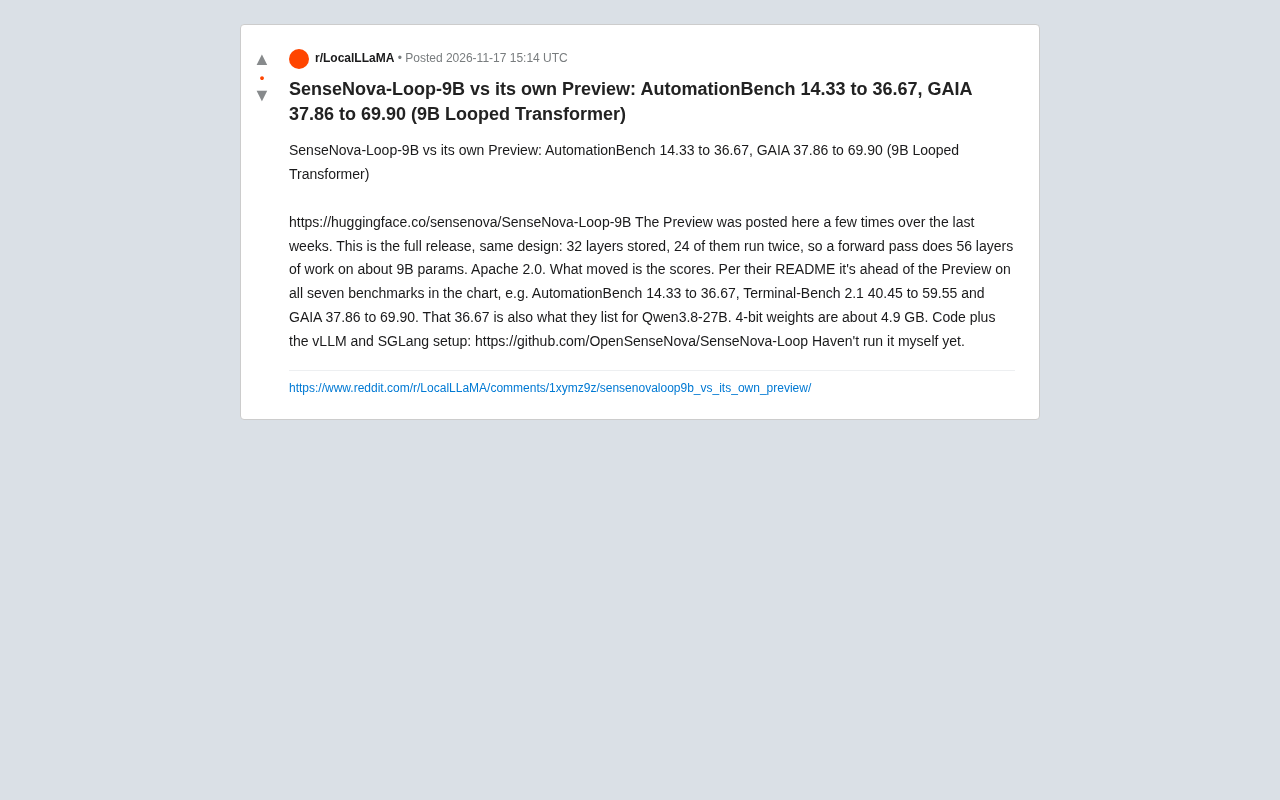
The SenseNova team has released the official version of SenseNova-Loop-9B, and compared with the earlier Preview version, several benchmark scores have jumped significantly. According to Reddit community discussion and the Hugging Face model card, this 9B-parameter model built on a recurrent Transformer design improved from 14.33 to 36.67 on AutomationBench, from 37.86 to 69.90 on GAIA, and from 40.45 to 59.55 on Terminal-Bench 2.1.
Recurrent Architecture: 32 Layers Stored, 24 Layers Run Twice
The core design idea behind SenseNova-Loop-9B is not complicated: the model stores 32 layers of parameters, but 24 of them are executed twice during the forward pass, so a complete forward computation effectively does the work of 56 layers while the parameter count stays at around 9B. This "layer looping" strategy lets the model expand computational depth without increasing parameter scale. The idea traces back to early recurrent architectures such as the Universal Transformer, but the engineering implementation makes more pragmatic trade-offs—not all layers are looped; only some layers are selectively reused.
From an efficiency perspective, this approach increases computation during inference, but weight storage and GPU memory usage are more manageable. Under 4-bit quantization, the weights are only about 4.9 GB, which is a low barrier for local deployment and experimentation. The model uses the Apache 2.0 license, and the code and deployment configurations for vLLM and SGLang are available in the OpenSenseNova/SenseNova-Loop repository on GitHub.
Universal Transformer is an architecture proposed by Google in 2018. Its core idea is to repeatedly iterate the same Transformer layer along the depth dimension rather than stacking multiple independent layers. It introduced the concept of "depth recurrence" and uses an Adaptive Computation Time (ACT) mechanism to dynamically decide how many steps each token needs to loop. The advantages of this design lie in the memory savings from parameter sharing and theoretically stronger compositional generalization. But early implementations faced problems such as training instability and difficulty learning the number of loops, and later practical variants mostly adopted fixed or layer-wise looping strategies. The "partial layer looping" of SenseNova-Loop-9B can be seen as a compromise on this idea: keeping some layers executed only once to maintain representational diversity, and reusing only the middle layers a fixed number of times, thereby striking a balance between engineering controllability and expanded computational depth.
Benchmark Scores Comprehensively Surpass the Preview Version
According to data disclosed in the model README, the official version outperforms the Preview version on all seven benchmarks listed in the chart. In addition to the three mentioned at the beginning, the other metrics also improved to varying degrees. Among them, the AutomationBench score of 36.67 deserves separate attention—this number happens to be the same score the team listed for Qwen3.8-27B, meaning that a 9B model has caught up with a larger competitor on the automation task benchmark, at least on that evaluation dimension.
The jump on GAIA from 37.86 to 69.90 is especially striking, nearly doubling. Terminal-Bench 2.1 improved by about 19 percentage points, indicating that the official version's reliability on terminal operation and code execution tasks has improved noticeably. Improvements of this magnitude are uncommon in version iterations within the same model family; usually, the gap between a preview and an official release is more about stability and edge cases than about order-of-magnitude changes in benchmark scores.
GAIA (General AI Assistants) is a benchmark proposed by Meta and other institutions in 2023, specifically evaluating how AI systems perform on real-world assistant tasks. The questions are designed as composite problems requiring multi-step reasoning, tool calls, and web retrieval, and the answers are usually a clear fact or number, making automatic scoring easy. GAIA has three difficulty levels: Level 1 is relatively straightforward, while Level 3 requires complex planning and coordination with external tools. The benchmark emphasizes tasks that are "easy for humans, hard for AI," so score improvements often reflect system-level capabilities—including tool use, information integration, and reasoning-chain stability—rather than the knowledge volume of a single model. The leap from 37.86 to 69.90 means that the official version has made substantial improvements in multi-step task orchestration and tool-calling reliability.
Terminal-Bench is an evaluation suite for terminal operation and code execution tasks, requiring models to complete tasks such as file operations, script writing, debugging, and command composition in a real shell environment. Unlike traditional code generation benchmarks, Terminal-Bench emphasizes end-to-end execution correctness: the model needs to understand command output, handle errors, and iterate corrections. Version 2.1 further expands task coverage and environment complexity. Scores on this benchmark are usually strongly correlated with the model's tool-calling ability, long-context management, and error recovery strategies, so the 19-percentage-point improvement not only indicates stronger coding ability but also suggests that the official version has significantly improved robustness in interactive task loops.
Observations Behind the Data and Points to Be Verified
A note: the above scores all come from the model publisher's own README, and there is currently no independent third-party reproduction. The author of the original Reddit post also explicitly stated that they "haven't run it personally yet." The Qwen3.8-27B data appearing in the benchmark comparison also comes from the same material. In cross-model comparisons, whether the evaluation configurations are fully consistent and whether the same prompt formats and toolchains are used will all affect the comparability of the scores.
Another point worth noting is the actual impact of the recurrent layer design on inference latency. The equivalent computation of 56 layers means that inference cost is higher than that of a conventional Transformer with the same parameter count, and the degree of adaptation for vLLM and SGLang will directly determine the actual deployment experience. The community is currently very interested in this kind of "parameter-efficiency-first" architecture, but the real test comes from independent evaluation and performance on actual tasks.
For developers who want to try it locally, the 4.9 GB 4-bit weights are a friendly starting point, and the GitHub repository provides complete deployment scripts. It is advisable to watch for whether third parties subsequently reproduce these benchmarks under the same conditions, and whether the loop depth can be adjusted through configuration—if the 24-layer loop is configurable, the model will have more room to trade off between latency and performance.
One-line Summary
SenseNova-Loop-9B official version uses a partial layer looping architecture, with major benchmark gains, but the scores still await third-party reproduction.
Paragraph Summary
The SenseNova team released the official version of SenseNova-Loop-9B, which improves on all seven benchmarks compared with the Preview version. The model uses a recurrent Transformer design: it stores 32 layers of parameters, with 24 layers executed twice during the forward pass, equivalent to 56 layers of computation, while the parameter count remains at 9B. AutomationBench rose from 14.33 to 36.67, GAIA from 37.86 to 69.90, and Terminal-Bench 2.1 from 40.45 to 59.55. The 4-bit quantized weights are about 4.9 GB, under the Apache 2.0 license, and vLLM and SGLang deployment configurations have been open-sourced. The AutomationBench score matches the Qwen3.8-27B score listed by the team. However, all data come from the publisher's README, with no independent third-party reproduction yet; the consistency of evaluation conditions in cross-model comparisons remains to be verified, and the actual impact of the recurrent layers on inference latency is also worth watching.
Related articles

Jensen Huang Returns to Nvidia: The Power Game Behind an "Aggro Reset"
Nvidia's board reappointed Jensen Huang as CEO less than two weeks after his scandal-driven resignation. This analysis explores the board's decision-making, Trump's political intervention, media power failure, and market reaction behind the dramatic return.

Why Voice AI Can't Understand Kenyans' Everyday Conversations
Swahili speech recognition hits 3.24% error on read text, but everyday Kenyan speech mixes English, Sheng slang, and accents—leaving mainstream voice AI struggling.

Data Centers Build Their Own Natural Gas Plants: AI Compute's Breakout Around a Decade-Long Grid Wait
Grid interconnection approvals can take a decade, so xAI and others are building off-grid natural gas plants to power AI clusters. This article analyzes the drivers, costs, and impact of behind-the-meter generation on AI infrastructure.