A 167-Year-Old Math Mystery May Fall to AI: Riemann Hypothesis Proof Verified in Lean

Mathematician and AI use Lean to formally verify a Riemann Hypothesis proof; machines certified it in a day, but humans have yet to understand it.
The article describes a claim to have solved the Riemann Hypothesis: mathematician Levent Alpajay announced on November 20 a proof built with AI, written in Lean and spanning 17 million lines. Unlike traditional proofs that rely on lengthy peer review, this proof passed Lean community certification within a day, with the machine checking every logical step. Yet machine verification does not mean humans understand the proof, and the math community is racing to digest this vast AI-assisted proof. If it holds, it would not only solve a 167-year-old prime distribution problem but also establish a new paradigm—AI-assisted discovery plus formal tool verification—that could reshape mathematical research.
The math world may be undergoing a paradigm shift: a problem that has confounded humanity for 167 years—the Riemann Hypothesis—is claimed to have been solved, with AI and formal verification as the core tools of the proof.
A Century-Old Unsolved Problem
In 1859, Bernhard Riemann discovered a special function hidden behind the primes—the Zeta function. The points where this function takes the value zero appear to line up perfectly on a straight line. If this pattern holds universally, humanity could truly understand how the primes are distributed. Yet for a century and a half, no one has been able to prove it.
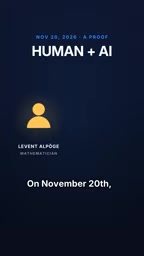
According to the YouTube channel's description, mathematician Levent Alpajay announced a proof on November 20, constructed jointly with AI. This may be the first time the Riemann Hypothesis has been claimed to be conquered.

The heart of the Riemann Hypothesis is the Riemann Zeta function (\zeta(s)), originally defined by the infinite series (\sum_{n=1}^{\infty} n^{-s}), which converges when the real part of (s) is greater than 1, and is then extended to the entire complex plane by analytic continuation (except for the pole at (s=1)). The so-called "nontrivial zeros" are the points where the function equals zero on the complex plane and that are not negative even integers (the trivial zeros). The Riemann Hypothesis asserts that the real part of every nontrivial zero is exactly (\frac{1}{2}), meaning they all lie on the line in the complex plane known as the "critical line." The power of this conjecture lies in the fact that the closer the zeros are to the critical line, the smaller the error between the prime-counting function and the logarithmic integral; in other words, it is equivalent to an extremely precise quantitative characterization of the distribution of the primes, and it is a prerequisite for the truth of over a thousand theorems in modern number theory.
AI and Lean: A Machine-Verified Proof
What makes this proof unusual is not its conclusion but its form. According to the video, the proof is written in Lean—software capable of checking every logical step. The proof is seventeen million lines long.
The verification speed is astonishing: within a single day, the Lean community certified it as correct. This marks the completion of machine checking of the proof, and humans are now racing to understand what it means.

Why Formal Verification Matters
Traditional mathematical proofs rely on peer review, a lengthy process that can miss subtle errors. Tools like Lean check logical correctness line by line, grounding "trust" in machine verification. Seventeen million lines of code passing community certification in a single day is extremely rare in the history of mathematics.
Lean is an interactive theorem prover and also a functional programming language, initiated in 2013 by Leonardo de Moura at Microsoft Research. Its core mechanism is the "Curry–Howard correspondence": propositions are represented as types, proofs as terms of those types, so that "checking a proof" is equivalent to "type checking." Lean's mathematics library, mathlib, is maintained by a global community and has accumulated hundreds of thousands of theorems. After a user writes a proof in Lean, the kernel verifies each step of reasoning against the axioms and existing lemmas; any logical leap or typo causes compilation to fail. For this reason, conclusions verified in Lean carry extremely high credibility at the level of "logical correctness," in sharp contrast to traditional peer review, which relies on human reading and may miss details.
The costs and benefits of formal verification are equally significant. Writing a formal proof typically takes several times to dozens of times longer than an informal one, because every step must be precise enough for a machine to check, and implicit "obvious" steps are never accepted. For this reason, a scale of seventeen million lines is unprecedented in formal mathematics, and passing community certification in a single day is even more so. It is important to distinguish: what Lean certifies is that "the proof code is valid with respect to the formalized proposition"; it does not automatically guarantee that the formalized proposition is the Riemann Hypothesis as people understand it—the faithful transcription of the proposition itself still requires review by human mathematicians. This is also why, even after machine verification passes, understanding and scrutiny by the human community remain indispensable.
Human Understanding Lags Behind Machine Verification
Although the machine has confirmed the correctness of the proof, the video notes that "humans are racing to understand it." This reveals an intriguing phenomenon: a proof can be verified without necessarily being immediately understood. The new challenge facing the math community is how to digest a vast proof generated with AI involvement and verified by machine.

What This Means
If the proof holds up and passes in-depth review by the human community, the Riemann Hypothesis will be solved and the mystery of prime distribution will have its answer. The deeper impact lies in methodology: AI participating in mathematical discovery and formal tools verifying proofs—this combination could reshape the way future mathematical research is conducted.
For now, the claim still requires rigorous scrutiny by the mathematical community, but the passing of machine verification has already given it far more weight than an ordinary preprint claim.
Related articles

Nothing CMF Buds 2A Drops to $17.89 on Black Friday: A New Low for ANC Earbuds
Nothing CMF Buds 2A wireless earbuds Black Friday deal: just $17.89 on Amazon, about $11 off retail and a record low. ANC earbuds at an entry-level price.

When AI Creation Gets Accused of "Spitting": Hacker News Heats Up Over the Glaude Controversy
A Hacker News post, "Spitting in the Face of Glaude," sparks debate on AI creation transparency and attribution ethics. This analysis examines the blurred creator identity behind the controversy and offers practical advice for AI content production.

Akai Embraces Custom Firmware: MPC Sample 1.4 Lets Users AI-Program Their Sampler
Akai embraces the modding community with MPC Sample 1.4 firmware, supporting vibe-coded custom firmware and effects. We analyze the impact of this open strategy on music hardware and AI-assisted programming.