A 17-Million-Line AI Proof: Machine-Verified, Yet Humans Can't Read It
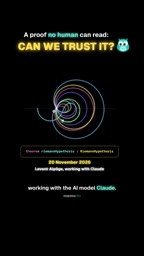
AI and a mathematician produce a 17-million-line formal Riemann proof—machine-verified but not yet human-understood.
A mathematician and Claude created a 17-million-line formal proof of the Riemann Hypothesis, which would take over half a year to read line by line. Verification uses programmatic checkers comparing each step to fixed rules, with cross-validation by multiple independently implemented checkers in different languages, two with their own reliability proofs. All accept it. Yet the mathematical ideas remain ununderstood. Formal verification decouples correctness from understanding, and without formal documents and peer review, it is premature to call it established.
When a Proof Grows Too Long for Humans to Read
A proof spanning 17 million lines. At one line per second, reading nonstop day and night, it would take over half a year. This is the proof of the Riemann Hypothesis—mathematics' most famous unsolved problem—completed by a mathematician working with the AI model Claude.
The question follows naturally: how can we trust that such a proof is correct?
How Machines "Understand" a Proof Humans Can't Finish Reading
The key lies in the proof's structure. It isn't a paper that requires a flash of insight to grasp, but a chain of tiny steps, each using only a few fixed rules.
A program called a checker examines each step line by line to verify it complies with the rules. It doesn't need to understand the idea behind the proof—just as a referee checks whether each move is legal without needing to know the player's overall plan. If a single step violates the rules, the entire proof fails.
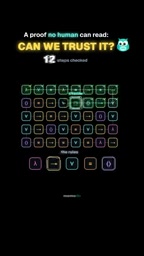
This design removes "understanding" from the verification process. Verification no longer depends on some genius's intuition but becomes a mechanically executable check. This is the first layer of foundation that allows extremely long proofs to be trusted.
Formal proof refers to a proof written in a strict language based on axioms and inference rules, where every step conforms to predefined logical rules and can therefore be mechanically checked by a computer program. In contrast, traditional mathematical papers use natural language and diagrams, relying on the reader's mathematical literacy to fill in reasoning gaps. Representative tools for formal proofs include proof assistants such as Coq, Lean, and Isabelle, which provide a formal language for expressing mathematical propositions and proofs, with a built-in kernel to ensure the validity of each deduction step. The formal statement of the Riemann Hypothesis was completed in multiple proof assistants long ago, enabling machines to precisely determine whether a proof truly proves the conjecture rather than some approximation or variant.
Three Questions: The Proof Is Correct, But Is It Correct?
Skeptics of formal verification typically raise three questions, and this material provides corresponding answers.
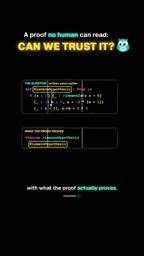
First, could it be proving a different proposition? Experts encoded the Riemann Hypothesis itself as code long ago. Two programs compared this "problem code" with what the proof actually proves, and the results matched perfectly.
Second, what if the checker itself has bugs? The answer is to use multiple independent checkers written in different programming languages. Two of them even come with their own formal proofs guaranteeing they will never accept an incorrect conclusion. All these checkers accepted this proof.
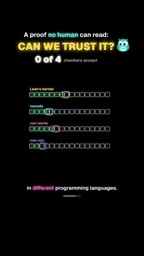
Third, could independent implementations collude? Multiple languages, multiple implementations, some with their own reliability proofs—this combination minimizes the risk of single-point failure. Cross-validation here is not rhetoric but a concrete engineering practice.
A proof checker is a core component of formal proof systems, responsible for examining step by step whether each line in a proof script is legally derived from preceding content and inference rules. A reliable checker is typically based on a small kernel (the de Bruijn criterion), which implements only a few basic rules, thereby minimizing the trust base. However, the checker itself is also software and may contain implementation errors or logical flaws. Therefore, the formal mathematics community advocates a "de-trusting" strategy: using multiple independently developed checkers to cross-verify the same proof. If checkers from different sources and languages all accept the proof, the probability of systematic error in a single checker is extremely low. Some checkers also come with their own formal proofs (such as Coq-extracted checkers), further ensuring their reliability.
What Is Verified Is Correctness, Not Understanding
The story is only half told here.
A proof is not just a pile of symbols; it is also an idea. And the idea embodied in this proof is not yet fully understood by anyone. The author plans to write a formal explanatory document later.
This creates a fascinating mismatch: the machine has completed the check, but humans have not completed understanding. In traditional mathematics, verification and understanding often occur together—reading and understanding a proof means believing it. Formal verification decouples this coupling, allowing correctness to be established before understanding.
This raises a practical question: what place does a proof no one understands occupy in the mathematical knowledge system? It can be cited and reused in other formal work, but for now it cannot inspire new conjectures or proof strategies. The "usability" and "understandability" of knowledge have separated here.
In mathematical philosophy, understanding of proof and correctness are usually regarded as two sides of the same coin. Traditionally, accepting a proof means the mathematical community not only confirms its logical validity but also understands its core ideas, key constructions, and proof strategies. But formal verification separates the two: machines can confirm that a proof is valid within a formal system but cannot extract human-understandable mathematical insight. This separation has sparked discussion about "knowledge without understanding"—does a machine-verified proof that no one understands count as mathematical knowledge? Can it be used to inspire new research? One view holds that such a proof is like a black box: we can trust its output but cannot learn from it. Another, more optimistic view holds that with the development of automated theorem proving and AI, humans can gradually "reverse-engineer" these proofs and extract new mathematical structures. Regardless, the rise of formal verification is reshaping the epistemological boundaries of mathematical knowledge.
A Sober Assessment of AI in Mathematics
What is noteworthy about this material is not that it announces some earth-shattering conclusion, but that it demonstrates a realistic path for AI participation in mathematical research: not letting the model provide inspiration on its own, but having the model produce formal content that can be verified line by line by machines, backed by an independent verification toolchain.
The value of this route lies in transforming the "trust" problem into an engineering problem. But it also has clear boundaries—verification tools can confirm that a proof complies with rules, but cannot tell us whether the proof is elegant, whether it reveals structure, or whether it can be generalized. These still await human judgment.
The material itself does not provide the specific content of the proof, the author's identity, the completion time, or whether it has undergone peer review by the mathematical community. Before formal documents and community review appear, it is premature to treat it as an established mathematical conclusion. The machine saying it's correct and the mathematical community saying it's correct are two different things.
AI-assisted mathematical research currently has several typical modes: first, using large language models to generate conjectures or proof ideas, which human mathematicians then verify and refine; second, using reinforcement learning or search algorithms to automatically find proofs in formal environments; third, as described in this article, having AI generate large-scale formal proof scripts, which are then verified by an independent checker toolchain. These three modes depend on "trust" to different degrees: the first relies most on human judgment, the second on algorithms and formal environments, and the third on engineered verification processes. Notably, even if an AI-generated proof passes formal verification, the mathematical community still needs to assess its novelty, simplicity, and generalizability. Formal verification can only guarantee "no errors," not "value." Therefore, AI's role in mathematics is more likely to enhance human research capabilities than to replace human mathematical judgment.
Frequently Asked Questions
What is the difference between a formal proof and an ordinary mathematical paper? An ordinary paper relies on peer reading and judgment, while a formal proof writes every step as symbolic deductions that can be checked by a program, making the verification process mechanically executable.
Why are multiple checkers needed? If a single checker has a bug, it might incorrectly accept an invalid proof. Using multiple checkers independently implemented in different languages, some with their own reliability proofs, reduces this risk.
Does passing machine verification mean the conjecture has been proven? In the sense of formal verification, the correctness of the proof has been supported. But the mathematical community typically also requires formal documents, readable arguments, and peer review before incorporating it into consensus.
One-line Summary
AI and a mathematician collaborated on a 17-million-line formal proof of the Riemann Hypothesis, machine-verified but not yet understood by humans.
Paragraph Summary
The article describes how a mathematician and the AI model Claude collaborated to produce a 17-million-line formal proof of the Riemann Hypothesis, which would take humans over half a year to read line by line. Verification relies on a programmatic checker comparing each step against fixed rules, cross-validated by multiple checkers independently implemented in different languages—two of which come with their own formal reliability proofs. All checkers accept the proof. However, while machines have completed the correctness check, no one fully understands the mathematical ideas behind the proof. The article notes that formal verification decouples correctness from understanding, and until formal documents and peer review appear, it should not be regarded as an established conclusion in the mathematical community.
Related articles

S&P Weighs Downgrading Nvidia's Credit Rating: Governance and Key Man Risk in Focus
S&P is considering downgrading Nvidia's credit rating to AA-, citing corporate governance and key man risk rather than financial performance. We analyze the drivers, potential impact, and the broader trend of governance scrutiny for large tech companies in the AI era.

Generating a 3D Stacking Game from a Few Prompts: Hands-on with the Playground Experimental Platform
Playground lets users generate the 3D stacking game One More Pie from a few text prompts. This article examines the capabilities and limits of prompt-based web game generation.
AI Math Proofs Are Exploding: Humans Can't Read Fast Enough
AI math proof output now outpaces human reading speed. AINews roundup covers Erdős problems, new matrix multiplication bounds, and Fourier transform bounds—verification is the new bottleneck.