A 4-Week Roadmap to Getting Started with AI Agent Development from Scratch

A structured 4-week roadmap to learn AI Agent development from zero to building functional agents.
This article presents a comprehensive 4-week learning path for AI Agent development, starting from core theory (LLM, Planning, Memory, Tools), progressing through classic paradigms like ReAct and Code Agent, advancing to multi-agent collaboration and Prompt optimization, and culminating in hands-on projects that integrate AI into real business scenarios.
Why Now Is the Window of Opportunity to Learn AI Agent Development
Competition for technical positions has reached a fever pitch. Traditional development roles are not only harder to land—news of pay cuts and layoffs has become commonplace. In this environment, mastering a differentiated skill has become the key for programmers to stand out, and AI Agent development is one of the most competitive directions right now.
From a resume standpoint, candidates with Agent development capabilities are clearly more sought-after when switching jobs or applying for positions. This isn't unfounded—the maturity of large language model capabilities has moved "letting AI autonomously complete tasks" from concept to reality, and demand for developers who can integrate AI technology into actual business operations is growing rapidly. For developers looking to transition or level up, this is a skill direction worth investing in.
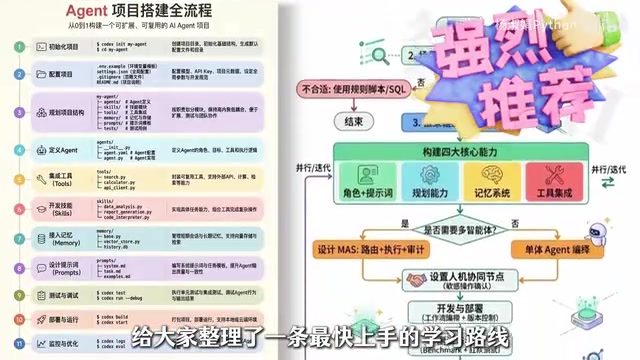
This article outlines a four-week learning path from zero foundation to independently developing AI agents, helping you avoid the common detours in self-study. It's worth emphasizing that the key to a successful career transition isn't about age or background—it's about whether you can commit to completing the full learning cycle.
Week 1: Building a Solid Foundation in AI Agent Core Theory
Understanding the Four Core Components of an Agent
When learning any technology, establishing the right mental model is crucial. The goal of Week 1 is to understand the core components of an AI Agent, so you don't end up "knowing what but not why" during later practice.
A complete AI Agent typically consists of four core modules:
-
Large Language Model (LLM): Serving as the Agent's "brain," responsible for understanding, reasoning, and decision-making. LLMs are deep neural networks based on the Transformer architecture, trained on massive text data through pre-training to acquire language understanding, logical reasoning, and knowledge retrieval capabilities. Representative models like GPT-4, Claude, and Llama range from billions to hundreds of billions of parameters. In Agent scenarios, the LLM doesn't just handle natural language understanding—more critically, it acts as the decision engine. It needs to determine which tool to call next based on current context, how to decompose tasks, and when to terminate the loop. This capability relies on the model's Instruction Following and In-Context Learning abilities, which is why different models perform so differently in Agent scenarios.
-
Planning Module: Responsible for breaking complex tasks into executable sub-steps. The planning module essentially gives AI the ability to transform vague goals into specific execution steps. Common planning strategies in technical implementation include: Task Decomposition (recursively breaking a complex goal into multiple subtasks), Chain-of-Thought (forming execution plans through step-by-step reasoning), and Tree of Thoughts (exploring and evaluating multiple possible planning paths). The quality of the planning module directly impacts Agent reliability—good planning not only decomposes tasks correctly but also considers dependencies and execution order between steps.
-
Memory Module: Enables the Agent to remember context and historical information for continuous dialogue and long-term tasks. An Agent's memory module typically falls into two categories: short-term and long-term memory. Short-term memory corresponds to the LLM's Context Window—the number of tokens the model can process at once, with mainstream models currently supporting 8K to 200K context lengths. Long-term memory requires external storage, with common solutions including vector databases (such as Pinecone, Chroma, Milvus) paired with Embedding Models to convert historical information into vectors for storage, retrievable through semantic similarity search when needed. This RAG (Retrieval-Augmented Generation) mechanism allows Agents to break through context window limitations and maintain cross-session memory.
-
Tools: Give the Agent the means to invoke external capabilities, such as search, code execution, API calls, etc. Tools are the bridge between the Agent and the external world. Through the Function Calling mechanism, the LLM can describe the tools and parameters it needs to invoke in a structured way, with the execution layer completing the actual call and returning results to the model.

Understanding the collaborative relationship between these four modules is the foundation of mastering Agent development. Many beginners fall into the trap of jumping straight into stacking code while neglecting foundational concepts, only to find themselves stuck when facing complex problems. Make sure to thoroughly digest these concepts during Week 1.
Week 2: Mastering Agent Working Principles and Classic Paradigms
From ReAct to Code Agent: Technical Approaches
Week 2 dives into deeper principle-level learning, focusing on understanding Agent working mechanisms and solutions for common challenges. This phase requires studying several classic Agent paradigms.
ReAct (Reasoning + Acting) is one of the most representative paradigms. It has the Agent alternate between "reasoning" and "acting"—first thinking about what to do next, then executing the corresponding action, observing the result, and continuing to reason. This loop pattern significantly improves Agent reliability in handling complex tasks. The ReAct paradigm originated from a 2022 paper jointly published by Google Research and Princeton University: "ReAct: Synergizing Reasoning and Acting in Language Models." Its core innovation lies in interleaving reasoning and action, forming a Thought-Action-Observation loop: the model first generates reasoning text (Thought), then decides to execute an action (Action), receives environmental feedback (Observation), and enters the next round of reasoning. Compared to pure reasoning (like Chain-of-Thought) or pure action approaches, ReAct significantly reduces hallucination rates and improves task completion rates. Mainstream Agent frameworks like LangChain and AutoGPT use ReAct or its variants as their default execution paradigm.

Code Agent represents another technical approach, completing tasks by having the model generate and execute code. It performs excellently in data processing, automation workflows, and similar scenarios. The core idea of Code Agent is to have the LLM generate executable code rather than natural language instructions to complete tasks. Research from Hugging Face shows that Code Agents improve tool-calling accuracy by approximately 30% compared to traditional JSON/text format Agents. The advantages are: code is inherently precise and composable, capable of handling conditional branches, loops, variable passing, and other complex logic; meanwhile, code execution results are deterministic, making debugging and error location easier. Typical implementations include OpenAI's Code Interpreter and Hugging Face's Transformers Agent. Applicable scenarios include data analysis, file processing, API orchestration, automated testing, and other tasks requiring precise control flow. Understanding the design philosophy behind these classic paradigms helps you choose the right architecture in real projects rather than blindly applying a single pattern.
Solving Common Challenges in Agent Development
This week also requires learning solutions for common challenges, such as how to handle Agent "hallucination" problems and how to design reliable error recovery mechanisms. These are key steps in going from a demo to a usable product.
The hallucination problem in Agents is more severe than in regular conversation scenarios because incorrect reasoning gets amplified through the action chain—one wrong judgment can lead to a cascade of subsequent erroneous operations. Common mitigation strategies include: output validation (having the Agent self-check its output), tool result verification (cross-validating through external data sources), execution sandboxing (trial-running in a safe environment before confirming), and human-in-the-loop (introducing human approval at critical decision points). At the architectural level, introducing an independent Critic Agent or Verifier Agent specifically responsible for reviewing the main Agent's output is also a commonly used reliability improvement approach in the industry.
Week 3: Multi-Agent Collaboration and Prompt Optimization in Practice
Making Multiple Agents Work Together
A single Agent's capabilities are inherently limited. Week 3 dives deep into the logic of Multi-Agent collaboration. In complex business scenarios, multiple specialized Agents often need to work together—for example, one responsible for planning, one for execution, and one for review. Understanding the communication and coordination mechanisms between them is essential for building complex agent systems.
Multi-Agent collaboration is similar to the microservices architecture philosophy in software engineering—decomposing complex systems into multiple specialized subsystems. Current mainstream collaboration patterns include: Hierarchical (a manager Agent assigns tasks to execution Agents), Parallel (multiple Agents independently handle subtasks and aggregate results), and Debate (multiple Agents offer different perspectives on the same problem and reach consensus through discussion). Representative frameworks include Microsoft's AutoGen, CrewAI, and MetaGPT. AutoGen supports flexible conversation topology definitions, CrewAI focuses on role-playing and workflow orchestration, and MetaGPT simulates a software company's collaboration process. Which pattern to choose depends on the complexity and reliability requirements of the specific business scenario.
Using Prompt Optimization to Improve Agent Precision
On the other hand, Prompt optimization techniques are another key focus this week. With the same model and the same task, Prompt quality often directly determines the accuracy of Agent output. Learning how to write clear, structured prompts, how to guide the model through examples, and how to constrain output formats will make your Agent understand and execute intended tasks more precisely.
Prompt Engineering in Agent scenarios is far more complex than in regular conversation because it needs to simultaneously control the model's reasoning path, tool-calling decisions, and output format. Systematic optimization methods include: role definition (clearly specifying the Agent's identity, capability boundaries, and behavioral norms in the System Prompt), Few-shot Examples (providing expected input-output pairs as templates), output format constraints (standardizing output structure through JSON Schema or XML tags), and negative instructions (explicitly telling the model what it should NOT do). Advanced techniques also include dynamic Prompt assembly—dynamically concatenating different prompt modules based on task type and context—and A/B testing workflows for iteratively optimizing Prompts based on evaluation data.
This learning phase will clearly separate developers by skill level. Many people can get an Agent "up and running," but only those who master optimization techniques can make it "run well."
Week 4: Hands-On Practice—Integrating AI Agent Technology into Business
Connecting All Knowledge Through Practical Projects
The theory and techniques accumulated over the first three weeks must ultimately be put into practice. Week 4's task is to independently complete several small projects based on what you've learned. Only through hands-on work can you truly understand how modules collaborate, how Prompts affect results, and how multiple Agents coordinate.

It's recommended to start with scenarios close to actual business needs, such as:
-
Automated Information Retrieval Assistant: Combining search tools and RAG technology, have an Agent retrieve and synthesize information from multiple data sources to generate structured reports. This project exercises your comprehensive ability to use tool calling, memory modules, and output format control.
-
Code Assistance Tool: Based on the Code Agent paradigm, build a development assistant that can understand code repository context, automatically generate code snippets, execute unit tests, and iteratively modify code based on feedback. This project helps you deeply understand the ReAct loop and code execution sandbox design.
-
Customer Service Q&A Agent: Design a multi-turn dialogue customer service system integrating knowledge base retrieval, intent recognition, response management, and human handoff mechanisms. This project involves comprehensive capabilities including memory management and multi-Agent collaboration (such as Intent Recognition Agent + Answer Generation Agent + Quality Review Agent).
After completing these projects, you'll have the ability to integrate AI technology into real business operations—which is precisely the core competency that companies value most.
Final Thoughts: Completing the Learning Cycle Is Key
The value of this four-week learning roadmap isn't about making you an expert in a short time—it's about helping you build a complete, correct knowledge framework and avoiding the pitfalls and detours common in self-study. AI Agent development is a field that's still rapidly evolving, and a solid foundation combined with continuous practice is the fundamental key to long-term success.
For career changers starting from zero, the key is to stay focused, follow the plan steadily, and not give up halfway. As long as you commit to completing this learning cycle, regardless of your age, you'll have the opportunity to find your place in this wave of AI advancement.
Key Takeaways
Related articles

Rust Behavior Tree Library Bonsai Surpasses 100K Downloads: From Game NPCs to NASA Robots
Rust behavior tree library Bonsai hits 100K downloads on crates.io, powering Titanfall 2 game bots and NASA Lunabotics space robots after four years of open-source development.

Attyn: The Mac Productivity Tool That Brings AI Directly to Your Cursor
Attyn is a macOS embedded AI tool featuring in-place text rewriting, real-time dictation, screen content Q&A, and visual explanations — all without switching apps. Supports BYOK and local models.

Cursor Beginner's Guide: A Complete Breakdown of Core Features and Use Cases for This AI-Native Coding Tool
A deep dive into Cursor, the AI-native coding tool: intelligent code generation, context awareness, multi-model support, and how it compares to traditional IDEs for developers at every level.