A Beginner's Guide to Vibe Coding: Practical Methods for AI Programming with Natural Language

Vibe Coding creates a new programming paradigm by using natural language to drive AI code generation
Vibe Coding is a new programming paradigm proposed by Andrej Karpathy that uses natural language descriptions to have AI generate code. This article covers mainstream AI programming tools like Cursor, Trae, and Bolt.new, highlighting their features and positioning differences. It emphasizes that AI tools are efficiency multipliers rather than replacements, while noting limitations such as hallucinations and security vulnerabilities in AI-generated code, and identifies prompt engineering as a critical skill.
What is Vibe Coding?
"Vibe Coding" is a brand-new programming paradigm that has recently emerged in the developer community — instead of writing code line by line, you describe your requirements in natural language and let AI tools generate, debug, and optimize the code for you. This approach makes it possible for anyone to become a "10x programmer."
The concept was formally introduced by OpenAI co-founder Andrej Karpathy in early 2025. He described a programming experience of being fully immersed in the "vibe" — expressing intent through natural language and letting large language models (LLMs) handle the actual code writing. The rise of this paradigm is rooted in the qualitative leap in LLMs' code generation capabilities — from GPT-3.5 to GPT-4 and the Claude 3 series, models' understanding of programming languages has evolved from "writing snippets" to "understanding architectural intent and generating complete, runnable projects." The underlying technical foundations include: the Transformer architecture's deep modeling of code semantics, massive open-source code training data (such as billions of lines of code on GitHub), and RLHF (Reinforcement Learning from Human Feedback) for continuous optimization of code quality.
This article will start from the overall approach to AI programming, introduce the current mainstream AI programming tools, and share how to use these tools to complete a real project from scratch.
A Comprehensive Comparison of Mainstream AI Programming Tools
The market is already rich with AI programming tools, covering everything from code completion to full-stack development.
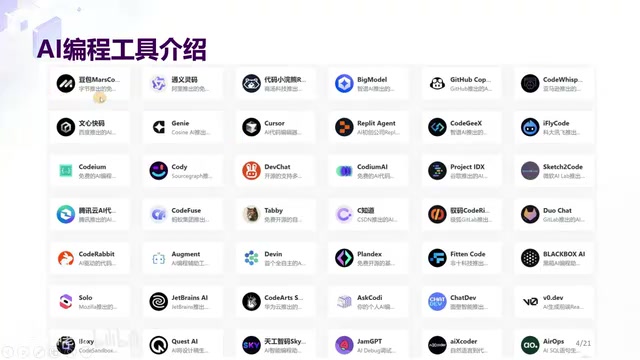
Overview of Representative Tools
- Cursor: An AI-assisted programming assistant integrated with large language models. When released in 2024, it generated enormous attention and was considered a true "programming Copilot." Cursor is an AI-native IDE deeply rebuilt on VS Code, developed by Anysphere. Its core features include Composer mode (multi-file simultaneous editing and generation), Chat mode (debugging code through AI conversation), and the @ symbol reference system (precisely referencing files, functions, and documentation as context). Cursor's key differentiator is its "codebase awareness" — by building a vector index of the entire project, the AI can understand cross-file dependencies, making it far superior to simple code completion tools when handling medium-to-large projects. In 2024, Cursor's ARR (Annual Recurring Revenue) reportedly surpassed $100 million, making it one of the fastest-growing products in the AI programming space.
- Trae (ByteDance): A standout AI programming product from China, with its biggest advantage being completely free to use
- Tongyi Lingma (Alibaba): One of the earliest AI coding assistants launched in China, supporting integration via VS Code plugin
- Raccoon (SenseTime): Built on SenseTime's large model, supporting mainstream languages like Python, Java, and JS
- GitHub Copilot (Microsoft): One of the first widely adopted AI programming assistants globally, based on OpenAI's Codex model specifically fine-tuned for code scenarios, trained on massive GitHub open-source code, pioneering AI code completion
- Bolt.new: An online AI programming platform focused on web development, excellent for building frontend pages. Its technical highlight is the deep integration of WebContainers technology with large language models — WebContainers can run a complete Node.js environment in the browser, allowing Bolt.new to run, preview, and debug complete web applications directly in the browser without any local environment, supporting mainstream frontend frameworks like React, Vue, and Svelte.

Positioning Differences Among Tools
Different tools excel in different areas: Cursor is suited for full-stack development scenarios, Bolt.new specializes in rapid frontend page generation, while Tongyi Lingma and Trae have natural advantages in Chinese language understanding and the domestic development ecosystem. When choosing a tool, you should decide based on your project type and personal preferences.
The Core Value of AI Programming Tools
Efficiency Enhancement, Not Complete Replacement
Taking Raccoon as an example, official data shows it can help developers improve programming efficiency by over 50%. This means AI programming tools are positioned as efficiency multipliers, not replacements for programmers.

Some key points to understand:
- AI tools can handle most repetitive coding tasks
- But architecture design, business logic comprehension, and code review still require human oversight
- Completely relying on tools without understanding the code is unworkable in practice
There are several systemic weaknesses in current LLM code generation worth noting: First, the "hallucination problem" — models may generate code that is syntactically correct but logically flawed, or reference APIs that don't exist. Second, context window limitations — codebases beyond a certain scale will exceed the model's processing capacity. Third, security risks — research has found that AI-generated code has a significantly higher probability of containing security vulnerabilities like SQL injection and XSS compared to code written by experienced human developers. Therefore, code review capability and basic security awareness remain essential prerequisites for using AI programming tools.
Zero-Experience Users Can Get Started Quickly
These tools are equally friendly to users with zero programming experience. By describing requirements in natural language, even complete beginners can have AI generate runnable programs. For example, using the Vibe Coding approach, you can tell the AI "build me a personal portfolio website," and it will generate complete HTML, CSS, and JavaScript code.
However, "how to describe requirements" is itself a core skill, known in the AI field as Prompt Engineering. A high-quality prompt typically includes: a clear objective (what to do), technology stack constraints (what language/framework to use), input/output format, and boundary conditions. For instance, "build me a website" is far less effective than "use HTML/CSS/JavaScript to build a responsive personal portfolio website with a navigation bar, project card display area, and contact form, using a dark color theme."
Related articles
 Tutorials
ChatGPT Plus Subscription Guide: Are GPT-5.5, image-2, and Codex Worth the Upgrade?
A detailed look at ChatGPT Plus features — GPT-5.5, image-2, and Codex — with a Plus vs Pro comparison and a complete step-by-step subscription guide for users outside the US.
 Tutorials
Harness AI Engineering in Practice: Using Claude Code to Master Enterprise-Level E-Commerce Development
Deep dive into Harness AI Engineering: master enterprise e-commerce development with Claude Code using the Rules, Skills, Wiki, and Changes framework.
 Tutorials
Cursor + Codex Dual-IDE Collaboration: A Practical Methodology for Open-Source Project Customization
A complete methodology for open-source project customization based on real-world experience, detailing the Cursor+Codex dual-IDE workflow, seven-stage process, MVP validation, and AI source code reading techniques.