A Complete Guide to Learning Python from Scratch: From Basics to Web Scraping Projects
A complete three-stage Python learning path from basics to web scraping and data analysis for beginners.
This guide presents a systematic Python learning path designed for complete beginners and graduate students, structured in three stages: fundamentals (environment setup, variables, control flow, functions), advanced topics (OOP, functional programming, Python-specific features), and hands-on projects (web scraping, office automation, data analysis, data mining). It also shares four key learning principles: don't skip basics, practice over passive watching, use project-driven learning, and build a knowledge framework.
Why Do You Need a Systematic Python Tutorial?
For graduate students and complete beginners, Python has become an essential skill for data processing, research experiments, and office automation. Since its release by Guido van Rossum in 1991, Python has evolved from a niche scripting language into one of the most popular programming languages in the world. According to the TIOBE Programming Language Index, Python has held the top spot for multiple consecutive years. The key to its success lies in its "low barrier, high ceiling" design philosophy — its syntax closely resembles natural English, making it easy for beginners to pick up, while its powerful third-party ecosystem including NumPy, Pandas, Scikit-learn, and TensorFlow enables everything from simple scripts to deep learning tasks. For graduate students, Python has permeated virtually every discipline: social sciences use it for statistical analysis, biomedical fields use it for genomic data processing, engineering uses it for simulation modeling, and humanities use it for text mining and digital humanities research.
However, there are a massive number of Python tutorials on Bilibili (B站), and the quality varies wildly — some popular tutorials have millions of views, while others languish with just a few dozen or hundred, but very few manage to be truly systematic, comprehensive, and easy to understand.
Recently, a content creator spent three months producing a systematic course for complete beginners after researching various Python tutorials on Bilibili. The design philosophy behind this course is worth noting: rather than a fragmented list of knowledge points, it offers a complete learning path from fundamentals through advanced topics to hands-on projects. This article breaks down the course structure and shares practical methodology for learning Python from scratch.
Course Structure: A Three-Stage Progressive Learning Path
This course adopts the classic Fundamentals → Advanced → Hands-on Projects three-stage structure, which has been proven to be the most effective approach to learning programming.
Fundamentals: Building a Programming Mindset
The fundamentals section covers the core knowledge points for getting started with Python:
- Environment Setup: Python installation and development environment configuration. While this is the first hurdle for beginners, the concepts involved are not trivial. Mainstream development approaches include using the official CPython interpreter with IDEs like VS Code or PyCharm, or using the Anaconda distribution (which comes with hundreds of scientific computing packages and the conda package manager). Anaconda is particularly well-suited for data science scenarios because it uses a Virtual Environment mechanism to resolve package version conflicts between different projects, allowing each project to have its own independent Python version and dependency libraries. Additionally, Jupyter Notebook, as an interactive programming environment that allows you to mix code, execution results, and Markdown documentation together, is ideal for data exploration and research experiment documentation, and has become the de facto standard tool in academia.
- Variables and Data Types: Understanding the most fundamental data storage concepts in programming
- Control Flow: Conditional statements (if-else) and loops (for/while)
- Functions: The basic unit of code reuse
These topics may seem simple, but they form the foundation for all advanced applications that follow. Many beginners frequently get stuck when learning web scraping or data analysis, and the root cause is often that they never truly mastered the fundamental concepts.
Advanced: From "Can Write" to "Write Well" in Python
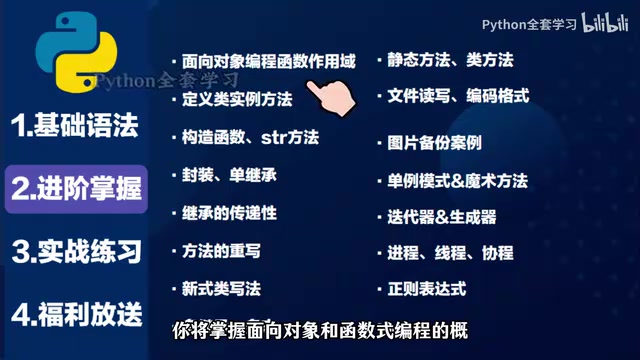
The advanced section is the critical stage that separates learners, covering two major programming paradigms:
-
Object-Oriented Programming (OOP): Concepts like classes and objects, inheritance, encapsulation, and polymorphism form the foundation for understanding the code structure of large-scale projects. Object-oriented programming is a cornerstone paradigm of modern software engineering, proposed by Alan Kay in the 1960s. Its core idea is to encapsulate data and the methods that operate on that data within "objects," using classes as blueprints to create object instances. The four pillars — encapsulation, inheritance, polymorphism, and abstraction — each have distinct engineering value: encapsulation hides internal implementation details, reducing coupling between modules; inheritance enables code reuse, allowing subclasses to extend parent class functionality; polymorphism allows different types of objects to respond differently to the same message, increasing code flexibility. In Python, OOP is ubiquitous — web frameworks like Django and Flask, PyTorch's neural network modules, and even Python's built-in data types are all objects. Understanding OOP is not only key to writing good Python code but also a prerequisite for reading open-source project source code and participating in team-based collaborative development.
-
Functional Programming: Higher-order functions, Lambda expressions, decorators, and more make code more concise and efficient. Functional Programming originates from Lambda calculus in mathematics and emphasizes building programs using pure functions (without side effects) and immutable data. While Python is not a purely functional language, it has borrowed extensively from languages like Haskell and Lisp. Lambda expressions allow the creation of anonymous functions, commonly used in sorting and filtering scenarios; higher-order functions like map(), filter(), and reduce() enable declarative operations on collections; decorators are essentially syntactic sugar for higher-order functions, adding functionality (such as logging, performance timing, and permission checks) without modifying the original function's code — one of the most commonly used patterns in Python framework design. The functional programming mindset makes code more concise, testable, and easier to parallelize, with particular advantages in building data pipelines.
-
Advanced Python Features: List comprehensions, generators, context managers, and other elegant Python-specific idioms. These features embody the "Pythonic" design philosophy — expressing programming intent in the most concise and elegant way possible. List comprehensions can compress traditional multi-line loops into a single line, resulting in not only shorter code but also typically better execution performance, since they are optimized at the C level under the hood. Generators use the yield keyword to implement lazy evaluation, eliminating the need to load all data into memory at once when processing large-scale datasets — particularly important for graduate students working with GB-scale experimental data. Context managers use the with statement to automatically manage resource acquisition and release, with the most typical applications being file operations and database connections, effectively preventing resource leaks. Mastery of these features is often the dividing line between Python beginners and proficient developers.
After mastering these topics, your code will evolve from merely "working" to being "efficient, elegant, and reusable." For graduate students, the maintainability and readability of experimental code will see a qualitative leap.
Hands-on Projects: Validating Your Learning Through Real Projects
The hands-on section is the highlight of the entire course, covering several high-demand application areas:
-
Web Scraping Projects: Scraping images, videos, and other multimedia resources. The working principle of web crawlers/spiders is to simulate a browser sending HTTP requests to target servers, then parsing and extracting the returned HTML, JSON, and other data. Python's web scraping ecosystem is very mature: the Requests library handles sending network requests, BeautifulSoup and lxml are used for parsing HTML documents, and Scrapy is a full-featured scraping framework that supports distributed crawling and data pipelines. It's important to note that web scraping has legal and ethical boundaries. In China, relevant judicial interpretations from 2019 clarified the applicable circumstances for the crime of illegally obtaining computer information system data; a website's robots.txt protocol specifies the allowed scope for crawling; and excessively frequent requests may constitute an attack on the server. When using web scraping to collect data for academic research, you should comply with the target website's terms of service, control request frequency, and ensure data usage complies with privacy protection regulations.
-
Office Automation: Batch processing of Excel, Word, and other office documents
-
Data Storage and Analysis: Data collection, cleaning, storage, and visualization. Python's data science ecosystem is the core reason for its widespread adoption in academia. This ecosystem is built on NumPy — which provides high-performance multidimensional array objects and mathematical functions, implemented in C and Fortran under the hood, with computation speeds far exceeding pure Python. Pandas is built on top of NumPy and provides the DataFrame data structure, similar to an Excel spreadsheet but far more powerful, supporting data cleaning, merging, group aggregation, time series processing, and more. Matplotlib and Seaborn handle data visualization — the former offers extreme flexibility, while the latter provides more aesthetically pleasing default styles for statistical charts.
-
Data Mining: Discovering valuable patterns and insights from data. At the data mining level, Scikit-learn provides a unified interface for classic machine learning algorithms including classification, regression, clustering, and dimensionality reduction, and its fit-predict API design has become an industry standard. For graduate students, mastering the Pandas + Matplotlib + Scikit-learn combination can cover the data processing and analysis needs of most research papers.
These skills are especially practical for graduate students — whether it's collecting data for papers, batch-processing literature, or analyzing experimental data, Python can dramatically improve work efficiency.
Four Practical Tips for Learning Python from Scratch
Make Good Use of Supplementary Resources
A good tutorial is more than just the videos themselves — supplementary resources are equally critical. This course provides a complete learning resource package including mind maps, project files, software installers, lecture notes, and e-books. For complete beginners, mind maps help you build a big-picture view of the knowledge system, while practice exercises are essential for reinforcing memory.
Proven Learning Methodology
Drawing from years of programming teaching experience, there are four key principles for learning Python from scratch:
-
Don't Skip the Basics: Many people rush to learn web scraping or data analysis, jumping straight into projects without covering basic syntax, only to find themselves completely lost when they encounter errors. A solid foundation is the prerequisite for everything. Error messages (Tracebacks) in programming are actually extremely valuable debugging clues — they tell you the error type (such as TypeError, IndexError, KeyError, etc.) and where it occurred. But if you don't understand fundamental concepts like variable types, data structures, and control flow, you won't be able to read these messages, let alone locate and fix the problems.
-
Doing Is More Important Than Watching: Programming is a practical skill — watching videos without writing code is the same as not learning at all. You should type out the code for every concept yourself and try modifying and extending it. Cognitive science research shows that Active Recall and Spaced Repetition are the most effective learning strategies, and programming is inherently a form of active practice — you must conceive the logic, write the code, and debug errors yourself. This process yields memory retention rates several times higher than passively watching videos.
-
Let Projects Drive Your Learning: After mastering basic syntax, find a small project that interests you as soon as possible. For example, scrape data from a website you follow, or automate repetitive daily tasks. The advantage of Project-Based Learning is that it provides a real problem context where you need to integrate multiple knowledge points to solve a complete problem — this kind of integrative practice builds much deeper understanding than doing isolated exercises.
-
Build a Knowledge Framework: Use mind maps or note-taking tools to connect the knowledge points you've learned into a complete knowledge network, rather than leaving them as scattered fragments.
Conclusion
For graduate students and complete beginners, Python is no longer a "nice-to-have" — it's a "must-have" skill. Choosing a systematic and comprehensive tutorial, following the Fundamentals → Advanced → Hands-on Projects path step by step, combined with ample practice and project work, is the most efficient way to get started.
The core principles boil down to three things: don't rush, don't skip steps, and keep practicing hands-on. About three months of systematic study is enough for a complete beginner to independently complete practical projects like web scraping and data analysis.
Related articles

Firemaps Spain: Real-Time Wildfire Monitoring Map with Wind Flow Visualization
Firemaps Spain is an open-source real-time wildfire monitoring tool for Spain and Portugal, combining fire hotspot data with wind flow visualization to help assess fire spread direction.

Google AI Studio Hiring TPM Lead: Decoding the Three Key Criteria Including 'AI Pilled'
Google DeepMind's AI Studio team is hiring a TPM lead with three key criteria: AI pilled, high agency, and pushing the frontier. A deep dive into Google's acceleration strategy and AI talent trends.

Google AI Studio Hiring TPM Lead: Decoding Three Key Selection Criteria Including 'AI Pilled'
Google DeepMind's AI Studio team is hiring a TPM Lead with three key traits: AI pilled, high agency, and pushing the frontier. Deep analysis of AI talent competition trends.