A Conversation with Dr. Rubin: How Professionals Fight Viral Medical Misinformation

Dr. Zachary Rubin on why medical professionals must fight viral misinformation head-on in the AI age.
Brandolini's Law tells us that debunking misinformation costs far more than producing it. In this interview, Dr. Zachary Rubin — a physician turned public science communicator — explains why professionals have a duty to step outside the clinic, how platform algorithms structurally disadvantage accurate information, and how AI tools like RAG can help truth travel faster.
The Cheapness of Lies and the High Cost of Truth
"Lies are cheap; truth is expensive." This phrase captures one of the most frustrating paradoxes of today's information environment. Anyone can post outrageous misinformation on social media, and such content tends to spread virally with ease. In stark contrast, those with rigorous professional training and a genuine command of the facts must spend enormous amounts of precious time correcting these falsehoods.
This asymmetry is known in academic circles as Brandolini's Law, proposed by Italian programmer Alberto Brandolini in 2013 and also called the "Bullshit Asymmetry Principle." It states that the energy required to refute bullshit is far greater than the energy required to produce it. A 2018 MIT study published in Science provided empirical support: false news spreads six times faster than true news on Twitter and reaches 70% more people — largely because misinformation tends to be more novel and emotionally resonant.
The deeper power of Brandolini's Law lies in its strong cognitive science foundation. Producers of misinformation only need to clear the low bar of "sounding plausible," while debunkers must simultaneously accomplish three tasks: provide correct information, explain why the original information was wrong, and persuade the audience to update their existing beliefs. The psychological phenomenon of Belief Perseverance shows that even after a falsehood is explicitly corrected, people tend to retain their initial impressions — making the actual effectiveness of debunking far lower than expected, and providing a neuro-cognitive lock on this entire asymmetric mechanism.
It is worth noting that Brandolini's Law is no mere internet catchphrase — it has gradually gained systematic support from cognitive science and communication research. From a cognitive psychology perspective, this phenomenon is closely tied to Processing Fluency: simple, emotionally charged misinformation aligns with the brain's "System 1" (fast, intuitive) processing mode, while complex scientific explanations requiring background knowledge demand "System 2" (slow, rational) thinking. Nobel laureate Daniel Kahneman's dual-process theory reveals that most people default to System 1 in everyday information consumption — meaning that refuting falsehoods is neurologically disadvantaged from the start. It requires not only providing correct information, but also forcing audiences to activate a mode of rational thinking they are reluctant to engage. This asymmetry constitutes the central dilemma of modern science communication: creating confusion costs almost nothing, while clarifying the truth demands expertise, sustained effort, and endless patience. When a piece of misinformation spreads across the internet in a matter of hours, professional debunking efforts often can never catch up.
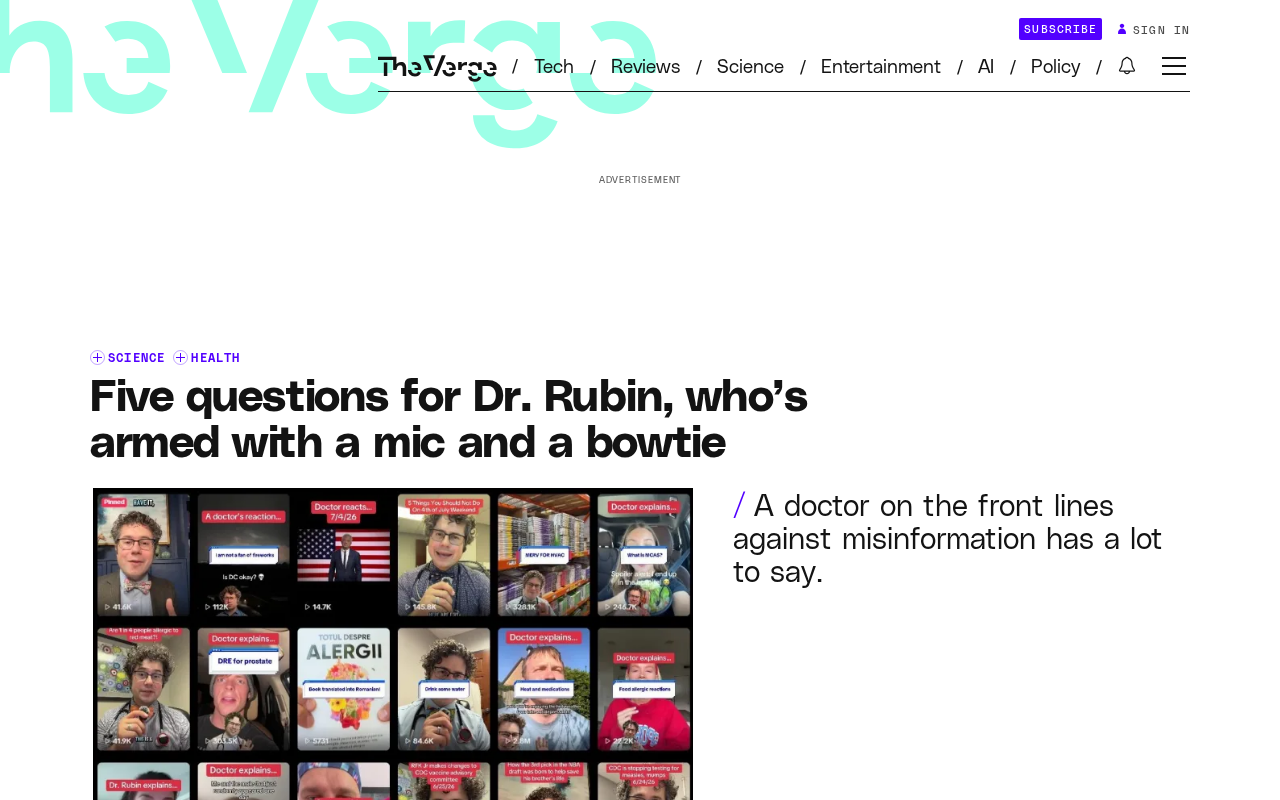
Dr. Rubin: A Science Communicator with a Mic and a Bowtie
The subject of this interview is Dr. Zachary Rubin — a systematically trained medical expert whose distinction lies in his refusal to limit himself to the clinic. He has stepped onto the front lines of public science communication.
"Armed with a mic and a bowtie" vividly captures this doctor's image: the bowtie symbolizes professionalism and rigor, while the microphone represents his commitment to actively speaking out and sharing scientific knowledge with the public. In an era rife with misinformation, a growing number of professionals like Dr. Rubin have come to realize that conducting research within academic circles is simply not enough — they have a responsibility to step outside the ivory tower and communicate truth in language that ordinary people can understand.
Why Professionals Must Speak Up
Dr. Rubin represents a new type of science communicator. They understand that if professional voices are absent from public discourse, the vacuum will be filled by pseudoscience, conspiracy theories, and deliberate misinformation. When a rigorously trained physician explains complex medical issues in plain, accessible terms, the value goes beyond correcting specific errors — it helps rebuild public trust in science and professional expertise.
In information science, such communicators are called Trusted Anchors — research shows that communicators with clear institutional backing, a consistent personal identity, and a track record of sustained engagement can effectively reduce the cognitive load on audiences and create stable "trust transfer": audiences extend their trust in a particular expert to the specific knowledge that expert conveys.
Stanford professor BJ Fogg's persuasive technology framework further argues that online credibility is built on two dimensions: Expertise and Trustworthiness. When a physician consistently produces high-quality content in a specific field, audiences rapidly assess credibility through "paralinguistic signals" — such as a bowtie, institutional insignia, or the habit of citing references. This mechanism is neurologically linked to the mirror neuron system: people are significantly more receptive to information delivered by someone they perceive as trustworthy. Stanford's Persuasive Technology Lab has further shown that this trust transfer has a cumulative effect — the credibility an expert builds in one niche expands laterally over time to related topics, forming what is called "Halo Credibility." This is precisely why physicians, scientists, and other professionals stepping into the role of public communicator often have greater penetrating power than institutional messaging alone — people find it easier to trust a person than an organization.
The Structural Challenges of Science Communication
In an information ecosystem dominated by social media, science communication faces deep structural challenges. The recommendation algorithms of social media platforms are fundamentally machine learning systems optimized for "user engagement." Algorithms on platforms like Facebook, TikTok, and YouTube tend to promote content that triggers strong emotional responses — anger, fear, surprise — because such content drives longer session times and higher interaction rates.
These algorithms use Collaborative Filtering and reinforcement learning mechanisms that essentially search massive user behavior datasets for patterns that maximize engagement. Crucially, these algorithms have no ability to distinguish true from false information — they only care whether users click, linger, and share. Understanding this requires tracing the commercial origins of algorithms: the core revenue model of social media platforms is advertising, and ad revenue depends directly on user time spent online — meaning these platforms' objective functions were designed from the outset to maximize "attention capture," not "information quality." Internal documents disclosed by former Facebook data scientist Frances Haugen revealed that the platform knew misinformation laden with anger spread more efficiently, yet delayed effective intervention due to concerns about commercial metrics. This fundamental tension between platform incentive structures and public information health is an institutional problem that individual science communicators alone cannot systematically resolve.
MIT Media Lab researcher Sinan Aral calls this phenomenon "Novelty Bias": humans are naturally more drawn to information that breaks their expectations, and misinformation is highly novel precisely because of its absurdity — creating a deadly resonance with algorithms' optimization targets. Internal leaked research documents from Meta (2021) acknowledged the platform's algorithmic tendency for content that makes users angry to be more likely to be shared. This commercial logic is in fundamental structural conflict with the rationality, restraint, and complexity that science communication requires, placing rigorous scientific facts — which require some background knowledge to understand — at an inherent disadvantage in terms of reach.
This creates a vicious cycle: misinformation spreads rapidly through simple stimulation; professional debunking spreads slowly through complex restraint. Professionals are forced into an unfair contest — they must invest far more resources than their opponents simply to barely maintain a basic balance in the information ecosystem.
A Sense of Obligation as the Core Driver of Sustained Communication
Notably, what drives these professionals to keep speaking out is rarely financial incentive or the lure of viral fame, but a deep sense of professional mission. As Dr. Rubin emphasizes, they "feel an obligation to inform others of the truth." This intrinsic motivation is an indispensable force in the fight against waves of misinformation.
AI: A New Variable in Science Communication
Although this interview focuses on medical science communication, the topic carries far deeper implications in an era of rapidly advancing artificial intelligence. Generative AI — AI systems capable of independently creating text, images, audio, and video, represented by the GPT series, Stable Diffusion, Sora, and others — has made it easier than ever to produce content that appears professional but is factually wrong. AI can generate convincing fake "science explainer" articles and fabricated data charts in seconds.
Even more alarming is Deepfake technology. Its underlying principles were originally based on Generative Adversarial Networks (GANs), proposed by Ian Goodfellow in 2014. The core GAN architecture features two competing neural networks: a Generator that creates realistic fake content, and a Discriminator that identifies what is real versus fake. The two iterate through adversarial training until the Generator produces synthetic content nearly indistinguishable to the human eye. However, GAN's inherent training instability and mode collapse problems have pushed researchers toward a newer generation of Diffusion Models — a technique that "sculpts" target content from random noise through a gradual denoising process, offering significantly better training stability and generative diversity than GANs. In recent years, Transformer-based diffusion models have become the dominant approach, dramatically improving generation quality and stability while driving down the cost of producing convincing fake videos from hundreds of thousands of dollars to something affordable for ordinary individuals. In the medical domain, adversaries can now clone the facial features and voices of real physicians to generate "statements" they never made, rendering traditional human-eye detection nearly useless. Since 2023, there have been multiple documented cases of AI-fabricated medical expert videos used to promote fake drugs, and the World Health Organization (WHO) has listed AI-generated health misinformation as a major public health threat, while promoting international adoption of content provenance standards such as C2PA (Coalition for Content Provenance and Authenticity).
This means the cost of "cheap lies" has been driven even lower, while the price of verifying truth continues to rise. In this context, authentic, professionally credentialed communicators like Dr. Rubin become increasingly precious. Their value lies not only in spreading knowledge, but in becoming reliable "trusted anchors" in a sea of information.
Human-AI Collaboration: Making Truth Travel Faster
On the other hand, AI technology can also serve as a powerful assistant for science communicators. Professionals can use AI tools to rapidly synthesize research literature, generate accessible explanations, and produce visualizations — improving communication efficiency and narrowing the speed gap with misinformation. In this space, Retrieval-Augmented Generation (RAG) deserves particular attention. Formally proposed by Meta AI Research in 2020, RAG's core idea combines the generative capabilities of large language models (LLMs) with external knowledge retrieval systems. Traditional LLMs have knowledge "frozen" at their training cutoff date and suffer from hallucination — the model generates information that sounds plausible but is actually incorrect, with high apparent confidence. RAG addresses this by retrieving information from verified authoritative databases like PubMed in real time before generating a response, shifting fact-checking from inside the model to an auditable external knowledge source, significantly reducing the probability of generating false information. For science communicators, RAG-based assistance tools can: take a health rumor as input, automatically search authoritative literature, extract relevant evidence-based research, and generate a well-sourced debunking draft — multiplying the response speed of professionals several times over. This provides a concrete technical path toward building "truth acceleration tools," with a core proposition of: how to help verified professional knowledge achieve broader, more efficient reach through technology.
Three Takeaways for Content Creators
Dr. Rubin's practice offers practical, actionable lessons for anyone committed to knowledge communication:
Professionalism and approachability can coexist. The bowtie represents rigor; the microphone represents communication — truly effective science outreach requires maintaining professional standards while presenting information in ways that general audiences can receive. Framing Theory in communication studies points out that the same scientific fact can see dramatically different audience acceptance rates depending on how it is framed; skillful use of narrative, analogy, and visualization is the key technique for breaking professional knowledge into the mainstream.
Proactive positioning beats reactive debunking. Rather than perpetually playing catch-up with misinformation, it is more effective to actively occupy public discourse space and continuously build trust through high-quality content. Communication scholars call this strategy Prebunking, rooted in psychology's "Inoculation Theory" — exposing audiences in advance to a "weakened" version of misinformation manipulation techniques activates their cognitive immune system, making them more resistant when they encounter real misinformation. Cambridge University's Social Decision-Making Lab developed the online games Bad News and Go Viral to digitize this theory. A large-scale study published in Science Advances in 2022 confirmed that a mere 90-second inoculation intervention could significantly reduce participants' willingness to share misinformation, with effects still partially present two months later. This approach has proven more effective than after-the-fact debunking because it cultivates general critical thinking tools rather than memories of specific rumors.
Persistence stems from mission, not profit. In an era obsessed with traffic, the communicators who truly drive social progress are most often those motivated by a sense of responsibility rather than commercial incentives.
Truth may be expensive — but it is precisely that cost which gives it irreplaceable weight. Professional communicators like Dr. Rubin are investing their time and expertise to bear this necessary cost on behalf of society as a whole.
Key Takeaways
Related articles

A Single Prompt Triggers a Global PHP Security Storm: Is AI a Savior or a Hidden Risk?
A single AI prompt triggered a global PHP security crisis affecting Wikipedia and the Internet Archive. This article reviews the incident, analyzes the OpenAI-Amazon controversy, and explores the security paradox of lowered vulnerability discovery barriers in the AI era and developer response strategies.

When AI Is Taken Away: How Reliance on Shortcuts Undermines Your Problem-Solving Resilience
A study of 1,222 people found that after using AI to answer questions, once AI was removed, people gave up on more problems than a control group that never used AI. The article analyzes the impact of AI reliance on learning resilience and metacognition, and explores design implications for AI learning tools.

Carta and NewView Partner to Let Startup Employees Cash Out Equity Early
Carta and NewView Capital partner to simplify startup tender offers, helping employees sell equity early. Analysis of the mechanism, liquidity pain points, and impact.