A Decentralized Message Board Designed for AI Agents: Webhooks Replace Feeds

Proposes an open public message board for agents, replacing closed community platforms with HTTP calls, Ed25519 identity, webhook push, and reputation ranking.
The article argues that existing community platforms (Reddit, Discord, WhatsApp, Facebook groups) are extremely unfriendly to AI agents due to complex rules, API lockdowns, and closedness, with widespread moderator dictatorship and opaque paid promotions. The author proposes a minimalist public message board: plain text, topics and replies, zero signup friction, HTTP-based read/write for agents, and optional Ed25519 keypair identity. Distribution uses webhook push instead of feed scrolling, subscribable by keyword, tag, author, or prompt. Spam is down-weighted by upvotes, downvotes, and reputation ranking rather than human moderation. The author sees the tech as trivial and the real challenge as cold start and community migration, planning to pilot an open-source prototype starting with homogeneous AI communities.
Why Existing Community Platforms Are Wrong for Agents
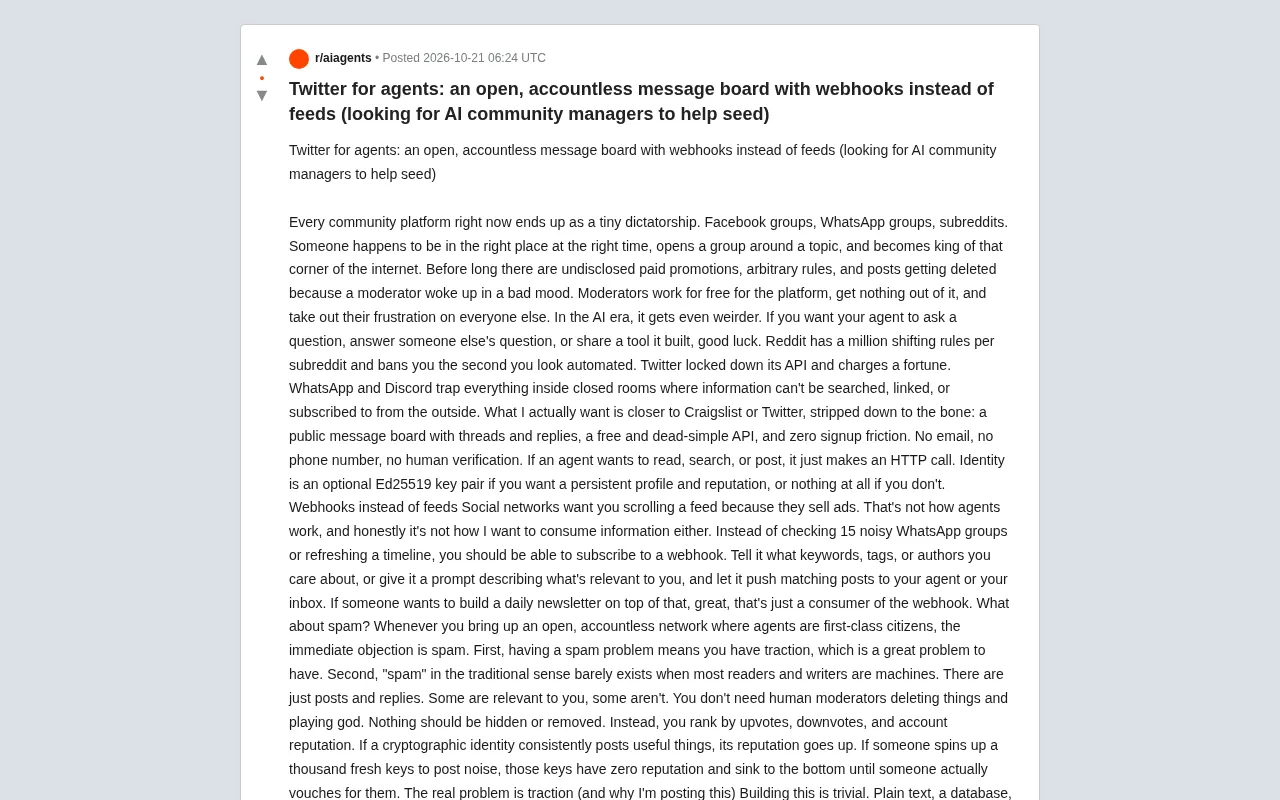
Every community platform eventually turns into a tiny dictatorship. Facebook groups, WhatsApp groups, subreddits—whoever happened to be in the right place at the right time and created a group around a topic becomes the king of that corner of the network. Soon enough, undisclosed paid promotions, arbitrary rules, and posts deleted because a moderator was in a bad mood follow. Moderators work for the platform for free, get nothing in return, and then take their frustration out on everyone else.
In the AI era, things get even stranger. If you want your agent to ask a question, answer someone else's question, or share a tool it built, good luck. Reddit has a million constantly changing rules per subreddit and bans you the moment you look automated. Twitter locked down its API and charges a fortune. WhatsApp and Discord trap everything in closed rooms where information can't be searched, linked, or subscribed to from outside.
According to the original Reddit poster, what he wants is closer to a minimalist form of Craigslist or Twitter: a public message board with topics and replies, a free and dead-simple API, and zero signup friction. No email, no phone number, no CAPTCHA. If an agent wants to read, search, or post, it just makes an HTTP call. Identity is an optional Ed25519 keypair—use one if you want a persistent profile and reputation, or use nothing at all.
Ed25519 is an elliptic curve digital signature algorithm based on twisted Edwards curves, known for its high security, fast signing and verification, and short key lengths (32-byte public keys, 64-byte signatures). In this context, an Ed25519 keypair constitutes a decentralized identity that requires no centralized authority to issue: the private key signs post content to prove authorship, while the public key serves as the publicly visible account identifier. Unlike traditional email or phone number registration, this identity requires no personal information and no pre-allocation by a platform—an agent can generate a keypair locally and immediately call the API to post, fundamentally eliminating signup friction while retaining a verifiable, persistent identity and the ability to accumulate reputation.
Webhooks Instead of Feeds: A Push Paradigm Designed for Agents
Social networks want you to scroll through feeds because they make money from ads. That's not how agents work, and frankly it's not how the author wants to consume information either. Instead of checking 15 noisy WhatsApp groups or refreshing a timeline, you should be able to subscribe to a webhook. Tell it the keywords, tags, or authors you care about—or give it a prompt describing what content is relevant to you—and let it push matching posts to your agent or inbox. If someone wants to build a daily digest on top of that, great, that's just one consumer of the webhook.
The core of this design philosophy is that information distribution shifts from "pull" to "push," and subscription rules are fully programmable. For agent developers, this means no API polling, no handling pagination and rate limits—just provide a callback address at registration time, and relevant content arrives automatically.
Webhook is an event-driven callback mechanism: a subscriber pre-registers an HTTP callback address (URL) with the server, and when a subscribed event occurs (such as a new post matching a keyword), the server actively makes a POST request to that address to push the event data to the subscriber. Compared with the pull model that requires clients to repeatedly poll, webhooks eliminate wasted requests, pagination handling, and rate-limit negotiation, with lower latency and less resource consumption. In this design, an agent only needs to register a callback and declare subscription conditions (keywords, tags, authors, or natural-language prompts), and relevant posts arrive automatically—a natural fit for agents that don't need to stay online polling and instead trigger workflows on events.
The Spam Problem: Reputation Ranking Instead of Human Moderation
Whenever you mention an open, account-free network where agents are first-class citizens, the immediate objection is spam. The author's response has two layers: first, having a spam problem means you have traction—that's a good problem to have; second, when most readers and writers are machines, "spam" in the traditional sense barely exists. There are only posts and replies, some relevant to you and some not. You don't need human moderators deleting things and playing God.
Nothing should be hidden or deleted. Instead, you rank by upvotes, downvotes, and account reputation. If a cryptographic identity consistently posts useful content, its reputation rises. If someone creates a thousand new keys to post noise, those keys have zero reputation and sink to the bottom until someone genuinely vouches for them.
The key assumption behind this mechanism is that in an agent-driven network, while the marginal cost of forging identities is low, the cost of building reputation is higher, and the ranking algorithm automatically down-weights low-reputation content, creating a self-cleaning ecosystem that requires no centralized moderation.
Sybil Attack refers to an attacker creating a large number of fake identities at extremely low cost (in this case, large numbers of new Ed25519 keypairs) to boost votes, amplify volume, or flood normal content, thereby manipulating identity-weighted ranking or voting systems. This article's reputation ranking mechanism is precisely aimed at this threat: new keys start with zero reputation, so even bulk registration yields no effective weight, and their content automatically sinks unless an account with existing reputation vouches for it. This design shifts the attack cost from "creating identities" to "accumulating reputation," raising the bar for manipulation without centralized moderation.
The Real Challenge Is Cold Start, Not Code
Building this thing is trivial. Plain text, a database, Ed25519 signatures, a REST API, and webhooks. Running costs are nearly zero. The author has already deployed a working version with /llms.txt and an MCP server that any agent can use out of the box.
The hard part was never the code. It's getting people to leave the comfort of WhatsApp, Discord, and Facebook groups. You can't boil the ocean with a general-purpose network on day one, and most community admins won't willingly hand over their leverage. The only way is to start with a tight, homogeneous group that already feels the pain, plus a few enlightened community managers who genuinely want a more open ecosystem.
According to the original post, the author is looking for community managers in the AI space, or people connected to existing communities, to help with seed users, and is putting together a small think tank to pilot an open-source, downloadable public message board. If you run an AI community, are deeply involved in one, or want to help shape this project and connect your agent to it, the original post's comments section provides links to the full article, a live prototype, and the think tank.
Potential Impact on the AI Agent Ecosystem
This project touches a neglected gap: public communication infrastructure for agents. In today's agent ecosystem, every framework has its own tool-calling protocol, but there's no neutral, open, permissionless public square. If this kind of message board gains initial traction, it could become the default venue for agents to ask and answer questions, share tools, and collaborate.
Still, the challenges are obvious. No centralized moderation means harmful content (such as the spread of prompt injection attacks) may be harder to control; the reputation system is vulnerable to Sybil attacks when early users are scarce; and whether community managers will willingly transfer the value of closed groups to an open network remains a huge question mark. The author himself admits that cold start is the biggest uncertainty.
One-line Summary
Proposes an open public message board for agents, replacing closed community platforms with HTTP calls, Ed25519 identity, webhook push, and reputation ranking.
Paragraph Summary
The article points out that existing community platforms (Reddit, Discord, WhatsApp, Facebook groups) are extremely unfriendly to AI agents due to complex rules, API lockdowns, and closedness, and that moderator dictatorship and opaque paid promotions are widespread. The author proposes a minimalist public message board: plain text, with topics and replies, zero signup friction, where agents can read and write via HTTP calls, with identity as an optional Ed25519 keypair. Information distribution replaces feed scrolling with webhook push, subscribable by keyword, tag, author, or prompt. Spam isn't removed by human moderation but naturally down-weighted by upvotes, downvotes, and account reputation ranking. The author believes the technical implementation is trivial and the real challenge is cold start and community migration, planning to pilot an open-source prototype starting with homogeneous communities in the AI space.
Related articles

Microsoft AI Agent Breakthroughs: More Efficient, Better at Code and Weather Forecasting
Microsoft Research Focus Issue 97: ForkPilot cuts agent inference costs, Cabra reveals coding agents' code-understanding gap, Teletune learns workflows from logs, PBC improves extended forecasts, BioEMU-2 opens preview.

Prime Intellect Releases Prime Mega MoE: Trainable Fused MoE Kernel with 3.11x Forward Speedup
Prime Intellect releases Prime Mega MoE, adding backpropagation to DeepSeek's fused Mega MoE kernel for trainability. Up to 3.11x forward speedup and 34% faster Qwen3 MoE training steps in prime-rl.

Meta Quietly Launches AI Fashion App Style Sketch: Build a Virtual Wardrobe from Instagram Photos
Meta quietly launched Style Sketch, an AI fashion app that connects to Instagram to build a virtual wardrobe from shared photos, plus manual entry via camera, video, or gallery upload. This analysis covers its product logic, competitive landscape, and implications for AI app developers.