A Former Tencent Engineer's Complete Journey Building a 'Decision Paralysis' Mini Program with AI

Former Tencent engineer builds an ad-free product comparison mini program solo using Tencent's CodeBuddy AI coding tool.
Frustrated by e-commerce platforms that sort products by ad spend rather than specs, a former Tencent engineer used AI coding tool CodeBuddy to build a WeChat mini program called 'Decision Paralysis' — letting users sort phones by Geekbench scores and DXOMark ratings. The project illustrates a complete solo product journey: from manual spreadsheet validation to AI-assisted coding, crowdsourced data entry, and a final app launch.
It Started with Helping a Friend Pick a Phone: How a Real Pain Point Was Born
Many products begin with a genuine everyday frustration. This former Tencent engineer's story is a perfect example: a female friend asked him to help her pick a phone — budget 2,000 RMB, primary use case being recording and editing videos. It was exactly the kind of thing he was good at — back in college, he'd helped plenty of classmates buy laptops and set up systems.
But when he actually got started, he ran into a problem: open any major e-commerce platform, and you can only sort by "Recommended," "Sales," or "Price" — what users actually need is sorting by performance or camera quality. E-commerce platform sorting has never truly served consumers' real decision-making needs. On mainstream platforms like Taobao and JD.com, "default sort" typically factors in paid promotion weight, sales conversion rate, store credit scores, and user reviews — with ad bidding (CPC/CPM models) often carrying significant weight. In practice, the "default ranking" consumers see largely reflects how much advertisers are willing to pay, not any objective measure of product performance. This phenomenon is what academics call the "platform intermediation" problem — platforms simultaneously act as market operators and sellers, creating an inherent conflict of interest.
So he decided to build his own data spreadsheet. He used Geekbench scores for performance and DXOMark ratings for camera quality, logging popular phone models one by one. Geekbench, developed by Canadian software company Primate Labs, is a cross-platform CPU/GPU benchmarking tool that simulates real-world workloads (image processing, machine learning inference, data compression, etc.) to generate single-core and multi-core scores — it's one of the most widely cited mobile processor performance metrics in the industry. DXOMark is a French image quality testing organization that runs standardized scene tests across tens of thousands of sample photos to generate comprehensive scores covering photos, video, zoom, and selfies. What both systems share is that their methodologies are transparent, reproducible, and independent of manufacturer commercial interests — which is precisely what makes them uniquely valuable for consumer decision-making. As a chronic sufferer of decision paralysis himself, he wanted to log every popular model to avoid bias in his recommendations.
The Struggle of Manual Data Entry: Hours for Just a Few Dozen Models
The process of organizing data in WPS Spreadsheets quickly validated the concept: sort by performance, scroll down, filter for the 2,000 RMB price range — two suitable models popped up almost immediately: the iPhone 13 Pro (6GB+256GB) and the Xiaomi Civi 5 Pro (co-developed with Leica, 16GB+512GB). A decision that had seemed agonizing was solved in under a minute.
But the problem quickly revealed itself: it had taken him half a day just to enter those few dozen phones, and there were still countless models left to add — no single person could ever keep up.

This is a common weakness of data-driven tools — the decision-making tool itself has genuine value, but the cost of collecting and maintaining the data is enormous, making it impossible to sustain alone. As a programmer, his instinct was natural: turn it into an app and share it, so everyone could find what they needed in under a minute — and attract enthusiastic users to collaboratively enter product data, using crowdsourcing to solve the scale problem.
The concept of crowdsourcing was formally introduced by Wired magazine editor Jeff Howe in 2006. The core idea is to distribute work that would traditionally be done by internal employees to a large network of users through open collaboration. Wikipedia leveraged global volunteers to build humanity's largest knowledge base; OpenStreetMap used user contributions to create a globally covering open-source map — both are classic validations of this model. For a product specifications database, crowdsourcing addresses the classic "cold start" problem: the marginal cost of maintaining data solo is extremely high, but once a user contribution mechanism takes hold, data scale and quality can form a positive flywheel effect.
Building the Mini Program Rapidly with an AI Coding Tool
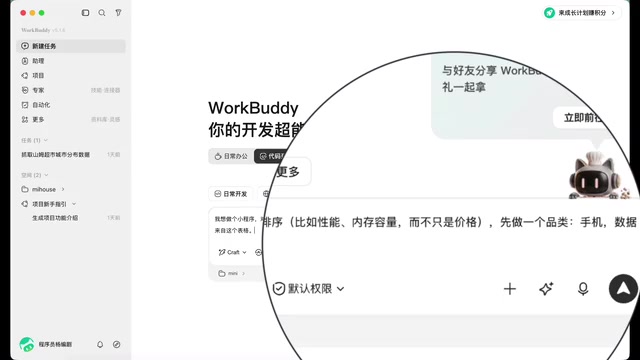
It happened to coincide with Tencent's AI programming competition, the "CodeBuddy Super Individual Challenge," and he decided to use the AI coding tool CodeBuddy to bring his idea to life. CodeBuddy is an AI programming assistant product launched by Tencent Cloud, built on large language model (LLM) technology, supporting full-cycle coding assistance including code generation, debugging, annotation, and refactoring. From a broader perspective, AI coding tools have formed a multi-polar competitive landscape represented by GitHub Copilot (Microsoft/OpenAI), Cursor, Windsurf, Tongyi Lingma (Alibaba), and CodeBuddy (Tencent). The core value of these tools lies in a closed loop from "intent understanding → code generation": developers describe requirements in natural language, and AI translates them into executable code — compressing product validation cycles from weeks to hours.
His development approach was clear and disciplined:
- First, create a workspace with a clear goal: build a mini program that "quantifies product data";
- The core concept: "everything numeric can be sorted" — not just price, but performance, RAM, and storage capacity can all serve as sorting dimensions;
- Start with a single category — "smartphones" — and feed the AI his previously organized Excel spreadsheet directly to generate features from it.
One detail worth noting: he named the project "Decision Paralysis" (选择困难症) — a name that directly targets the psychological state of the intended user. It's a very smart product naming choice.
Validating the AI-Generated Output
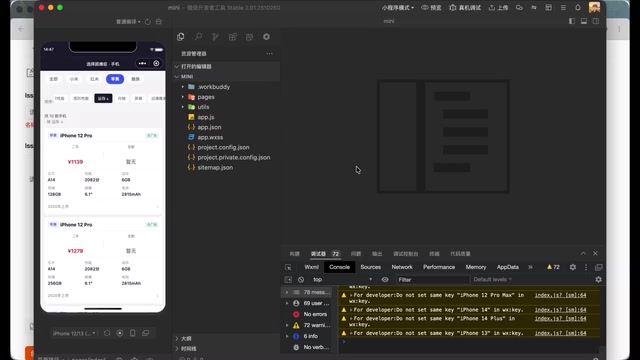
After development was complete, he verified the results in WeChat DevTools: sort by performance, sort by RAM (16GB, 12GB in descending order), filter by brand — and no ads. For a mini program rapidly generated with AI assistance, the functionality was already impressively complete and polished.
Requirements Management: From an Idea to 200 To-Dos
A product ready for launch is far more than a single sorting feature. To systematically manage ideas and requirements, he turned to Tencent's own free project management tool, CNB.cool.
On this platform, he created nearly 200 requirements, of which more than 100 have already been completed. That number speaks volumes: even a seemingly simple "sort by specs" mini program requires extensive feature iteration and detail refinement to reach a launch-ready level of maturity.
The gap between "a spreadsheet" and "a launchable mini program" is bridged by a whole series of engineering steps: requirements breakdown, feature implementation, UI optimization, and App Store submission preparation. AI coding tools have dramatically lowered the barrier from idea to implementation — but the systematic work of productization still requires the developer's ability to plan holistically.
A Few Thoughts on Business Models
The video also touched on an interesting side topic: advertising-based business models. "Free + ad-supported" is one of the most important business model innovations of the internet age, with theoretical roots in the economics concept of "two-sided markets" — a product simultaneously serves users (the free side) and advertisers (the paying side), creating value flow between both sides through user attention. The author mentions that WPS began its "free + advertising" model back in 2007 and became wildly popular, breaking down Microsoft Office's paid barrier in the Chinese market and driving the adoption of domestic productivity software. This model later proliferated everywhere: domestic Android phones bundled ads into the OS to lower hardware prices; Android TVs did the same.

However, when a device's price tag has already moved into the premium tier yet system ads remain, this model shifts from "price subsidy" to "double dipping." He also pointed out the imbalance: some phones sell at a high price and still bundle ads — that's crossing a line. His "Decision Paralysis" mini program takes the opposite approach — no ads — which is itself a response to today's monetization-driven ecosystem. It's both a functional promise and an implicit critique of that culture.
Conclusion: In the Age of AI, Anyone Can Be a Super Individual
The value of this case study isn't in the complexity of the product itself — it's in how completely it illustrates the full chain: identify a pain point → validate manually → implement with AI coding tools → scale via crowdsourcing → launch the product.
The concept of the "Super Individual" takes on new meaning in the AI era. Traditional software industry logic divides labor like this: product managers define requirements, designers create prototypes, frontend and backend engineers implement separately, and QA engineers ensure quality — a complete product typically requires 5–10 people working together. AI coding tools are reshaping this division of labor: a report from Stanford's HAI institute found that developers equipped with AI tools can achieve 40–55% productivity gains on specific tasks. The deeper shift is that AI tools allow an individual with systematic thinking to "independently cover" an entire value chain that previously required team collaboration — just as personal computers in the 1990s enabled individuals to handle professional typesetting, and smartphones in the 2010s enabled individuals to produce professional-grade photo and video content. It's the same democratization of productivity in a new form.
The author references a 1993 book called What Are People For?, later discarded by a Beijing library, and draws a sharp analogy: the book said "no matter how great computers are, if you can ignore them, they don't really matter" — but today, substitute "computers" with "AI" and the situation is completely different. Students, office workers, engineers, homemakers, teachers, small shop owners — no one can afford to ignore AI anymore. Everyone has to engage with it.
AI coding tools are making the "Super Individual" a reality: one person, with one genuine need and a suite of AI tools, can independently ship a product that once required a full team. The "Decision Paralysis" mini program is a vivid testament to this trend. The mini program has been successfully launched and is available to search for and use within WeChat.
Key Takeaways
Related articles

The Truth Behind Codex 'Build a Website in 5 Minutes': AI Isn't Creating Sites—It's Helping You Copy Them
Exposing the truth behind viral Codex 5-minute website videos: creators aren't building original sites with AI—they're copying shared prompts or scraping others' work. Learn AI coding tools' real limits.

Getting Started with AI Agent Development: A Complete Guide from Concept to Practice
A comprehensive guide to AI Agent architecture and development, covering automated marketing, intelligent customer service, and investment analysis scenarios with single and multi-agent collaboration.

The Truth Behind Codex 'Build a Website in 5 Minutes': AI Isn't Creating Sites — It's Helping You Copy Them
Exposing the truth behind viral Codex 5-minute website videos: creators aren't building original sites with AI — they're copying shared prompts or scraping others' work.