A Guide to the Best AI/ML Engineering Communities and How to Choose One
A curated guide to the best AI/ML communities and how to evaluate and engage with them effectively.
This guide surveys the most active AI/ML communities across Discord (Hugging Face, EleutherAI), Reddit (r/MachineLearning, r/LocalLLaMA), and Slack (MLOps Community). It explains why real-time community engagement is essential in today's fast-moving AI landscape, offers practical criteria for evaluating community quality—such as signal-to-noise ratio, member composition, and domain fit—and encourages practitioners to maximize value by contributing, not just consuming.
Why Do AI/ML Practitioners Need Communities?
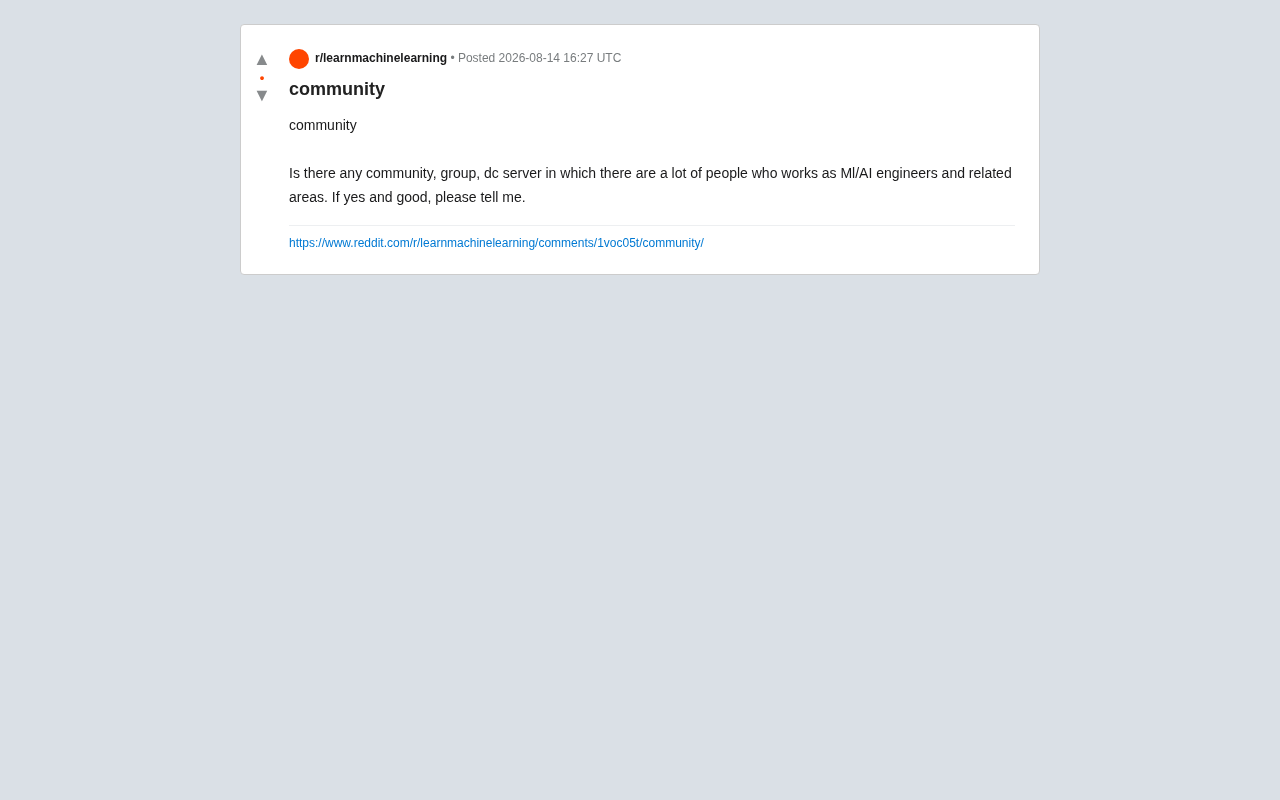
On Reddit, a user posted a seemingly simple yet highly representative question: "Are there any communities, groups, or Discord servers where a large number of ML/AI engineers and related professionals gather? If so, and if they're good, please recommend them."
This question reflects a real pain point for today's AI practitioners. As AI technology iterates at an unprecedented pace, it's become nearly impossible to keep up by reading papers and browsing documentation alone. Since ChatGPT's launch in late 2022, the AI field has entered an acceleration phase where "major breakthroughs happen every week." Take large language models as an example: from GPT-3.5 to GPT-4o, from Llama 2 to Llama 3.1, the cycle of capability leaps has shrunk from years to months. Meanwhile, the technology stack is rapidly diverging—RAG (Retrieval-Augmented Generation), Agent frameworks, multimodal models, model quantization, and other new concepts keep emerging. The traditional learning path of "read papers + check docs" can no longer keep up. This acceleration makes real-time information exchange in communities especially critical: a freshly published paper can be discussed, reproduced, and even improved within hours.
Whether you're a newcomer to the field or a seasoned engineer, everyone needs a community environment for real-time communication, Q&A, and resource sharing. The value of a community goes beyond information access—it's about building professional networks, staying current with industry trends, discovering career opportunities, and even finding potential collaborators. In a fast-moving field, "who you learn with" is often just as important as "what you learn."
An Overview of Major AI/ML Community Platforms
Although the original post didn't provide specific answers, based on broad community consensus, the following types of platforms are where AI/ML practitioners are most active.
Discord Server Recommendations
Discord has become a major hub for technical communities. The Hugging Face official Discord brings together a large number of NLP and large model developers. Founded in 2016, Hugging Face started as a chatbot company before pivoting to become a hosting and sharing platform for AI models and datasets—often called "the GitHub of AI." The platform hosts over 500,000 open-source models and 100,000 datasets, covering virtually every AI subfield including NLP, computer vision, and audio processing. Its core open-source library, Transformers, has become the de facto standard for using Transformer-based models in both academia and industry. The Discord community's activity is closely tied to the platform's open-source ecosystem—questions about model usage, fine-tuning tips, and deployment experiences are discussed here in real time.
EleutherAI is a stronghold of open-source large model research, where many cutting-edge discussions take place. EleutherAI is a decentralized AI research organization that was spontaneously formed on Discord in 2020 by a group of independent researchers, with the original goal of breaking the monopoly that large tech companies held over large language models. The organization first gained fame for reproducing GPT-3, subsequently releasing open-source models such as GPT-Neo, GPT-J-6B, and GPT-NeoX-20B. They also created The Pile—an 800GB high-quality training dataset that has been used by numerous subsequent models. Their Language Model Evaluation Harness has become an industry-standard tool for evaluating language model performance. EleutherAI's community model proved the viability of distributed volunteer collaboration in frontier AI research, and many of its members have since joined well-known AI companies like Anthropic and Stability AI.
Additionally, servers like Learn AI Together and MLOps Community also have active member bases, covering the full pipeline from getting started to deployment and operations.
Discord's strengths lie in its real-time nature and casual atmosphere, making it ideal for quick questions and bite-sized exchanges. The downside is that information can easily get buried, with little systematic archiving.
Reddit Subreddit Recommendations
Ironically, Reddit itself—the platform where the question was asked—is an excellent resource. r/MachineLearning has nearly 3 million subscribers and is a core venue for discussing papers and sharing research across academia and industry. Subreddits like r/deeplearning and r/LocalLLaMA each have their own focus areas.
r/LocalLLaMA has rapidly risen in recent years, fueled by the boom in running large models locally, and has become a gathering place for open-source model enthusiasts. This trend is closely linked to breakthroughs in model quantization and local inference optimization. After Meta open-sourced the Llama models in 2023, community developers quickly discovered that quantization techniques such as GGML (which later evolved into the GGUF format), GPTQ, and AWQ could compress models with billions of parameters to run on consumer-grade GPUs or even CPUs. The birth of the llama.cpp project was a landmark event in this wave—it enabled ordinary users to run large language models on a MacBook. The r/LocalLLaMA community has built an extremely active ecosystem around these technologies, with members continuously sharing hardware configuration advice, quantization parameter tuning, local knowledge base setup, and other practical experiences. The rise of this community also reflects a deeper trend toward AI democratization: more and more practitioners want to break free from API dependency and control AI capabilities in their local environments.
Professional Forums and Slack Workspaces
Beyond Discord, the MLOps Community also operates an active Slack workspace focused on machine learning engineering and production deployment. MLOps (Machine Learning Operations) is a methodology that brings DevOps principles into machine learning workflows, covering the full lifecycle including model training, version control, continuous integration/deployment (CI/CD), monitoring, and governance. There's a widely circulated saying in the industry: "In enterprise settings, model training accounts for only 5%–10% of the total work in an ML system—the rest is engineering challenges"—including data pipeline construction, feature stores, model serving, A/B testing, model drift detection, and more.
The MLOps Community was founded in 2020 by Demetrios Brinkmann, CEO of Neptune.ai, and currently has over 20,000 active members, with regular online meetups and podcasts. The community's core value lies in bridging the gap between "research" and "production," bringing together a large number of ML engineers and platform engineers with hands-on experience. Discussions revolve around engineering tools like Kubeflow, MLflow, BentoML, and Seldon Core. For engineers focused on deploying models rather than pure research, these kinds of communities often offer more practical value.
How to Determine Whether an AI Community Is Worth Joining
The original poster specifically emphasized "good"—a reminder that while communities abound, their quality varies widely.
When evaluating whether a technical community is worth your time, consider the following dimensions:
Activity Level and Response Speed: A healthy community should have ongoing discussions and timely replies. Lurk for a few days and observe whether questions receive quality answers.
Member Composition: Are there genuine practitioners and researchers participating, or is the space flooded with marketing and low-quality content? High-quality communities typically have clear rules and content moderation.
Signal-to-Noise Ratio: Quality communities effectively filter out ads, duplicate questions, and irrelevant chatter, letting valuable information surface. The "Signal-to-Noise Ratio" is the core metric for evaluating technical community quality. With the explosion of generative AI, many AI-related communities face serious content quality challenges: low-quality tutorial marketing, AI-generated filler content, repetitive beginner questions, and spam from cryptocurrency/NFT promoters. Take r/MachineLearning as an example—the subreddit maintains content quality through a strict tagging system ([R] for Research, [D] for Discussion, [P] for Project, etc.) and moderator review, with paper discussion posts typically requiring links to the original paper and a summary of key contributions. High-quality Discord communities usually employ role-based hierarchies (such as verified researcher and contributor tags), topic-specific channels, and automated bot filtering to manage content. The quality of community governance often directly determines the community's long-term viability.
Domain Fit: AI is a vast field—NLP, computer vision, recommendation systems, and MLOps each have their own dedicated communities. Finding a community that precisely matches your area of focus is far more rewarding than joining a generic large group.
From Question-Asker to Contributor: Maximizing Community Value
It's worth emphasizing that community value is a two-way street. Many newcomers join groups with a "take" mindset, only to find they struggle to truly integrate.
Those who benefit the most from communities are often those willing to contribute—answering others' questions, sharing projects, translating materials, curating resources. This kind of participation not only deepens your own understanding but also builds your personal reputation and network.
For practitioners like the original poster who are searching for communities, the advice is: don't just stop at "joining." After selecting one or two communities that match your direction and have a good atmosphere, actively participate in discussions—that's the right way to maximize community value.
Conclusion
Finding quality AI/ML communities is an essential part of every practitioner's growth journey. From Discord servers like Hugging Face and EleutherAI, to Reddit subreddits like r/MachineLearning and r/LocalLLaMA, to engineering-focused communities like the MLOps Community—there are plenty of options, but discernment is required.
Rather than casting a wide net and joining dozens of groups, it's better to focus on one or two communities that truly align with your needs and engage deeply as a contributor rather than a spectator. In today's era of rapidly evolving AI technology, finding "the right people" to learn with may be the most effective path to accelerating your growth.
Related articles

Gemini 4 Argon Hands-On: AI Builds Board Games, Constructs Temples, and Trains Robots Autonomously
Gemini 4 Argon hands-on roundup: AI autonomously builds a desk racetrack and temple in Blender, writes a ray tracing engine, trains a humanoid robot to sink 7 shots, plus API pricing and developer access.

The Magic Octagonal Coin: Why Only 9% of People Can Predict Its Flip?
Only 9% of people can correctly predict the Magic Octagon coin flip. This article explains its spatial rotation mechanism, common cognitive pitfalls, and a new hypothesis based on Relevance Theory, exploring the limits of human spatial reasoning.

Sam Altman: AI Is Entering the Era of Scientific Discovery — Math Breakthroughs Will Replicate in Biology and Energy
Sam Altman says AI is entering the era of scientific discovery — math breakthroughs will replicate in biology, materials science, and energy to help develop new drugs and energy sources.