A Language Model in a Boot Sector: The 512-Byte AI Extreme Experiment

Cramming a language model into a 512-byte boot sector, exploring the far-left end of the model size spectrum.
A Show HN project on Hacker News puts a language model into a 512-byte boot sector. The boot sector is the first area executed at startup, with no operating system or runtime support, and extremely tight space. Constrained by this, the so-called language model can only be a minimal n-gram lookup table or finite state machine, lacking practical language ability. The project's value lies not in replacing large models but in using an extreme case to ask about the minimal viable form of language models and pointing to minimal routes for resource-constrained scenarios such as embedded systems, firmware, and on-device AI. The HN community noticed it because it hits three topics at once: retro computing, low-level programming, and AI boundary exploration.
When a Language Model Moves Into the Boot Sector
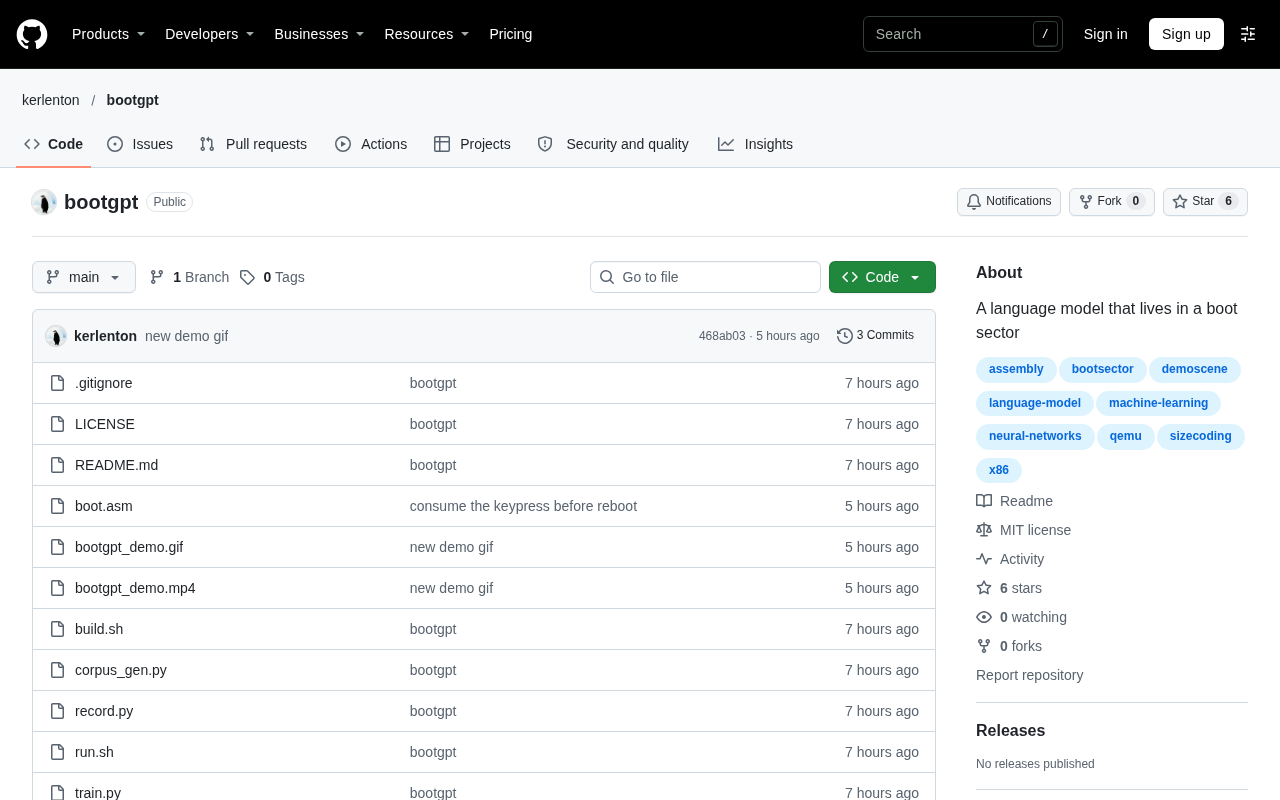
A Show HN project titled "A language model that lives in a boot sector" appeared on Hacker News, cramming a language model into the first 512 bytes that a computer executes at startup. The project comes with no lengthy technical documentation and no performance comparison tables—the mere combination of "boot sector" and "language model" is enough to spark the tech community's imagination.
The boot sector is the first 512 bytes on a hard disk or floppy disk, traditionally holding the bootloader. It must execute without an operating system, without a file system, and even without a full runtime environment—once BIOS or UEFI hands over control, everything must be self-contained. Putting a language model in this position means abandoning all the conveniences of the modern AI stack: no PyTorch, no CUDA, no Python interpreter, and even the stack must be carefully budgeted.
The core value of this project lies not in practicality but in the question it raises that most AI practitioners overlook: How small can the minimal viable form of a language model actually be?
Show HN is a regular section on Hacker News where creators publish their own projects, experiments, or works and receive community votes and comments. It emphasizes "runnable, experienceable" original results rather than news reports or commercial promotion, so engineering experiments under extreme constraints often appear there.
BIOS and UEFI are the firmware interfaces at computer startup. Traditional BIOS, after power-on self-test, reads the first 512 bytes of the storage device (i.e., the boot sector), checks for the 0x55AA signature at the end, and then jumps control there. Although UEFI is more modern, it also supports the traditional boot sector startup method. This process means the boot code runs in 16-bit real mode, with no operating system and no standard library, and can only use BIOS interrupts for the most basic input and output.
What Can Fit in 512 Bytes
From an engineering perspective, the boot sector constraints are extremely harsh. Code and data share the same 512-byte space, and some bytes must be reserved for the boot sector signature (usually the last two bytes are 0x55AA). The space truly available for model logic is even smaller.
At this scale, a so-called "language model" cannot contain any neural network with a practical vocabulary. More likely forms are: a minimal n-gram lookup table, a hardcoded finite state machine, or a tiny probabilistic model with only a few parameters. Its "language ability" may be limited to outputting a few fixed lines of text at startup, or performing pattern matching against extremely limited input.
But this is precisely where the project's insight lies. Current large models have weight files in the hundreds of GB, and inference requires dedicated accelerators, while the boot sector language model poses a counter-question through action: Have we already assumed that language models must be "large"? In embedded systems, firmware, and extremely constrained environments, is there another minimal route?
n-gram models are statistical language models that assume the current word depends only on the previous n-1 words, estimating probabilities by counting the frequency of word sequences in a corpus. n-grams do not require neural networks; the parameters are just a frequency table, so they can be compressed to the extreme. Under the 512-byte constraint, the order (n) and vocabulary of the n-gram would be compressed to a minimum, for example keeping only a few dozen common words or characters and generating short sentences via table lookup.
Finite state machines (FSM) are another minimal approach: describing input-output behavior with a set of states and transition rules, essentially a hardcoded state transition table. It has no "learning" ability but can implement fixed dialogue templates or command parsing. Both show that at the boot sector scale, a "language model" degrades into a deterministic pattern-matching mechanism rather than a probabilistic generative model in the modern sense.
Why Hacker News Noticed It
The project received 9 points and 0 comments on Hacker News, and the numbers themselves indicate it is at the "just spotted" stage. But the HN community's interest in such projects has a traceable pattern: it hits the intersection of three topics—retro computing, low-level programming, and AI boundary exploration.
HN readers have a long-standing preference for "doing the impossible in impossible places." From writing web servers in assembly language to implementing ray tracing in Excel, such projects often are not meant for production environments but to test the boundaries of the tech stack. The boot sector language model continues the same tradition: it pulls the hottest current technology (language models) back to the most primitive runtime environment (bare-metal boot), creating a strong cognitive contrast.
Another signal worth noting is that such projects usually do not stop at the demonstration stage. If the author later releases source code or technical details, it is very likely to trigger a round of discussion on "micro-models" and "extreme compression inference." For developers focused on on-device AI and firmware AI, this is worth following closely.
Retro computing refers to the cultural practice of reimplementing modern functions on old hardware or in extremely constrained environments, such as writing games for 8-bit machines or booting a complete system from a floppy disk. Low-level programming emphasizes directly manipulating hardware, memory, and instruction sets rather than relying on high-level language runtimes. Both topics have a stable audience on Hacker News because they demonstrate a deep understanding of computer system principles.
When such practices are combined with AI boundary exploration, additional传播 power is generated: it uses the most primitive environment to contrast with the enormous current AI stack, forming a "tech contrast" narrative. HN's voting mechanism favors novel, verifiable projects with a geek spirit, so even if the project has not yet released source code, the mere combination of concepts can attract attention.
The Practical Significance of the Minimal Model Route
Cramming a language model into a boot sector is of course an extreme case, but it points to a real engineering direction: running lightweight language capabilities on resource-constrained devices. Smart home sensors, industrial controllers, legacy hardware, trusted components in secure boot chains—these scenarios often cannot afford an operating-system-level runtime, yet have simple text generation or pattern recognition needs.
The current mainstream approach is to call cloud APIs, but this brings latency, privacy, and connectivity dependencies. Minimal models offer a third path: not pursuing general conversation ability, but building extremely small-scale statistical models for specific tasks. The boot sector experiment proves "it can fit," not "it is useful once fitted," but once the boundary is verified, practical application has a starting point.
It is important to stay clear-headed: a 512-byte model has no meaningful language understanding ability. Interpreting the project as "large models will be replaced" is a misreading. It is more like a signpost marking the far-left end of the language model size spectrum, reminding practitioners: while chasing larger parameter counts, there is also space worth exploring at the other end.
One-line Summary
Cramming a language model into a 512-byte boot sector, exploring the far-left end of the model size spectrum.
Paragraph Summary
A Show HN project on Hacker News puts a language model into a 512-byte boot sector. The boot sector is the first area executed at startup, with no operating system or runtime support, and extremely tight space. Constrained by this, the so-called language model can only be a minimal n-gram lookup table or finite state machine, lacking practical language ability. The project's value lies not in replacing large models but in using an extreme case to ask about the minimal viable form of language models and pointing to minimal routes for resource-constrained scenarios such as embedded systems, firmware, and on-device AI. The HN community noticed it because it hits three topics at once: retro computing, low-level programming, and AI boundary exploration.
Related articles

VERS: Editing Activation Explanations to Halve Reasoning Model Tokens
VERS guides reasoning models by editing activation explanations, cutting 45.8% of tokens on GSM8K with only a 0.82 pp accuracy drop and transferring to larger models, but losing accuracy on competition problems.

Finding Errors Is Not Enough: Selective Model Escalation for Entity-Targeted Sentiment Analysis
This study explores selective model escalation for entity-targeted sentiment analysis, comparing data collection ordering, uncertainty-driven re-examination, and model routing—finding that minority-class priority only helps at very small data volumes, the oracle upper bound far exceeds actual gains, and escalation must be tailored to each dataset.

WAS-PO: Using Whitened Advantages to Solve the Correlation Trap in Multi-Reward Reinforcement Learning
WAS-PO paper proposes whitening advantages to correct correlation bias in multi-reward RL: when rewards are correlated, naive weighted summation effectively applies Σ^{1/2}w instead of w. Experiments show training reward improves steadily, but held-out accuracy does not improve in sync, and under two rewards it actually falls behind.