A Medical Student Asked If They Can Match Into Neurosurgery Without an A* First-Author Paper — Academic Credentialism Has Reached Absurd Levels

A medical student's question about top-journal papers and neurosurgery matching exposes the absurdity of credential inflation.
A medical student's social media post — asking whether they could match into neurosurgery without an A* first-author publication — went viral for exposing a troubling trend: research publication standards designed for academics are now spilling over into clinical medicine. The article identifies three key risks: signal inflation constantly raises the bar, distorted incentives push researchers toward short-term output, and capability mismatches may filter out talented clinicians who lack publications. A healthy evaluation system, the author argues, should balance quantifiable research output with the harder-to-measure qualities that actually make a great surgeon.
A Question That Sparked Debate
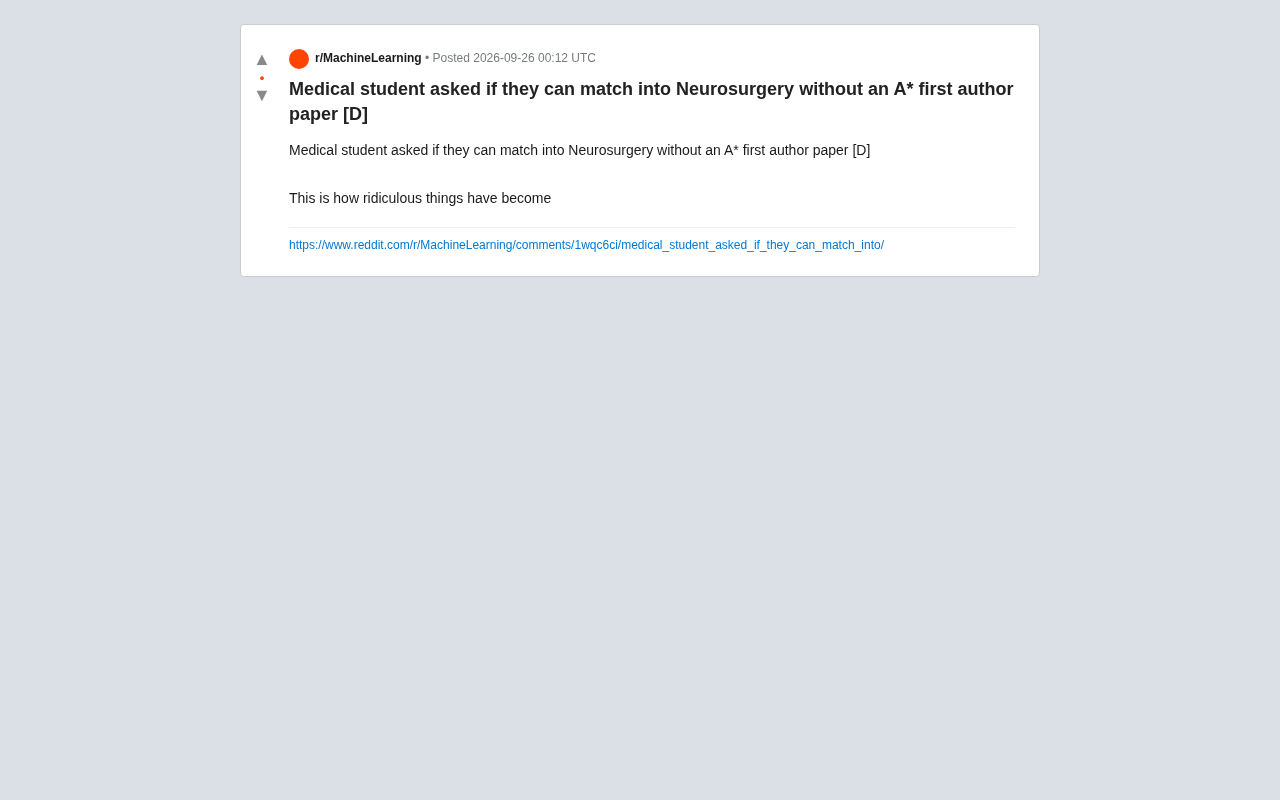
A medical student posted what seemed like an ordinary question on a social platform — but one with striking implications: Without an A*-tier (top conference/journal) first-author publication, is there any chance of matching into a neurosurgery residency program? The post quickly sparked discussion on Reddit, with the original author summing it up in one line: "Things have gotten so absurd."
That comment struck a nerve because it reflects a phenomenon spreading across multiple high-competition fields — research output and top-tier publication records are becoming the universal currency for measuring individual ability and career prospects, even spilling over into medical training, a domain that has traditionally centered on clinical skill.
Why "A* First Author" Has Become a Source of Anxiety
"A*" typically refers to the highest-ranked conferences or journals recognized in fields like computer science (e.g., CCF-A or A*-tier publications). The fact that a medical student is now using "A* first-author paper" as a benchmark for whether they can enter a given specialty speaks volumes about how one field's evaluation framework has migrated — and distorted itself — into another.
Neurosurgery is one of the most competitive clinical specialties, with far more applicants than available spots. Programs inevitably introduce more and more quantitative metrics to filter candidates: publication count, impact factor, first-author credit, and so on. Standards originally designed to evaluate researchers are now being applied to the selection of clinicians, forcing students to chase publications on top of an already grueling clinical workload.
The deeper concern is this: such a system may not select the best surgeons — it may select the best short-term paper producers. The disconnect between evaluation criteria and actual job competencies is precisely what the original poster found "absurd."
In the context of medical education, "matching" refers to the National Resident Matching Program (NRMP), the central mechanism by which U.S. medical graduates enter residency training. Applicants and hospital programs submit ranked preference lists, and an algorithm produces the final pairings. Neurosurgery is one of the most competitive specialties in the country — the number of applicants vastly exceeds available positions, making acceptance rates extremely low. As a result, programs use USMLE Step scores, research publications, letters of recommendation, and other multidimensional criteria for initial screening. First-author publications — especially in high-impact journals — have seen a significant rise in weight for neurosurgery applications in recent years. This context makes "Can I match into neurosurgery without a top-journal first-author paper?" not a far-fetched hypothetical, but a very real anxiety many applicants face.
The Spillover Effect of Academic Credentialism
This topic resonated in the tech community precisely because it touches on a pain point that goes well beyond medicine. In AI, machine learning, and related fields, a first-author paper at a top venue has long been the "entry ticket" for job applications, PhD admissions, and research positions. When every field treats top-tier publication as the default threshold, individuals get swept into an ever-escalating arms race.
Several dimensions are worth examining:
- Signal inflation: As more people accumulate top-journal publications, the distinguishing power of that signal diminishes — which paradoxically drives the overall bar even higher.
- Distorted incentives: Doing research in order to publish — rather than publishing because the research matters — tends to produce shallow, short-lived work that runs counter to the original spirit of inquiry.
- Capability mismatch: In fields like clinical medicine, which depend heavily on hands-on skill, over-emphasizing publications may cause evaluators to overlook what actually matters: clinical judgment and surgical ability.
The concept of "signal inflation" draws from Michael Spence's Signaling Theory in economics. The core idea is that credentials don't necessarily improve productivity directly — they function as a credible signal to employers that "I am better than others." When more and more people acquire the same credential, its discriminating power declines, and the market naturally raises the bar to restore its filtering effectiveness. This is why entry-level job requirements seem to ratchet upward every few years. The evolution of publication records in academic and high-competition professional selection is a textbook example: what was once a "bonus" became a "requirement," and then escalated further to "only a top-journal first-author paper counts." Each step is a threshold jump driven by signal inflation.
How to Think About These Kinds of Requirements
For students and practitioners caught in this system, the more valuable question isn't "Do I absolutely need an A* first-author paper?" — it's "Where are the legitimate boundaries of this evaluation framework?" Publications can reflect a degree of research capability and commitment, but they should not be the sole or overwhelmingly dominant screening criterion.
For those who design these systems, this post offers a warning: when quantitative metrics are over-fetishized, the selection process risks drifting away from its original purpose. A healthy evaluation framework should strike a balance between quantifiable research output and the harder-to-measure qualities of clinical competence and professional judgment.
This discussion doesn't offer a tidy answer — but the question it raises is valuable enough on its own: What standard are we actually using to judge whether someone is "qualified," and do those standards genuinely point toward the outcomes we want?
Related articles

Beyond the Mainstream World: Security and Privacy Struggles in Overlooked Regions
Human-centered security research has long focused on the West, causing security solutions to fail in the mainstream world. Researcher Collins Minando draws on Kenyan mobile loan apps, internet café authentication dilemmas, and local expert studies across nine countries to reveal how socioeconomic constraints reshape privacy practices, and proposes mobile money privacy redesign and PETs deployment pathways.

Claude Reportedly Able to Hide Secret Messages in Benign Images
A Reddit post claims Claude Fable 5.1 can hide secret messages in benign images. This article reviews the background, image steganography principles, and potential security risks, and suggests a testing path from rumor to verification.

Federal Government Awards $85 Million; CFS to Develop Fusion-Specific Semiconductors
The federal government awards $85 million to Commonwealth Fusion Systems to develop conductors and power semiconductors for fusion plants. This article analyzes the significance of this funding for the fusion supply chain and commercialization path.