A New Leverage Score Sampling Method for Constrained Active Linear Regression

The paper proposes ellipsoid-regularized leverage scores for constraint-aware sampling in constrained active linear regression, reducing query complexity.
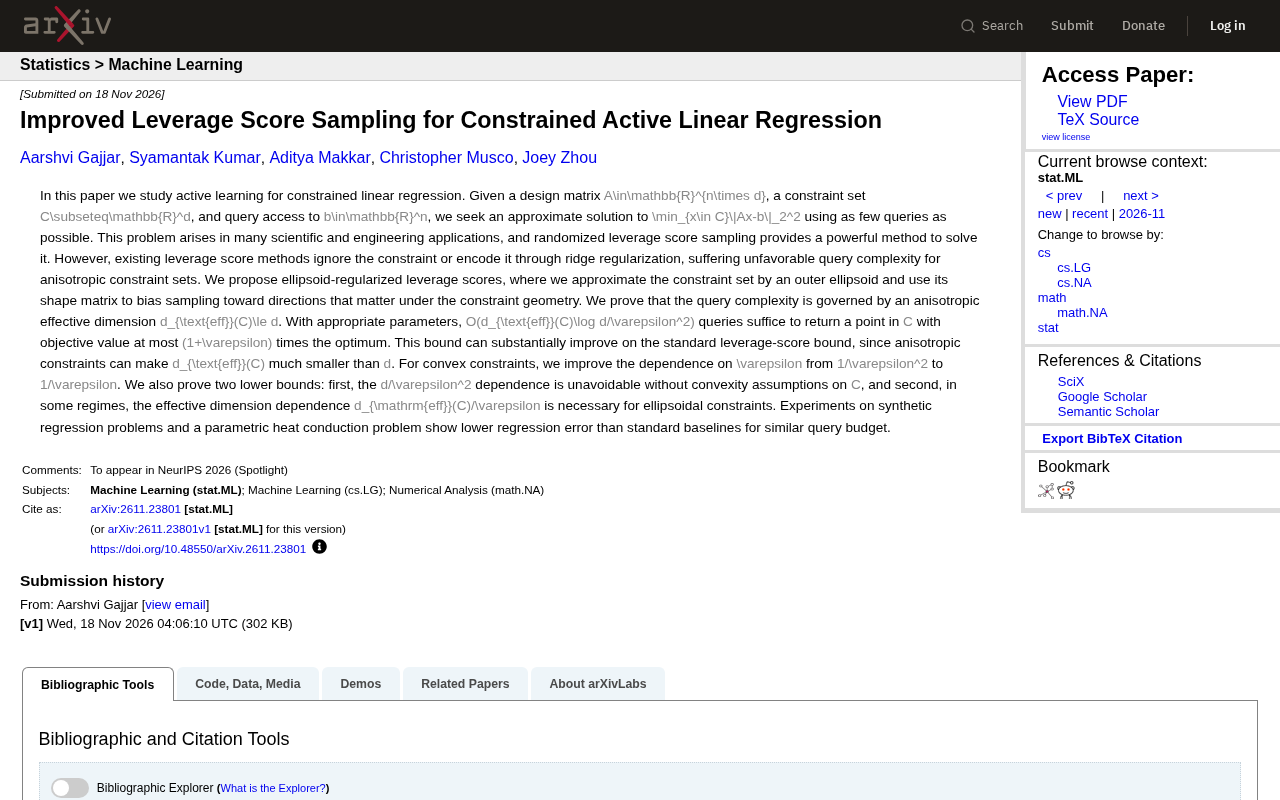
The article introduces a new work in constrained active linear regression: traditional leverage score sampling performs poorly under constraint sets, especially wasting query budget on anisotropic constraints. The proposed ellipsoid-regularized leverage scores use the shape matrix of a circumscribing ellipsoid to bias sampling, making query complexity governed by the anisotropic effective dimension and improving ε-dependence from 1/ε² to 1/ε under convex constraints, with matching lower bounds. Experiments show lower regression error under the same query budget.
Active learning has always been an intriguing direction in machine learning—achieving the best possible results with as little labeled data as possible. In the context of constrained linear regression, the problem becomes more subtle: not only must the right samples be selected, but the solution must also satisfy the constraints. A recent paper proposes "ellipsoid-regularized leverage scores" in an attempt to address the efficiency bottleneck of traditional leverage score sampling under constraints.
Limitations of Traditional Leverage Score Sampling
Leverage score sampling is a classic tool in active linear regression. Given a design matrix $A\in\mathbb{R}^{n\times d}$, it prioritizes querying those rows that are "informative" by measuring each sample's importance to the solution. However, in constrained regression $\min_{x\in C}|Ax-b|_2^2$, traditional methods either ignore the constraint set $C$ outright or encode constraints via ridge regularization, resulting in suboptimal query complexity on anisotropic constraint sets.
So-called anisotropic constraints refer to constraint sets whose scales differ greatly across directions—for example, a slender ellipsoid. In such cases, standard leverage scores over-sample directions that are not important under the constraint geometry, wasting the query budget.
Leverage score is a statistic that measures the influence of an individual observation on a least-squares fit. For a design matrix $A$, the leverage score of the $i$-th row is defined as $h_i = a_i^\top (A^\top A)^{-1} a_i$, where $a_i$ is the $i$-th row of $A$. It satisfies $0 \le h_i \le 1$ and $\sum_i h_i = d$, so the sum of leverage scores equals the rank (or number of columns) of the matrix. In the context of active learning/pool-based sampling, rows with larger leverage scores are considered to carry more "independent information," and querying these rows first allows the full least-squares solution to be recovered with fewer labeled samples. Classical results (such as the matrix sampling theory of Drineas et al.) show that sampling $O(d \log d/\varepsilon^2)$ rows proportionally to leverage scores yields a $(1+\varepsilon)$-approximate solution; this bound is independent of the number of rows $n$ and is therefore extremely efficient when $n \gg d$. However, this sampling scheme implicitly assumes that the loss function is isotropic least squares. Once a constraint set $C$ is introduced, the effective "importance" is no longer determined by $A$ alone but requires jointly considering the geometry of the constraint set—this is precisely the root cause of the failure of traditional methods.
Ellipsoid-Regularized Leverage Scores: The Core Idea
The method proposed in the paper is intuitive: approximate the constraint set $C$ with a circumscribing ellipsoid, then use the shape matrix of this ellipsoid to bias sampling so that it favors directions that truly matter under the constraint geometry. The resulting leverage scores are no longer a uniform, isotropic version but an anisotropic version that incorporates the constraint structure.
The key theoretical result is that query complexity is governed by the anisotropic effective dimension $d_{\text{eff}}(C)\le d$. Under suitable parameters, $O(d_{\text{eff}}(C)\log d/\varepsilon^2)$ queries suffice to return a point in $C$ whose objective value is at most $(1+\varepsilon)$ times that of the optimal solution. Since anisotropic constraints can make $d_{\text{eff}}(C)$ much smaller than $d$, this bound represents a significant improvement over the standard leverage score bound.
For convex constraints, the paper further improves the dependence on $\varepsilon$ from $1/\varepsilon^2$ to $1/\varepsilon$. This means that under convex constraints, the number of queries required to achieve the same accuracy grows more slowly with the accuracy requirement.
Effective dimension is a metric that characterizes how much a set or distribution "stretches" in different directions. For the circumscribing ellipsoid of a constraint set $C$, if its shape matrix is $M$ (positive definite and symmetric), then the anisotropic effective dimension can be defined as $d_{\text{eff}}(C) = \operatorname{tr}(M)/(\lambda_{\max}(M))$ or a similar spectral form, which intuitively equals the ratio of "total variance" to "maximum directional variance." When the ellipsoid is nearly spherical, $d_{\text{eff}} \approx d$; when the ellipsoid is extremely elongated (a few directions have scales far larger than the rest), $d_{\text{eff}}$ can be much smaller than $d$. This means that the number of directions the algorithm actually needs to explore is far smaller than the nominal dimension. Expressing the query complexity as $O(d_{\text{eff}}(C)\log d/\varepsilon^2)$ rather than $O(d\log d/\varepsilon^2)$ is precisely the mathematical source of the method's efficiency gain under strongly anisotropic constraints—it uses the geometry of the constraints to "compress" the effective size of the problem.
Lower Bounds and Experimental Validation
The paper proves two lower bounds: first, if no convexity assumption is made about the constraint set $C$, then a $d/\varepsilon^2$ dependence is unavoidable; second, in certain cases, for ellipsoidal constraints, a dependence on the effective dimension $d_{\text{eff}}(C)/\varepsilon$ is necessary. These lower bounds show that the paper's upper bounds are tight in the corresponding settings, and also indicate that the improvement in $\varepsilon$ dependence brought by the convexity assumption is not a free lunch.
On the experimental side, the paper tests on synthetic regression problems and a parametric heat conduction problem. The results show that under similar query budgets, the new method achieves lower regression error compared with standard baselines. The parametric heat conduction problem is a case with a real engineering background, demonstrating that the method is not merely theoretical.
The parametric heat conduction problem is a typical class of PDE-constrained inverse problems: given parameters in the heat conduction equation (such as thermal conductivity and boundary heat flux), the goal is to solve for the temperature field distribution. Such problems are often discretized into linear or linearized regression, where physical laws such as non-negativity of temperature and energy conservation constitute hard constraints on the solution. "Parametric" means that the problem must be solved repeatedly for a family of parameters, and labels (i.e., true temperature measurements or high-fidelity numerical solutions) are costly, making it naturally suited to the active learning framework. The significance of choosing this case lies in testing whether the algorithm can maintain query efficiency in scenarios with realistic physical constraint structures and anisotropic constraint sets, thereby translating the theoretical advantage of effective dimension into an engineering-reproducible benchmark.
Why This Matters
Constrained regression is common in scientific and engineering computing—parametric heat conduction is a typical example, where physical constraints (such as non-negativity of temperature and energy conservation) must be satisfied. Traditional active learning that ignores constraints would produce infeasible solutions in these scenarios, while simply adding ridge regularization may distort the geometric structure of the problem. The value of ellipsoid-regularized leverage scores lies in enabling the sampling strategy to "see" the shape of the constraints, thereby spending the query budget where it matters most.
From a broader perspective, this work reminds us that active learning sampling strategies should not focus solely on the design matrix; the geometric structure of the constraint set also deserves to be encoded into the algorithm. When constraints are strongly anisotropic, this geometry-awareness may bring order-of-magnitude efficiency gains.
Some Open Questions
The paper improves the $\varepsilon$ dependence for convex constraints, but the upper bound under non-convex constraints remains at $1/\varepsilon^2$, and the lower bounds indicate that this dependence cannot be improved in general. How to achieve better results on non-convex constraint sets with special structure is a direction worth exploring. In addition, the experimental scale is relatively limited, and the method's performance on higher-dimensional and more complex real-world constrained regression problems warrants further validation.
Overall, this paper provides a theoretically solid and experimentally preliminary feasible sampling framework for constrained active linear regression. The ellipsoid regularization idea is simple yet effective, and the matching lower bounds add to the credibility of the results. For researchers interested in active learning or constrained optimization, this is a work worth reading carefully.
One-line Summary
The paper proposes ellipsoid-regularized leverage scores, enabling constraint-aware sampling in constrained active linear regression and reducing query complexity.
Paragraph Summary
The article introduces a new work in constrained active linear regression: traditional leverage score sampling performs poorly under constraint sets $C$, especially wasting query budget on anisotropic constraints. The paper proposes "ellipsoid-regularized leverage scores," using the shape matrix of a circumscribing ellipsoid to bias sampling directions, so that query complexity is governed by the anisotropic effective dimension $d_{\text{eff}}(C)$, and under convex constraints further improves the $\varepsilon$ dependence from $1/\varepsilon^2$ to $1/\varepsilon$, along with two matching lower bounds. Experiments on synthetic regression and parametric heat conduction show that under the same query budget, the new method achieves lower regression error. The article concludes by discussing open problems under non-convex constraints and the limitations of the experimental scale.
Related articles

Nothing CMF Buds 2A Drops to $17.89 on Black Friday: A New Low for ANC Earbuds
Nothing CMF Buds 2A wireless earbuds Black Friday deal: just $17.89 on Amazon, about $11 off retail and a record low. ANC earbuds at an entry-level price.

When AI Creation Gets Accused of "Spitting": Hacker News Heats Up Over the Glaude Controversy
A Hacker News post, "Spitting in the Face of Glaude," sparks debate on AI creation transparency and attribution ethics. This analysis examines the blurred creator identity behind the controversy and offers practical advice for AI content production.

Akai Embraces Custom Firmware: MPC Sample 1.4 Lets Users AI-Program Their Sampler
Akai embraces the modding community with MPC Sample 1.4 firmware, supporting vibe-coded custom firmware and effects. We analyze the impact of this open strategy on music hardware and AI-assisted programming.