A New Paradigm for Self-Evolving Image Editing: Rubric-CEPR Achieves Self-Distillation with Internal Rewards

Rubric-CEPR enables image editors to self-validate and self-evolve using their own representations, without human annotation or external reward models.
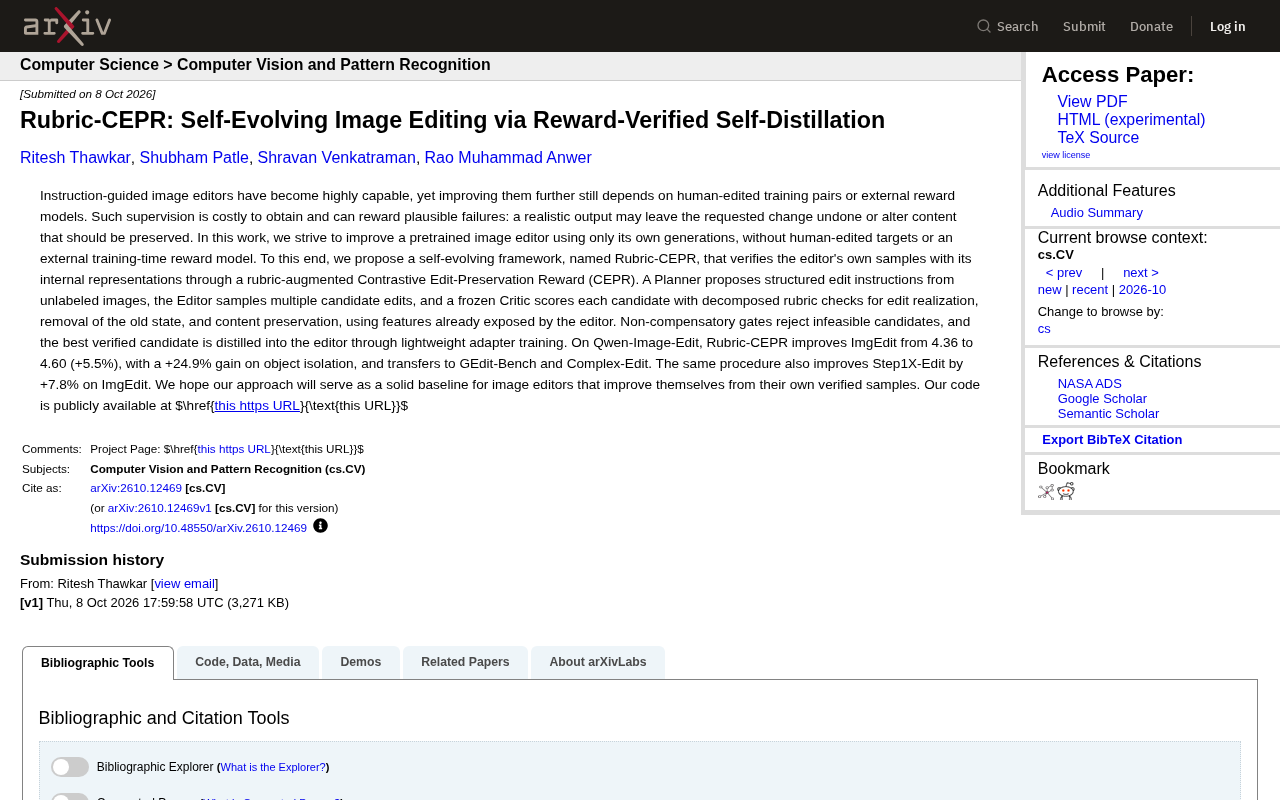
To address the problem that instruction-driven image editors rely on costly human training pairs or external reward models that can reward "seemingly successful but actually failed" outputs, a new study proposes the Rubric-CEPR framework: self-evolution using only samples generated by the editor itself. It consists of three roles—Planner, Editor, and Frozen Critic—with the core being a rubric-enhanced Contrastive Edit-Preservation Reward (CEPR) that independently scores three dimensions: whether the edit was performed, whether the old state was removed, and whether content was preserved. Non-compensatory gates directly reject infeasible candidates, preventing partial successes from being misjudged as high-quality samples. The best verified candidates are distilled back into the editor via lightweight adapters, keeping computational costs manageable. On Qwen-Image-Edit, ImgEdit improves by 5.5% and the object isolation task by 24.9%; transferred to Step1X-Edit, it achieves a 7.8% improvement, demonstrating cross-model generalizability.
Instruction-driven image editors have become quite capable, but pushing them further typically relies on human-annotated training pairs or external reward models. Such supervision is not only expensive to obtain, but can also reward outputs that "look plausible but actually fail"—images that appear realistic, yet where the requested modification wasn't made, or content that should have been preserved was altered. A new study from rss proposes Rubric-CEPR: a framework that can self-evolve using only the editor's own generated samples, requiring no human targets and no external reward model at training time.
Core Idea: Let the Editor Validate Itself Using Its Own Internal Representations
The key to Rubric-CEPR is that it doesn't introduce a new scoring network—instead, it leverages features the editor already exposes to construct the reward signal. The entire loop consists of three roles:
- Planner: Proposes structured editing instructions from unlabeled images, defining "what to change."
- Editor: Samples multiple candidate edit results for each instruction.
- Frozen Critic: Scores candidates using a rubric-enhanced Contrastive Edit-Preservation Reward (CEPR).
CEPR decomposes scoring into multiple rubric checks: whether the edit was actually performed, whether the old state was removed, and whether content was preserved. Each dimension is evaluated independently rather than being merged into a single aggregate score.
Contrastive Learning is the key background for understanding the word "Contrastive" in CEPR. Its core idea is not to directly learn "what constitutes a good sample," but to shape the representation space by pulling positive samples closer and pushing negative samples apart. In the image editing scenario, multiple candidate results under the same instruction naturally form a set of contrastive samples: candidates that truly perform the edit while preserving content reasonably should be pulled in as "positive," while those that fail to perform the edit or destroy original content are pushed away as "negative." Compared to absolute scoring, contrastive signals are more robust to thresholds and scales, and can be more easily read directly from the editor's existing feature space without training a separate scoring network. CEPR borrows precisely this mechanism, allowing "edit success" and "edit failure" to form separable gradient directions in the representation space.
Non-Compensatory Gating and Self-Distillation
A design highlight of the paper is Non-compensatory gates. In traditional weighted rewards, a high score on one dimension can compensate for failure on another; but failures in image editing are often "fatal"—for example, if the edit wasn't performed at all, the image shouldn't be adopted no matter how natural it looks. Non-compensatory gates directly reject infeasible candidates, preventing "partial successes" from being mistaken for high-quality samples.
The best verified candidates are then distilled back into the editor through lightweight adapter training. This means the entire self-evolution process only updates a small number of parameters rather than retraining the whole model, keeping computational costs manageable.
Reward Model typically refers to a standalone network used in reinforcement learning or preference optimization to replace human scoring and provide training signals for model outputs. It generally requires large amounts of human preference data for training, and once distribution drift occurs, it may reward outputs that "look plausible but actually fail"—the so-called reward hacking. Rubric-CEPR deliberately bypasses this step: rewards no longer come from a trained black-box model, but are computed directly from the editor's own exposed features combined with structured rubrics. This eliminates the compute and data costs of training an external reward model, and also reduces the risk of the reward model becoming disconnected from the true editing objective.
Adapter refers to a small set of trainable parameters inserted into a pretrained model, where the main weights are frozen during fine-tuning and only the adapter is updated. It is common in parameter-efficient fine-tuning (PEFT), with benefits including low training overhead, less risk of damaging the original model's capabilities, and easy switching between multiple tasks. Rubric-CEPR uses lightweight adapters to distill the best verified candidates back into the editor—precisely this approach: the entire self-evolution process only updates a small number of parameters rather than full retraining.
Experimental Results: Consistent Improvements Across Multiple Models and Benchmarks
According to the paper, on Qwen-Image-Edit, Rubric-CEPR improves ImgEdit from 4.36 to 4.60, a gain of +5.5%; the object isolation task improves by as much as +24.9%. The method also transfers to two other benchmarks, GEdit-Bench and Complex-Edit.
When the same pipeline is applied to Step1X-Edit, it achieves a +7.8% improvement on ImgEdit. Two editors with different architectures both benefit, demonstrating that the framework is decoupled from specific models and has a degree of generalizability. The authors have released the code and hope this work becomes a baseline method for "editors self-improving from their own validated samples."
ImgEdit, GEdit-Bench, and Complex-Edit are all benchmark suites for evaluating instruction-driven image editing capabilities. ImgEdit focuses on covering multiple edit types (such as object replacement, addition, removal, isolation, etc.), and typically scores based on a combination of instruction following and image fidelity; GEdit-Bench focuses on more general editing instructions and realism; Complex-Edit targets complex edits requiring multi-step reasoning or compositional operations. Different benchmarks have different emphases, and if a method achieves consistent improvements across multiple benchmarks, it usually indicates that it improves the editor's general capabilities rather than overfitting to a particular task type. This also explains why the authors emphasize cross-benchmark transfer: it is important evidence that the framework is decoupled from specific models.
Why This Direction Is Worth Watching
Current image editing model iteration relies heavily on a data flywheel: human annotation, preference data, and external reward models are all indispensable. Rubric-CEPR demonstrates a lighter path—internalizing validation capability into the editor's own representation space, constraining reward quality with structured rubrics, and ensuring sample reliability with non-compensatory gates.
From a broader perspective, this "self-generate—self-validate—self-distill" closed loop aligns with self-improvement research directions in the language model field. But in image editing tasks, defining "edit success" is far more difficult than in text, and rubric decomposition and gating mechanisms are precisely engineered answers to this challenge. For teams constrained by annotation budgets, such methods offer a way to continuously improve editor performance without adding new human data.
One-line Summary
Rubric-CEPR lets image editors self-validate and self-evolve using their own representations, without human annotation or external reward models.
Paragraph Summary
Addressing the problem that instruction-driven image editors rely on costly human training pairs or external reward models that can reward "seemingly successful but actually failed" outputs, a new study proposes the Rubric-CEPR framework: self-evolution using only samples generated by the editor itself. It consists of three roles—Planner, Editor, and Frozen Critic—with the core being a rubric-enhanced Contrastive Edit-Preservation Reward (CEPR) that independently scores three dimensions: whether the edit was performed, whether the old state was removed, and whether content was preserved. Non-compensatory gates directly reject infeasible candidates, preventing partial successes from being misjudged as high-quality samples. The best verified candidates are distilled back into the editor via lightweight adapters, keeping computational costs manageable. On Qwen-Image-Edit, ImgEdit improves by 5.5% and the object isolation task by 24.9%; transferred to Step1X-Edit, it achieves a 7.8% improvement, demonstrating cross-model generalizability.
Related articles

Gemini 4 Argon Hands-On: AI Builds Board Games, Constructs Temples, and Trains Robots Autonomously
Gemini 4 Argon hands-on roundup: AI autonomously builds a desk racetrack and temple in Blender, writes a ray tracing engine, trains a humanoid robot to sink 7 shots, plus API pricing and developer access.

The Magic Octagonal Coin: Why Only 9% of People Can Predict Its Flip?
Only 9% of people can correctly predict the Magic Octagon coin flip. This article explains its spatial rotation mechanism, common cognitive pitfalls, and a new hypothesis based on Relevance Theory, exploring the limits of human spatial reasoning.

Sam Altman: AI Is Entering the Era of Scientific Discovery — Math Breakthroughs Will Replicate in Biology and Energy
Sam Altman says AI is entering the era of scientific discovery — math breakthroughs will replicate in biology, materials science, and energy to help develop new drugs and energy sources.