A New Take on the Platonic Representation Hypothesis: Where Does Alignment Come From, and What Does It Mean?

A systematic examination of the Platonic Representation Hypothesis: where alignment emerges, whether the trend persists, and what baselines are needed.
This article systematically reviews the controversies surrounding the Platonic Representation Hypothesis (PRH) across three fronts: first, locating the "source" of alignment across model layers and representation dimensions while introducing baselines to control for depth and width confounds; second, clarifying that the capability-alignment trend still holds for newer language models provided captions are sufficiently clean and informative, thereby explaining that previous contradictory findings stem from data quality; and finally, establishing a frame of reference for cross-modal alignment, finding that cross-modal alignment between unimodal models can exceed that of explicitly aligned vision-language models but still falls far short of same-modality alignment. The research emphasizes that PRH should not be answered with a simple "yes or no" but rather by asking at what level, under what conditions, and relative to what reference alignment truly emerges.
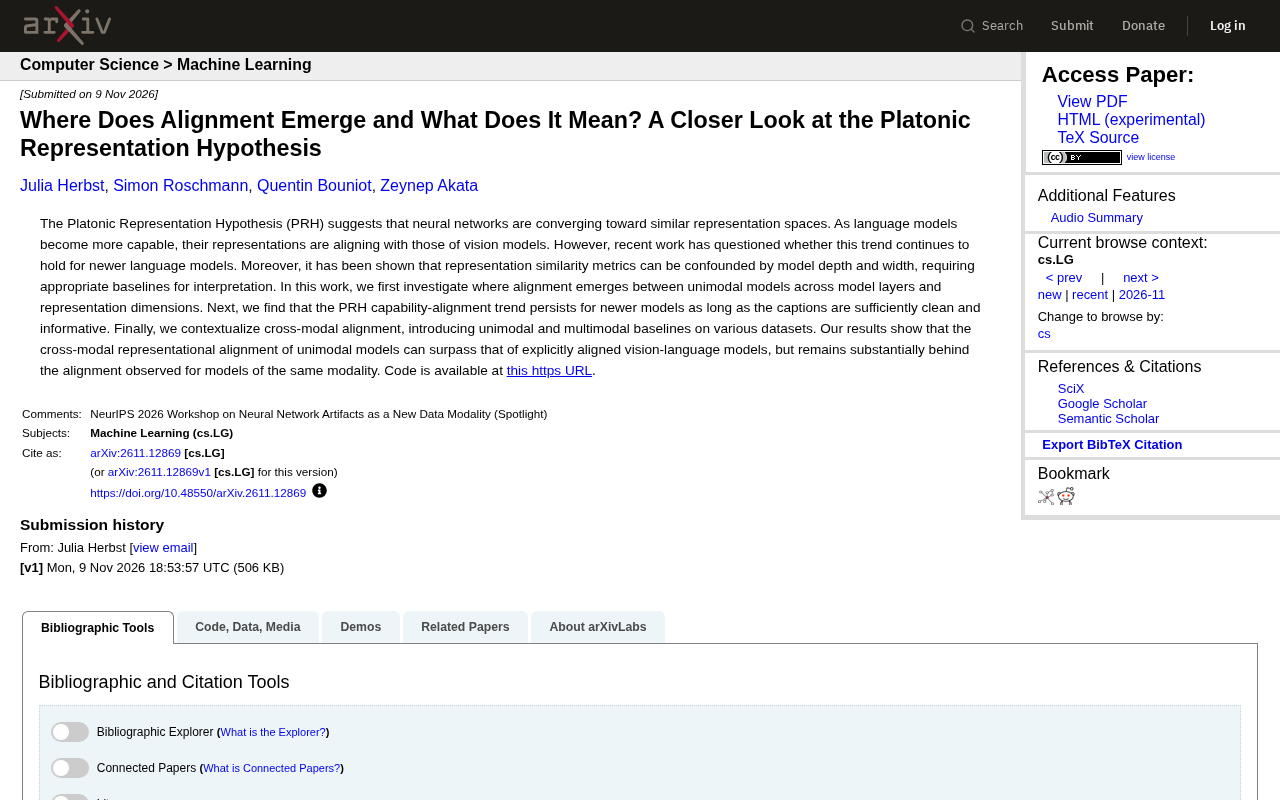
Are neural networks converging toward similar representation spaces? The Platonic Representation Hypothesis (PRH) offers an intriguing answer: as model capabilities improve, the internal representations of language models and vision models are converging. However, this hypothesis has recently come under considerable scrutiny—some studies suggest that this convergence trend may not hold for newer language models, and that representation similarity metrics themselves may be confounded by model depth and width, requiring appropriate baselines for interpretation.
A recent work systematically addresses these issues. The research team proceeds on three fronts: where exactly alignment "emerges" across model layers and representation dimensions; whether the capability-alignment trend of PRH still holds for newer models; and how to establish a reasonable frame of reference for cross-modal alignment.
Where Alignment Emerges: A Layer-by-Layer and Dimension-by-Dimension Examination
The study first examines alignment within unimodal models—between layers and between representation dimensions. This amounts to descending from macro-level model comparisons to the micro-structure inside the network.
The significance of this approach: if two models have similar overall representations, this similarity may not be uniformly distributed but rather concentrated in certain layers or dimensions. Only by identifying the "source" of alignment can we determine whether convergence is a natural consequence of model capability or a byproduct of architecture or training objectives. Prior work has already demonstrated that representation similarity metrics are affected by model depth and width, so this study introduces appropriate baselines in its analysis to avoid misreading architectural differences as representational convergence.
Representation similarity metrics (such as CKA and SVCCA) measure the degree of similarity between internal representations of two models, with the core idea being to compare the relative structural relationships of samples in their respective representation spaces. However, such metrics are sensitive to model depth and width: deeper networks naturally have more layers, and the distribution of inter-layer similarity changes accordingly; wider networks may dilute the signal in individual dimensions. Therefore, without controlling for architectural variables, similarity values may reflect capacity differences rather than genuine representational convergence. Appropriate baselines typically refer to similarity levels measured on models with identical architectures or random initialization, used to calibrate observed values and thereby distinguish "meaningful alignment" from "architectural artifacts."
The Capability-Alignment Trend: Still Holds for Newer Models, With Caveats
Regarding the controversy over "whether newer language models still follow the PRH trend," the study offers a more nuanced conclusion: as long as caption texts are sufficiently clean and informative, the capability-alignment trend persists for newer models.
This effectively provides an explanation for previous contradictory findings—the trend has not disappeared but was masked by data quality. When the text descriptions used for training or evaluation are noisy or lacking in information, the alignment signal between model representations is weakened, making it appear that the trend has been interrupted. This finding also reminds future research: when testing PRH, data cleaning and caption quality are variables that must be controlled.
The capability-alignment trend refers to the observation that the stronger a model's capability, the higher the similarity between its internal representations and those of models in other modalities—this is the core empirical prediction of PRH. Testing this trend relies on paired samples: for the same semantic content, representations are obtained from both a language model and a vision model, and then similarity is computed. Captions serve as semantic anchors here; if they are noisy or insufficiently informative, the semantic correspondence between paired samples becomes模糊 (blurred), thereby weakening the observable alignment signal. This explains why different studies reach contradictory conclusions on newer models: the trend itself may persist but be masked by data quality.
Cross-Modal Alignment Needs a Frame of Reference: Unimodal and Multimodal Baselines
The study further provides contextualized interpretation for cross-modal alignment by introducing unimodal and multimodal baselines across different datasets. The results reveal a clear hierarchy:
- Cross-modal representational alignment between unimodal models can exceed that of vision-language models trained with explicit alignment;
- However, such cross-modal alignment still falls substantially short of alignment levels between models within the same modality.
In other words, convergence between language and vision models does exist—even stronger than some multimodal models specifically designed for alignment—but it remains considerably distant from the tightness "within the same modality." This comparison provides a more honest yardstick for the strength of PRH: convergence is real but should not be overstated.
Unimodal baselines refer to representation similarity between models of the same modality (e.g., two language models or two vision models), representing the upper-bound reference for representational convergence within that modality. Multimodal baselines refer to vision-language models trained with explicit alignment (e.g., contrastive learning), whose cross-modal representation similarity represents the level after "forced alignment." Only by placing cross-modal alignment between these two types of baselines can its strength be assessed: exceeding the multimodal baseline indicates that convergence emerges spontaneously, while falling short of the unimodal baseline indicates that cross-modal convergence still has fundamental limitations. Without a frame of reference, isolated similarity values cannot be interpreted.
What This Means for Representation Learning Research
The methodological value of this work may be no less than its conclusions. It breaks PRH down from a grand hypothesis into testable specific questions: where alignment occurs, under what conditions it holds, and relative to what baseline it becomes meaningful.
For practitioners focused on representation learning, there are at least three takeaways. First, when comparing representations across different models, architectural factors such as depth and width must be controlled; otherwise, similarity numbers themselves lack explanatory power. Second, data quality is a prerequisite for observing alignment trends—clean caption texts make signals clearer. Third, while cross-modal alignment is advancing, it still lags significantly behind same-modality alignment, and explicitly aligned multimodal models are not the endpoint.
The code is open-sourced on GitHub (ExplainableML/prh-closer-look), providing a foundation for subsequent reproduction and extension. Whether PRH holds may not deserve a "yes or no" answer; instead, we should ask: at what level, under what conditions, and relative to what reference does alignment truly emerge.
Related articles

Gemini 4 Neon Leak: A Potential Strong Contender Against Opus 5.5
A Hacker News thread suggests Gemini 4 Neon looks like an Opus 5.5 competitor. This article unpacks the product positioning behind this community signal, shifts in the top-model competitive landscape, and what it means for developers' model selection strategy.

Claude Fable 5.2's Self-Authored Short Film 'Fable' Sparks Discussion
A short film 'Fable,' credited to Claude Fable 5.2 for script, visuals, and directing, appears on Hacker News. This article analyzes the significance of full-pipeline AI creation, community reactions, and what it means for content creators.

Anthropic IPO Pricing: A Signal of AI Giants Going Public
Anthropic's IPO pricing draws attention. This article analyzes its potential impact on AI industry valuation, commercialization paths, and the competitive landscape, and highlights public-market expectations and challenges for AI companies.