A Practical Guide for Java Developers Transitioning to AI Agent Development: Technology Selection, Architecture Design & Resume Positioning

A practical guide for Java developers to enter AI Agent development with architecture and resume tips
This article systematically maps out the complete path for Java developers entering AI Agent development. Starting from the core Agent definition (Perception-Planning-Action-Feedback loop), it distinguishes between general-purpose and vertical Agent product categories, deeply compares Workflow (determinism-first) and Agent (flexibility-first) architectural schools, recommends hybrid architecture as the best practice, highlights Spring AI Alibaba as the preferred technology stack for Java developers, and provides practical advice for featuring Agent projects on resumes.
2026 is widely recognized in the industry as the inaugural year of AI Agents, with explosive growth in enterprise demand for Agent development talent. However, for the vast majority of Java developers, critical questions remain largely unanswered: What exactly is an AI Agent? How do you build one? Which frameworks should you use? How do you present it on your resume?
This article starts from the core concepts of Agents, systematically breaks down product classifications and technical architectures, and helps Java developers map out a complete development path and technology selection strategy for AI Agent development.
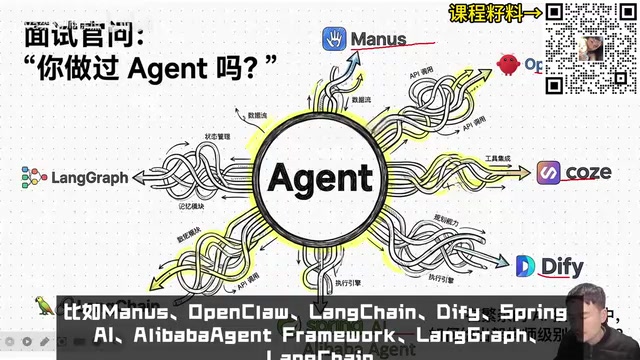
The Core Definition of AI Agents: The Essential Difference from Regular ChatBots
Many developers still think of AI Agents as simply "calling a large model API for conversations." But if you're interviewing for Agent-related positions, basic API integration and dialogue capabilities are far from sufficient. What interviewers really want to know is: Have you built a complete Agent project?
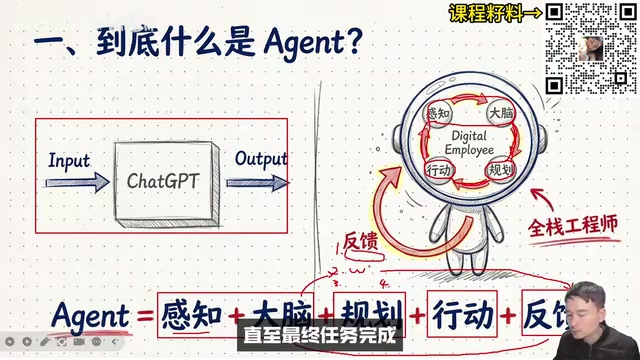
As the technology has evolved, AI Agents now have clearly defined standards. A qualified Agent must possess four core capabilities:
- Perception: Receiving user tasks and understanding intent
- Planning: Decomposing tasks and formulating execution steps
- Action: Calling specific tools to execute each step
- Feedback: Returning execution results to the large model, determining whether the task is complete, and looping if not
This four-step cyclical mechanism has deep theoretical roots in academia. It originates from the classic BDI (Belief-Desire-Intention) architecture in artificial intelligence and the Agent-Environment interaction paradigm in reinforcement learning, representing a modern evolution of Cognitive Architecture. It can be traced back to the SOAR and ACT-R systems of the 1990s, while modern AI Agents use large language models as the cognitive core, replacing traditional rule engines and giving Agents natural language understanding and complex reasoning capabilities. The ReAct (Reasoning + Acting) paper published in 2022 was a milestone in this paradigm, demonstrating that having LLMs alternate between reasoning and acting significantly improves task completion rates, laying the design foundation for today's mainstream Agent frameworks.
Here's a concrete example: A user issues the task "Search for a topic on Baidu and summarize it in 100 words." The Agent first perceives the task content and determines whether its existing information is sufficient to complete it. If not, it plans and decomposes the task into four steps: "open browser → enter Baidu URL → search keywords → summarize content," then sequentially calls tools to execute each step. The result of each step is fed back to the large model for evaluation until the task is finally completed.
This closed-loop mechanism of "Perception-Planning-Action-Feedback" is the essential distinction between AI Agents and regular ChatBots. Understanding this is the first step for Java developers entering Agent development.
Product Dimension Classification: General-Purpose vs. Vertical Agents
All AI Agent products can be categorized along two dimensions: product/business dimension and underlying technical dimension. Let's first look at the product dimension.
General-Purpose Agents: Versatile but Hard to Differentiate
General-purpose Agents handle arbitrary tasks with fuzzy boundaries—they're "jack-of-all-trades" products. Manus, OpenCloth, and similar products fall into this category. They can handle all kinds of tasks, but precisely because they're so general, it's difficult for developers to package them into a resume with differentiated competitive advantage. That said, you can still build a simplified general-purpose Agent as a practice project.
Vertical Agents: The Direction with Highest Enterprise Demand
Vertical Agents focus on a single business process, and this is the direction with the strongest enterprise-level Agent demand. Typical examples include:
- Code assistance: AI programming assistants like Cursor
- Complex business optimization: Such as DeepTrip for flight combination optimization
- Internal enterprise automation: Such as automated approvals and ticket routing
For Java developers who are job hunting, vertical Agents are the most worthwhile project type to feature on your resume. You can design Agent solutions based on your industry:
- Finance: Credit approval and risk assessment Agents replacing client managers
- Manufacturing: Equipment prediction and fault diagnosis Agents replacing equipment engineers
- HR: Automated intelligent talent matching Agents replacing recruiters
The advantage of choosing a vertical scenario is that interviewers can clearly see the depth of your business understanding, not just technical stacking.
Technical Architecture Breakdown: Workflow vs. Agent — Two Schools of Thought
From an underlying technical architecture perspective, AI Agent development divides into two major schools. Understanding the difference between them is crucial for Java developers making technology choices.
The Workflow School: Determinism First, Suitable for Core Business
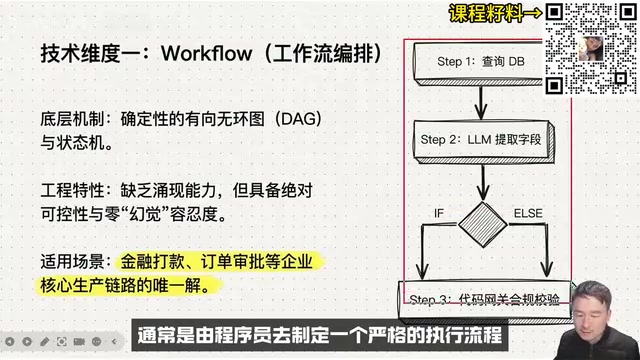
In the Workflow approach, programmers pre-define a strict execution flow. For an automated coding Agent, for example, the flow might be: requirements analysis → feasibility assessment (exit if infeasible) → architecture design → code implementation. Every step is deterministic and controllable.
Applicable scenarios: In business environments requiring strict governance, Workflow is the only solution. Because the business absolutely cannot allow the large model to deviate from established business processes due to "hallucination." In scenarios like financial risk control and medical approvals, every step in the process must be traceable and auditable.
From a technical implementation perspective, Workflow is essentially a State Machine or Directed Acyclic Graph (DAG) programming paradigm. Java developers are already familiar with this—Spring State Machine, Activiti/Camunda, and other workflow engines embody similar thinking. Workflow in AI Agents simply replaces certain nodes in traditional workflows with LLM calls, giving them natural language processing capabilities, but overall process control remains in the developer's hands.
The Agent School: Flexibility First, Suitable for Exploratory Tasks
The Agent school doesn't preset fixed steps. Instead, it provides an overall goal and a toolkit, letting the large model autonomously decide which tools to call, evaluate execution results, self-reflect when encountering problems, and repeat execution until the task is complete.
The "tool calling" here relies on a key technology—Function Calling. Function Calling was first introduced by OpenAI in June 2023 and subsequently adopted by all major model providers. Its core principle is: describing available tools' names, parameters, and functionality in JSON Schema format within the Prompt. During inference, the large model determines whether a tool call is needed; if so, it outputs a structured function call request (including function name and parameters), which the application layer executes and returns the result to the model to continue reasoning. This mechanism is the foundational capability enabling Agents to interact with the external world—without Function Calling, Agents would be limited to pure text generation.
Advantages: Extremely flexible, suitable for handling general tasks where SOPs cannot be exhaustively enumerated.
Disadvantages: The entire execution process is a "black box," potentially falling into infinite loops or excessive token consumption, so it's rarely used directly in core production environments.
Hybrid Architecture: Best Practice in Real Projects
In real enterprise projects, the most recommended approach is a Workflow + Agent hybrid architecture—using Workflow to ensure determinism in critical processes while introducing Agent autonomy in areas requiring flexible decision-making.
For example, an intelligent customer service system could use Workflow to control the overall service process (identity verification → issue classification → ticket creation), while using an Agent within the "issue classification" step to flexibly determine user intent.
Currently, mainstream frameworks like LangGraph and Spring AI Alibaba already support this hybrid orchestration pattern. LangGraph is an Agent orchestration framework from the LangChain team, whose core idea is modeling the Agent's execution flow as a Directed Graph. Nodes in the graph represent execution steps (such as LLM calls, tool execution, conditional logic), and edges represent state transitions. Compared to traditional chain-based calling, graph structures can express loops, branches, parallelism, and other complex control flows—which is critical for implementing Agent reflection loops and multi-Agent collaboration. Spring AI Alibaba's Graph orchestration borrows similar ideas but deeply integrates with the Spring ecosystem, supporting seamless collaboration with Spring Boot's auto-configuration, dependency injection, and other features—a natural technological affinity for Java developers.
AI Agent Technology Selection for Java Developers
Once you've clarified your business direction and architecture approach, the next challenge is specific technology selection.
Option 1: Low-Code/SaaS Platforms for Rapid Validation
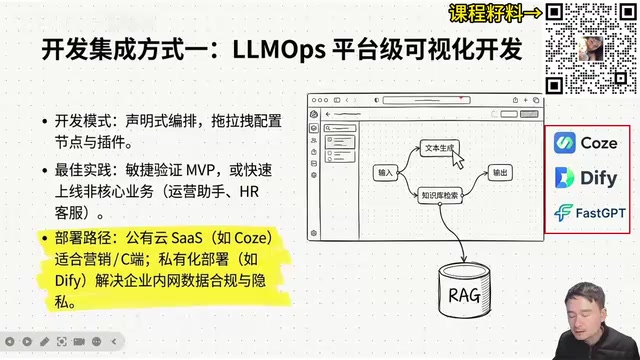
Through Agent low-code platforms like Coze, Dify, and FastGPT, you can configure nodes, mount knowledge bases, and connect MCP through drag-and-drop interfaces. Coze is ByteDance's Agent building platform, while Dify and FastGPT are open-source solutions. These platforms typically offer visual process orchestration interfaces, built-in vector databases (for RAG—Retrieval Augmented Generation), pre-built tool plugin marketplaces, and one-click deployment capabilities. Their underlying infrastructure is usually built on the Python ecosystem, using LangChain or similar frameworks as execution engines.
This approach is suitable for:
- Quickly building personal assistants to improve daily work efficiency
- Rapidly launching AI capabilities for non-core business functions
- Conducting Proof of Concept (PoC) in early project stages
Limitations: When Agents need to complete distributed transactions across microservices, integrate with existing system authentication, perform fine-grained concurrency control, or connect with infrastructure like Nacos/Redis/MQ, low-code platforms fall short. This is precisely why enterprises ultimately need Java developers to build production-grade Agents—enterprise core systems mostly run on Java microservice architectures (Spring Cloud, Dubbo), and Agents must deeply integrate with these systems to deliver real value.
Option 2: Deep Development with Spring AI Alibaba
For Java developers, Spring AI Alibaba + Agent Framework is currently the most worthwhile technology stack to invest in. Its core advantages include:
- Graph-based programming: Supports orchestrating single Agents, multi-Agent systems, and Workflows as graphs
- Comprehensive Agent ecosystem: Provides rich open-source frameworks and toolsets
- Seamless integration with Spring ecosystem: Easily connects with existing microservice architectures, databases, message queues, etc.
Java developers are recommended to follow this progressive learning path:
- Spring AI Alibaba basics: Large model integration, Prompt engineering, basic dialogue capabilities
- Agent Framework core: Single Agent development, tool calling (Function Calling)
- Advanced Graph orchestration: Multi-Agent collaboration, Workflow design
- Advanced features: A2A (Agent-to-Agent) protocol, Human-in-the-Loop mechanisms
- MCP protocol: Model Context Protocol for standardized tool integration and reuse
Regarding the A2A protocol: This is an inter-Agent communication standard proposed by Google in early 2025, aimed at solving interoperability issues between different Agent systems. In multi-Agent architectures, different Agents may be developed by different teams, frameworks, or even organizations. A2A defines standard interfaces for Agent capability discovery (Agent Card), task delegation, and state synchronization. Java developers can think of it as the gRPC or REST API specification of the Agent world—just as microservices need standardized communication protocols, Agents also need unified interaction standards.
Regarding the MCP protocol: This is an open protocol released by Anthropic in late 2024, aimed at solving the fragmentation of AI Agent tool integration. Before MCP, every Agent framework had its own tool definition and calling methods, requiring developers to repeatedly write tool adaptation code for different frameworks. MCP defines a standardized communication protocol covering tool discovery, parameter passing, result returning, and more—similar to how the USB protocol unified peripheral interfaces. Through MCP, a tool only needs to be implemented once to be called by any Agent framework supporting the protocol, greatly reducing ecosystem fragmentation costs.
This learning path progresses from basic to advanced, with each step producing demonstrable project outcomes.
Practical Advice: How to Put Agent Projects on Your Resume
For Java developers who are job hunting, here's a proven resume positioning strategy:
Step 1: Select a vertical scenario and clarify business value
Don't build a broad, general-purpose Agent. Instead, focus on solving a specific business problem. For example, "Intelligent Resume Screening System Based on Multi-Agent Collaboration" is far more compelling than "General AI Assistant."
Step 2: Adopt a Workflow + Agent hybrid architecture to demonstrate technical depth
Use Workflow for core processes to ensure controllability, and Agent for flexible components to showcase intelligence. This architectural design itself demonstrates your deep understanding of Agent technology.
Step 3: Use Spring AI Alibaba as the technical foundation
Demonstrate your ability to integrate with enterprise-level Java ecosystems, including microservice connectivity, data persistence, and message queue integration.
Step 4: Highlight key technical terms in project descriptions
Ensure your resume includes these high-frequency technical keywords: Multi-Agent collaboration, Graph workflow orchestration, Function Calling tool invocation, A2A protocol, Human-in-the-Loop, MCP protocol, etc.
Conclusion: The Best Time for Java Developers to Enter AI Agent Development
AI Agent development isn't mysterious, but it's certainly not as simple as calling an API. Java developers need to understand the core Agent mechanism (Perception-Planning-Action-Feedback), master the differences between product classifications (general-purpose vs. vertical) and technical architectures (Workflow vs. Agent vs. hybrid), and then select appropriate frameworks for hands-on practice.
For Java developers, Spring AI Alibaba provides a complete path from getting started to production-grade development. The 2026 Agent development wave has arrived. Getting in now allows you to capture the technology dividend while building differentiated advantages in the job market.
Related articles
 Tutorials
ChatGPT Plus Subscription Guide: Are GPT-5.5, image-2, and Codex Worth the Upgrade?
A detailed look at ChatGPT Plus features — GPT-5.5, image-2, and Codex — with a Plus vs Pro comparison and a complete step-by-step subscription guide for users outside the US.
 Tutorials
Harness AI Engineering in Practice: Using Claude Code to Master Enterprise-Level E-Commerce Development
Deep dive into Harness AI Engineering: master enterprise e-commerce development with Claude Code using the Rules, Skills, Wiki, and Changes framework.
 Tutorials
Cursor + Codex Dual-IDE Collaboration: A Practical Methodology for Open-Source Project Customization
A complete methodology for open-source project customization based on real-world experience, detailing the Cursor+Codex dual-IDE workflow, seven-stage process, MVP validation, and AI source code reading techniques.