A Practical Guide to Literature Reviews for Master's Students: From Topic Selection to Taxonomy Construction

A step-by-step guide for master's students to conduct literature reviews, from topic narrowing to taxonomy building.
This article provides a practical roadmap for master's students facing their first literature review. Using concept drift in machine learning as an example, it covers how to narrow broad topics into researchable questions, conduct systematic literature searches across academic databases, leverage existing surveys as research springboards, construct original taxonomies as core contributions, and communicate effectively with advisors using structured, decision-ready questions.
A Statistics Master's Student's Confusion
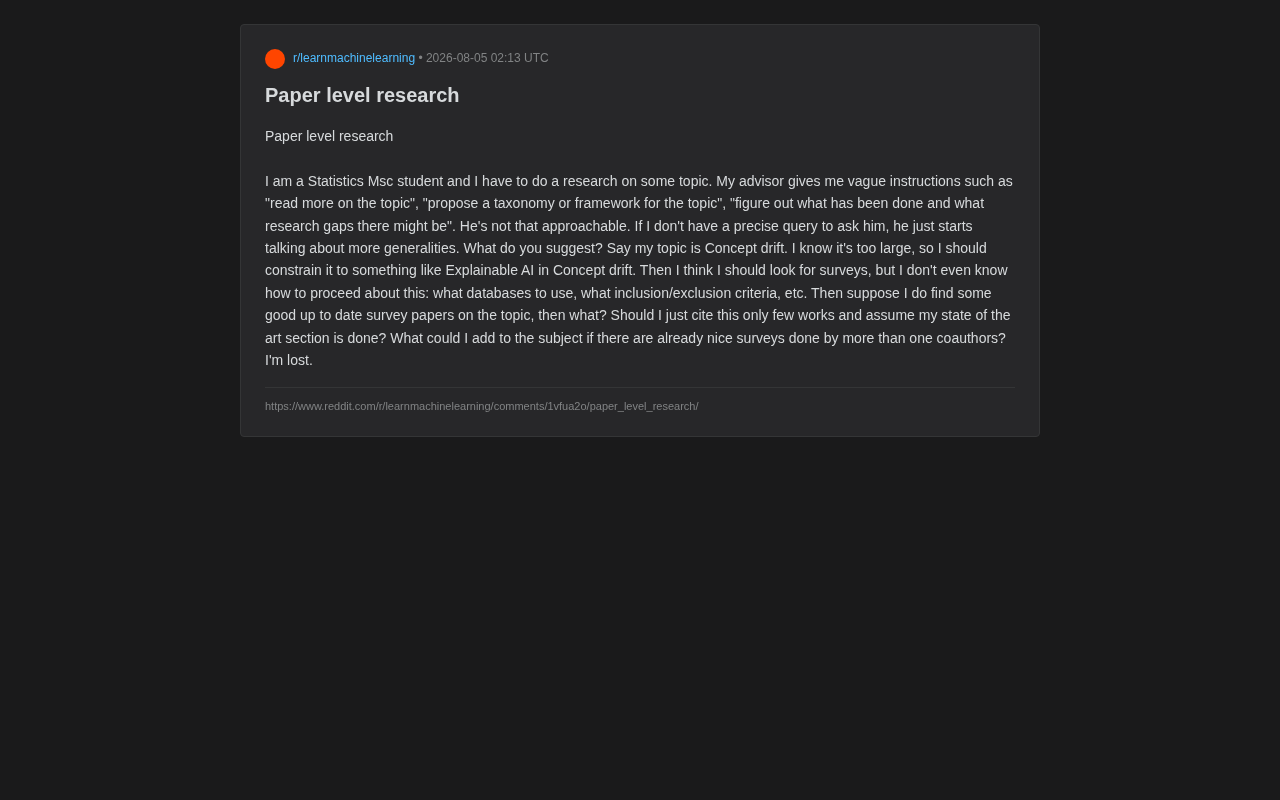
In an academic discussion on Reddit, a statistics master's student shared his predicament: his advisor assigned him a research task but only gave vague instructions like "read more related literature," "propose a taxonomy or framework for this topic," and "figure out the existing work and research gaps." Making things worse, the advisor wasn't very approachable—if the student couldn't come up with specific questions, the advisor would only speak in generalities.
This "hands-off" mentoring style is extremely common at the graduate level. Many students facing open-ended research topics for the first time fall into the same confusion: How do you narrow down a broad topic? Which databases should you use for searching? What do you do after finding review papers? Using "Concept Drift"—the topic mentioned by this student—as an example, this article outlines a complete path from zero to one in literature research.
Concept drift is a core challenge in machine learning, referring to changes in the underlying data distribution over time that cause previously trained models to degrade in performance. For example, a spam classifier might gradually fail as spam characteristics continuously evolve; a credit scoring model might show increasing prediction bias due to dramatic economic changes (such as the impact of a pandemic). Concept drift can be categorized into sudden, gradual, incremental, and recurring types. This problem is particularly prominent in real-time decision-making scenarios such as stream data processing, financial risk management, cybersecurity, and recommendation systems. In recent years, with the rise of online learning and adaptive systems, it has become a research hotspot with numerous related works published annually at top conferences like ICML, NeurIPS, and KDD.
Topic Narrowing: Turning a Broad Subject into a Researchable Question
This student's instinct was correct—"concept drift" by itself is too broad and needs to be constrained to something like "Explainable AI in Concept Drift." This is a critical step in research topic selection.
Explainable Artificial Intelligence (XAI) aims to make the decision-making processes of machine learning models understandable to humans. The field's emergence stems from the tension between deep learning models' "black box" nature and the transparency demands of high-stakes applications (such as medical diagnosis, judicial decisions, and autonomous driving). Mainstream methods include LIME (Local Interpretable Model-agnostic Explanations), SHAP (Shapley Additive Explanations based on game theory), attention mechanism visualization, and decision rule extraction. The "right to explanation" clause in the EU's GDPR has further accelerated XAI development from a legal perspective. Combining XAI with concept drift, the core question becomes: when a model detects that data distribution has changed, can it clearly explain to users "why drift occurred" and "which feature dimensions have changed"—this is precisely a cutting-edge interdisciplinary research direction.
Three Criteria for Judging Topic Granularity
A good research question should meet three conditions: specific enough (completable within a limited timeframe), novel enough (with unexplored angles), and significant enough (valuable to academia or applications).
The evaluation method is simple: search your narrowed topic directly in Google Scholar.
- If thousands of papers come up, it's still too broad and needs further constraints (e.g., adding application scenarios, specific algorithms, or specific data types).
- If almost no results appear, it might be too narrow or too niche, posing higher risk.
- If you find dozens to hundreds of related works with 1-3 recent surveys, this is usually the ideal research granularity.
Taking "Explainable AI in Concept Drift" as an example, it can be further refined to something like "A Survey of Explainable Methods for Concept Drift Detection in Streaming Data." Here, "streaming data" constrains the data type, "detection" constrains the task stage (as opposed to "adaptation"), and "explainable methods" constrains the technical perspective—three constraints compress a vast topic into an actionable research scope.
Systematic Literature Search: Database Selection and Search Strategy
This student touched on a core pain point: which databases to use? What inclusion/exclusion criteria? This is essentially the methodology of a Systematic Literature Review (SLR), which has a well-established process.
Systematic literature reviews originated in evidence-based medicine and were introduced to software engineering and computer science research by Kitchenham et al. in their seminal 2004 paper. Unlike traditional narrative reviews, SLRs require researchers to pre-define a strict search protocol, including research questions, data sources, search strings, inclusion/exclusion criteria, quality assessment criteria, and data extraction forms. The core value of this approach lies in reproducibility and transparency—anyone following the same protocol should obtain similar result sets, thereby avoiding the selection bias inherent in traditional reviews. For master's students, mastering SLR methodology is not only necessary for completing the current project but also a foundational capability for future independent academic research.
Choosing Appropriate Academic Databases
For the intersection of AI and statistics, the following sources are recommended:
- Google Scholar: Broadest coverage, suitable for initial exploration and citation tracking. It indexes content from virtually all academic publishers, but its drawbacks include inability to export structured search results and opaque ranking algorithms, making it unsuitable as the sole source for an SLR.
- Scopus / Web of Science: Ideal for conducting rigorous systematic searches and citation analysis. Both databases offer advanced search syntax, citation network analysis, and statistical breakdowns by year/source/author, and are the most recognized data sources by reviewers when publishing SLRs. Scopus has broader coverage while Web of Science has stricter quality filtering—using both is recommended.
- arXiv: For accessing the latest preprints. The AI field moves fast, and much cutting-edge work is only published here. Note that arXiv papers are not peer-reviewed and vary in quality; in SLRs they typically serve as a supplementary source, noted in the inclusion criteria.
- ACM Digital Library / IEEE Xplore: Authoritative indexes of core conferences and journals in computer science. ACM covers data mining conferences like SIGMOD, KDD, and CIKM, while IEEE Xplore includes extensive work on pattern recognition and signal processing.
Building Structured Search Queries and Screening Criteria
Searching isn't about randomly typing keywords—you should construct structured search queries, for example:
("concept drift") AND ("explainable" OR "interpretable" OR "XAI")
When building search queries, consider synonym expansion (e.g., near-synonyms for concept drift include dataset shift, distribution shift, covariate shift), truncation operators (e.g., interpret* matches both interpretable and interpretation), and nested Boolean logic. It's recommended to first test and refine your query on one database, confirm that recall and precision are balanced, then migrate to other databases (noting syntax differences across databases).
Then clearly define inclusion criteria (e.g., published after 2018, peer-reviewed, focused on methods rather than pure applications) and exclusion criteria (e.g., non-English, abstract-only, weakly related to the topic). Record the number of papers at each screening stage (using a PRISMA flow diagram)—this is both a standard practice and demonstrates your rigor in writing. PRISMA (Preferred Reporting Items for Systematic Reviews and Meta-Analyses) provides a standardized reporting framework, and its classic four-level funnel diagram (Identification → Screening → Eligibility → Inclusion) has become the academically recognized visualization for SLRs, virtually a required element when submitting papers.
Survey Utilization Strategy: Turning Existing Reviews into Research Springboards
This student's deepest confusion was: "If several excellent surveys already exist by established scholars, what can I possibly add? Is it enough to just cite a few in my related work section?"
The answer is clear: Absolutely not enough—and this is precisely where the opportunity lies.
Surveys Are Starting Points, Not Destinations
Existing surveys should be treated as maps, not destinations. The correct approach is:
- Follow the trail: A survey's reference list is a gold mine. Use it for "backward snowballing" (finding cited foundational works) and "forward snowballing" (finding the latest works that cite the survey).
Snowballing was systematically formalized by Wohlin in his 2014 monograph as an important supplement to database searches in systematic literature reviews. Backward snowballing starts from a core paper's reference list and traces citation chains into the past to find foundational works and methodological origins; forward snowballing uses Google Scholar's "Cited by" feature or Scopus's citation tracking tools to extend along the timeline into the future, discovering the latest improvements, extensions, and applications. Combining both forms a bidirectional network that effectively compensates for gaps in keyword searches—because some highly relevant works may use entirely different terminology. In practice, multiple iterations (typically 2-3 rounds) are recommended until no new relevant papers are found, reaching so-called "theoretical saturation."
-
Identify temporal gaps: Note the publication year of surveys. If an excellent survey was published in 2021, then developments from 2022 onwards represent gaps you can fill—two to three years in AI is enough for paradigm-level changes. In the concept drift field, for example, the rise of large language models after 2022 brought entirely new drift detection paradigms (such as distribution shift metrics based on embedding spaces), which likely won't appear in a 2021 survey.
-
Discover perspective gaps: Even with multiple surveys, they often approach the topic from different angles. You can ask: Do existing surveys overlook certain application scenarios? Do they lack a unified taxonomy? Do they fail to provide quantitative method comparisons? Do they focus only on algorithm performance while ignoring computational costs, deployment constraints, or fairness issues? These "perspective blind spots" are often entry points for new contributions.
Building a Taxonomy: The Core Contribution Your Advisor Is Asking For
The advisor's repeated emphasis on "propose a taxonomy or framework" is actually hinting at where the core contribution lies. A taxonomy means: you're not simply listing existing work, but reorganizing and synthesizing the field using your own set of dimensions.
In computer science research, taxonomy construction itself is a recognized form of academic contribution. Nickerson et al. proposed a widely cited taxonomy development methodology in their 2013 paper published in the Journal of the Association for Information Systems, which includes a conceptual-empirical iterative process: first derive initial dimensions from theory (the conceptual path, i.e., your intuitive understanding of the field), then validate and revise dimension definitions using actual paper samples (the empirical path, i.e., letting the data speak), iterating until termination conditions are met (e.g., dimensions no longer change, all classified objects find a home, no empty combinations or extremely imbalanced distributions exist). A good taxonomy should satisfy several criteria: mutual exclusivity (each object belongs to only one category per dimension), completeness (covering all known objects), parsimony (a manageable number of dimensions), and extensibility (able to accommodate future new works).
For example, for "Explainable AI in Concept Drift," you could build a two-dimensional or three-dimensional classification matrix along "drift type × explanation method × application domain," then map scattered papers into it. During this mapping process, empty cells represent research gaps—and these are your independent contributions. For instance, you might discover that "gradual drift × rule-based explanation × healthcare domain" is a virtually unexplored intersection—this is a potential research direction where you can both identify the gap in your survey and attempt to fill it in subsequent research.
Advisor Communication Strategy: Replace Open-Ended Questions with Multiple-Choice Questions
Facing an advisor who speaks in generalities, the student's complaint that "he only gives platitudes without precise questions" actually reveals a communication strategy problem. The solution is: Always come with specific, decision-ready questions.
There's deeper academic cultural logic behind this. In graduate education, the advisor's role is not that of a hands-on teacher, but more akin to a project "reviewer" and "direction gatekeeper." Many advisors—especially senior professors—are accustomed to providing judgment and corrections on already-formed ideas, rather than building research plans from scratch with students. Understanding this, students will realize that vague instructions from advisors aren't irresponsible—they're expecting you to think independently first, form a preliminary plan, and then seek feedback. This "propose first, refine later" model actually simulates how academia truly works—whether writing grant applications or submitting papers, you need to present a complete proposal before you can receive valuable review comments.
Don't ask "what should I do?" Instead, ask:
- "I plan to narrow the topic to X, with search query Y—do you think this scope is reasonable?"
- "I noticed there's no survey addressing scenario Z in this direction since 2021. I'd like to use this as my entry point—do you think it's feasible?"
- "I've drafted a three-dimensional taxonomy (attached sketch)—are the dimension choices appropriate?"
When you present multiple-choice questions rather than open-ended ones to your advisor, even advisors who aren't great at mentoring can more easily provide valuable feedback. This is essentially the process of taking "research leadership" from the advisor's hands—and this is the necessary path from student to researcher. A more practical suggestion: before each meeting, prepare a one-page written summary containing "progress since last meeting," "current blockers," and "my two alternative approaches and preference." This structured communication can dramatically improve meeting efficiency.
Conclusion: From Vague Instructions to Clear Action
This statistics master's student's predicament is a shared experience of virtually every research novice. Between vague instructions and clear output lies a learnable methodology: narrow the topic → systematic search → use surveys as maps → build your own taxonomy → fill in the gaps.
This path appears linear but is actually full of iteration and backtracking. You might find after systematic searching that your topic is too broad and needs re-narrowing; you might discover while building a taxonomy that literature for a certain dimension is insufficient and requires additional searching; you might need to adjust your entire framework's perspective after discussions with your advisor. This non-linearity is the norm in research, not an anomaly. The key is having a clear "next action" and "completion criteria" at each stage to avoid falling into an aimless literature reading loop.
The essence of research is not finding existing answers, but learning to ask good questions and discovering overlooked corners. When you can independently walk through this path, your advisor's vague instructions to "read more, find gaps, propose a framework" will naturally become a clear action checklist in your hands.
Related articles

Gemini 4 Argon Hands-On: AI Builds Board Games, Constructs Temples, and Trains Robots Autonomously
Gemini 4 Argon hands-on roundup: AI autonomously builds a desk racetrack and temple in Blender, writes a ray tracing engine, trains a humanoid robot to sink 7 shots, plus API pricing and developer access.

The Magic Octagonal Coin: Why Only 9% of People Can Predict Its Flip?
Only 9% of people can correctly predict the Magic Octagon coin flip. This article explains its spatial rotation mechanism, common cognitive pitfalls, and a new hypothesis based on Relevance Theory, exploring the limits of human spatial reasoning.

Sam Altman: AI Is Entering the Era of Scientific Discovery — Math Breakthroughs Will Replicate in Biology and Energy
Sam Altman says AI is entering the era of scientific discovery — math breakthroughs will replicate in biology, materials science, and energy to help develop new drugs and energy sources.