A Practical Guide to Preventing Context Loss During Cursor Development

How to prevent AI coding agents from losing product context as projects scale.
As AI coding projects grow, agents like Cursor and Claude Code suffer from "context drift" — gradually losing early design decisions due to LLM context window limitations. This guide explains why drift occurs and shares proven strategies including structuring context into layered persistent files (AGENTS.md, Cursor Rules), enforcing validation checklists, shrinking task scope, and conducting regular consistency audits.
What Is Context Drift? An Underestimated Engineering Challenge in AI Programming
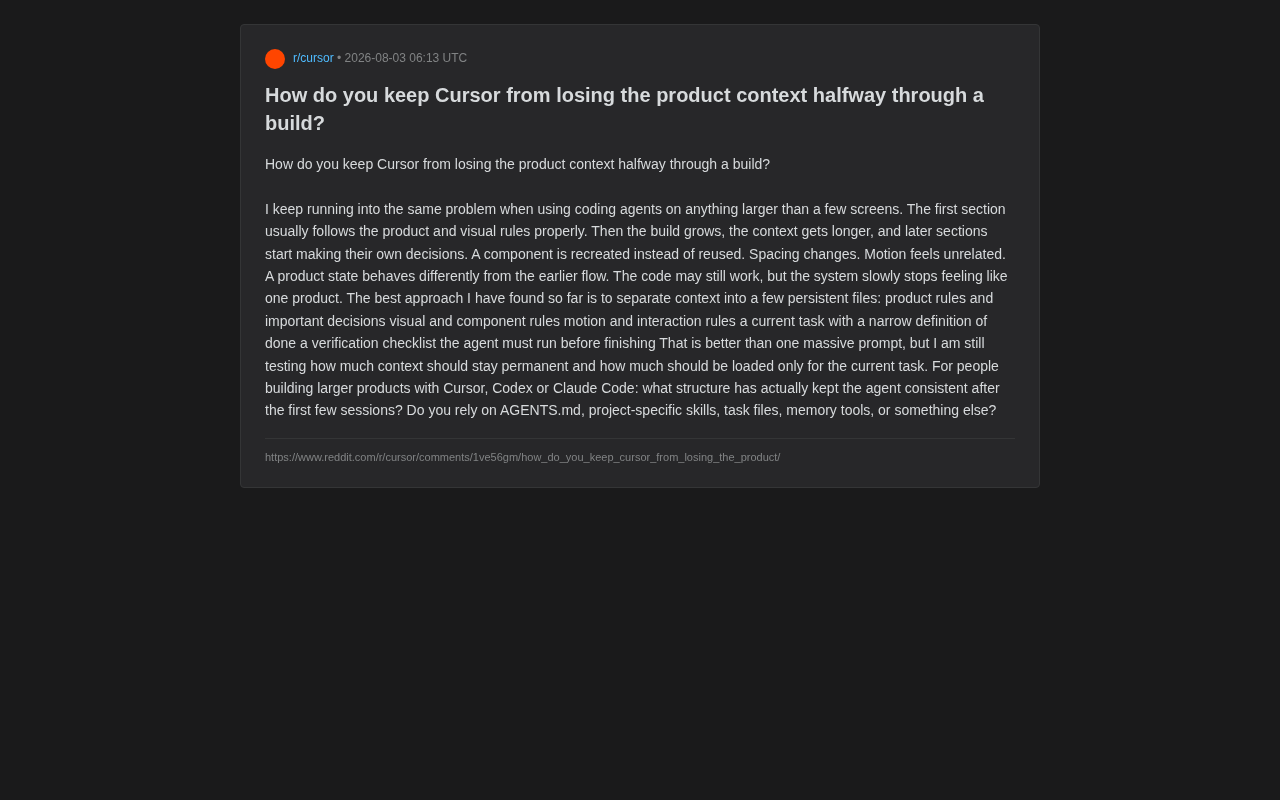
When building products of any significant scale with AI coding agents like Cursor, Codex, or Claude Code, many developers encounter a common pain point: Everything starts off well-organized, but as the codebase grows, the AI agent gradually "goes off track."
As one Reddit developer described it: the first part of a project typically follows product rules and visual specifications well, but as the build scales up and context grows longer, subsequent sections start "doing their own thing" — components get recreated instead of reused, spacing subtly changes, animation styles become disconnected, and certain product states behave inconsistently with earlier flows.
The code might still run, but the entire system slowly stops feeling like "the same product." This phenomenon is called "Context Drift," and it's a widely underestimated engineering challenge in current AI-assisted programming.
Why Does Context Drift Happen?
The root cause lies in the fact that large language models have limited, linear context windows. The Context Window refers to the maximum number of tokens a model can "see" simultaneously during a single inference — GPT-4, for example, expanded from an initial 8K tokens to 128K tokens, while Claude 3.5 supports 200K tokens. However, window size does not equal effective utilization. Academic research has confirmed that LLMs exhibit a "Lost in the Middle" phenomenon: models pay the strongest attention to content at the beginning and end of input sequences, while information in the middle tends to be overlooked. This is determined by the inherent characteristics of the Self-Attention mechanism in Transformer architectures.
As conversations and code accumulate, design decisions, naming conventions, and component specifications established early on get gradually pushed out of the "effective attention" range. When generating new code, the model is more likely to rely on recent context while ignoring core conventions from dozens of conversation turns ago.
Understanding this requires recognizing the underlying working mechanism of AI coding agents: tools like Cursor, Codex CLI, and Claude Code package the user's codebase, conversation history, system instructions, and other information into prompts sent to the LLM for inference. Each code generation is an independent inference call — the agent itself doesn't possess true "memory" — it relies on context injection to simulate continuity. Early design conventions aren't "forgotten" per se; rather, they're diluted and overwritten by information that appears later within the limited context budget.
Core Solution: Structuring Product Context in Layers
Facing this problem, a consensus has gradually formed in the community: Don't rely on a single massive prompt — instead, split context into several persistent files.
The best practice, validated through real-world use, is to separate context into several types of persistent files:
- Product rules and key decisions: Define the product's core logic, business constraints, and finalized architectural decisions
- Visual and component rules: Unified design system, component reuse specifications, spacing standards
- Animation and interaction rules: Ensure consistency in animation and interaction behaviors
- Current task file: A narrow, explicit "Definition of Done" for the current work
- Validation checklist: Items the agent must check before completing a task
The core idea behind this layered approach is: Manage "permanently valid rules" and "temporary context for the current task" separately, so the AI agent clearly knows at each stage which constraints are inviolable.
Persistent Context vs. Temporary Context: How to Choose?
A key question still being actively explored is: How much context should be permanently retained, and how much should only be loaded during the current task?
This touches on the core tension in AI programming workflow design. Too much persistent context occupies precious window space and may introduce noise; too little temporary context causes the agent to lose critical constraints. The ideal approach is to establish a "load on demand" mechanism — core rules stay resident, while detailed specifications are injected only when relevant tasks arise.
This "load on demand" philosophy is highly related to Retrieval-Augmented Generation (RAG) technology. In RAG architectures, the system first retrieves relevant document fragments from a knowledge base based on the current query, then injects them into the LLM's context for generation. Applied to AI programming scenarios, this means agents can intelligently pull corresponding specification documents based on the current task type (such as UI development, API design, database operations) rather than loading all rules at once. Cursor's @docs reference feature and Codebase indexing are concrete implementations of this approach — they allow agents to precisely obtain relevant code and documentation when needed, rather than stuffing the entire project into the context window.
Tools and Solutions for Maintaining Context Consistency
For context consistency issues, the current AI programming ecosystem offers several different mechanisms that developers are actively putting into practice:
AGENTS.md and Cursor Rules: Project-Level Configuration
AGENTS.md (along with Cursor's Rules and Claude's CLAUDE.md) is currently the most mainstream solution. These files serve as the project's "constitution," automatically read by the agent in every session, carrying product rules, coding standards, and key conventions. Their advantage lies in being persistent and automatically effective — they form the infrastructure for maintaining long-term consistency.
From a design philosophy perspective, AGENTS.md is a project-level configuration file concept introduced by OpenAI in the Codex product, inspired by developer-familiar Convention over Configuration traditions like README.md and .editorconfig. It supports hierarchical configuration — the root directory's AGENTS.md defines global rules, while same-named files in subdirectories can override or supplement constraints for specific modules. Similar mechanisms have different implementations across tools: Cursor uses the .cursor/rules directory to support loading rules by file pattern matching, and Claude Code uses CLAUDE.md files for similar functionality. The common characteristic of these configurations is that they're automatically injected into the system prompt of every inference, without requiring manual user reference, ensuring core constraints are "never forgotten."
Project-Specific Skills Definitions
Some platforms are beginning to support project-specific "skill" definitions, allowing developers to encapsulate specific workflows or code generation patterns. This is more structured than plain text rules and can constrain agents to produce code that conforms to team conventions. For example, you can define a "create API endpoint" skill template that explicitly specifies error handling patterns, response formats, and logging standards, ensuring the agent follows consistent patterns each time it performs a similar task.
Task Files and Memory Tools
Writing the current task as an independent file, paired with a "Definition of Done" and validation checklist, is an effective means of controlling single-task scope. The "Definition of Done" concept originates from the Scrum framework in Agile development methodology, providing teams with a shared, explicit standard to judge whether a work item is truly "done" rather than merely "worked on." Introducing this concept into AI programming workflows has special significance: LLMs tend to generate code that "looks complete" but lacks rigor in details. An explicit DoD provides agents with executable acceptance criteria, transforming subjective "good enough" into objective checklists.
Additionally, various "Memory Tools" attempt to let agents remember key decisions across sessions, but current maturity and reliability are still evolving. Claude Code's built-in memory feature and various third-party memory plugins are exploring different persistence strategies — from simple key-value storage to semantic retrieval based on vector databases — this field is still in a rapid iteration phase.
Four Practical Tips: Building a Sustainable AI Programming Workflow
Synthesizing community practices, developers building large products with AI agents can reference the following workflow principles:
First, document rules rather than prompt them. Relying on verbal conventions within conversations will inevitably fail as context grows. Codifying core rules into persistent files like AGENTS.md or Cursor Rules is the first line of defense against drift. The key distinction here is: instructions in conversations are "one-time" and get diluted as the conversation progresses; project-level configuration files are "injected every time" and carry systematic enforcement power.
Second, enforce validation steps. At the conclusion of each task, have the agent proactively check against a checklist — for example, "Were existing components reused?" "Does spacing conform to the design system?" "Is the new state's behavior consistent with existing flows?" This self-check mechanism can catch drift before it expands. In practice, you can append validation instructions at the end of task files, requiring the agent to confirm each item before committing code — essentially establishing an automated "code review" gate for AI.
Third, shrink the scope of each task. Rather than having the agent build large amounts of functionality at once, break work into small tasks with clear definitions and explicit boundaries. Each task has its own independent "Definition of Done," reducing the agent's room for "creative improvisation." This principle aligns with the Single Responsibility Principle in software engineering — the smaller and more focused the task, the higher the probability that the agent maintains consistency within its limited context.
Fourth, conduct regular consistency audits. No matter how intelligent the tools are, periodic human review remains indispensable. Especially at key milestones, check whether the entire product still "feels like one product." It's recommended to perform a comprehensive visual and behavioral consistency walkthrough after each Sprint or completed feature module, and record discovered deviations in rule files, forming a continuous improvement loop.
Conclusion: Context Management Is a Required Course in AI Programming
Context drift isn't a defect of any particular tool — it's a structural challenge of the current AI programming paradigm. It reveals a deeper issue: AI agents excel at local generation, but still need human-engineered "constraint frameworks" to guide them in maintaining global consistency.
From a broader perspective, this problem is essentially a new manifestation of the "local optimum vs. global optimum" contradiction in software engineering for the AI era. In traditional development, we maintain consistency through coding standards, architectural design, and code reviews; in AI-assisted programming, these mechanisms need to be translated into structured constraints that models can understand. This isn't a regression in model capability — it's the inevitable evolution of engineering practices adapting to a new paradigm.
Whether you use Cursor, Codex, or Claude Code, what truly determines long-term consistency isn't how powerful the model itself is, but how you organize context and design your rule layering and loading strategies. As memory tools and project-level configuration capabilities mature, this problem is expected to be further mitigated. But for the foreseeable future, structured context management will remain a required course for every AI programming practitioner.
Related articles

Yondry: Using AI to Turn Instagram Saves into Actionable Day Plans
Yondry is an AI day planning app that extracts real locations from Instagram saves and generates weather-aware, time-optimized itineraries—solving the universal problem of 400 saves but only 6 visited.

celld: Deno's Open-Source Self-Hosted Durable Objects Alternative
Deno open-sources celld, a Rust-built self-hosted distributed Durable Objects implementation helping developers escape Cloudflare lock-in. Deep dive into its architecture and impact.

Superlog Responder: A Detailed Look at the Open-Source AI Auto Bug-Fixing Agent
Superlog Responder is a free open-source AI bug-fixing agent that integrates with Sentry and Datadog alerts to automatically perform root cause analysis and generate mergeable PRs.