A Rare Quiet Day in AI: Thinking Clearly in an Age of Information Overload
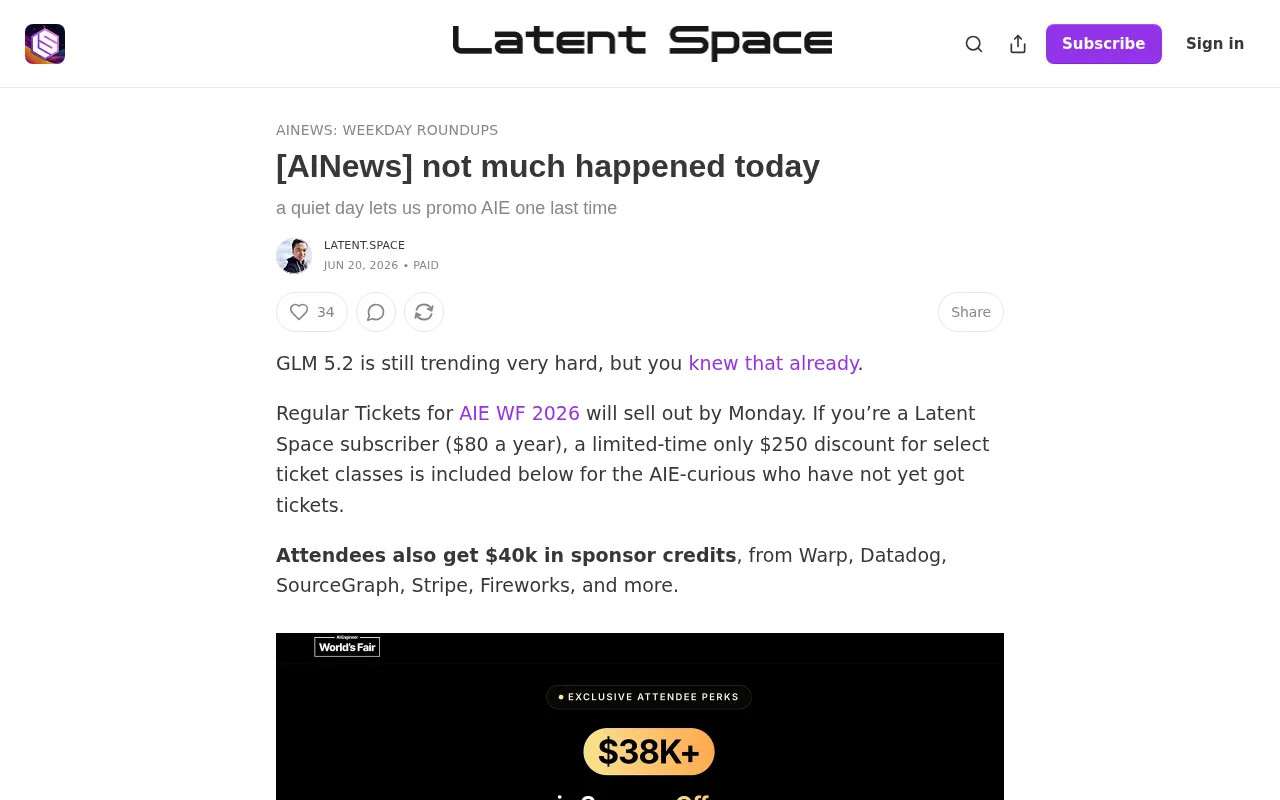
A rare quiet day in AI is a reminder to slow down, filter noise, and think strategically.
AINews recently admitted 'not much happened today' — a surprisingly candid moment in an industry defined by relentless information overload. This article uses that quiet day as a lens to explore the AI industry's release rhythms, the psychology of FOMO, and why practitioners should treat calm periods as valuable windows for deep technical work, knowledge consolidation, and long-term strategic thinking.
A Rare Quiet Day in the AI World
In an era where AI technology evolves at breakneck speed and major announcements seem to drop every single day, a day where "nothing much happens" has itself become something worth noting. In its latest newsletter, AINews candidly admitted: "not much happened today."

AINews is one of several community-driven information aggregation platforms that have emerged from the AI research world, representing a broader phenomenon known as the "AI newsletter economy." As the volume of AI-related content has exploded, vertically focused newsletters targeting developers, researchers, and investors have surged in popularity — publications like The Batch, Import AI, and TLDR AI have each amassed hundreds of thousands of subscribers. The core value these newsletters offer is curation — distilling what truly matters from the hundreds of papers, blog posts, and news articles published every day. AINews's candid admission is a testament to editorial integrity: better to acknowledge a quiet day than to manufacture artificial hype. In a content ecosystem driven by traffic at all costs, that kind of honesty is genuinely rare.
The honesty itself is interesting — in an age of information overload, admitting "today was quiet" takes a certain kind of courage.
The Rhythm Behind the Calm
Breathing Room in a Fast-Moving Industry
Product releases in the AI industry are far from random. They follow a clear "peaks and valleys" rhythm. Major launches tend to cluster around a handful of key moments: annual developer conferences (Google I/O, Microsoft Build, OpenAI DevDay), top academic conferences (NeurIPS, ICML, ICLR), and rapid-response windows following a competitor's release. A "quiet day" typically falls between two release peaks — a critical window when engineering teams are translating research into shippable products. From an industrial economics perspective, this rhythm is also closely tied to AI chip supply cycles, funding milestones, and competitive dynamics.
Looking back over the past few months, the AI industry has seen a relentless pace of product launches and technical breakthroughs: iterative model upgrades, expanding multimodal capabilities, and a proliferation of AI Agent frameworks.
Multimodal capabilities have followed a clear evolutionary arc: CLIP (OpenAI, 2021) established the foundation for image-text alignment; GPT-4V (2023) integrated visual understanding into large language models; Gemini 1.5 and the Claude 3 series extended long-context multimodal processing; and GPT-4o achieved real-time fusion of text, voice, and image interaction. Architecturally, multimodal systems rely on the interplay between modality encoders (which convert different data types into unified vector representations) and cross-modal attention mechanisms. This rapid iteration is one of the key reasons information density in the AI space remains so high — benchmarks are broken every few weeks, and it's genuinely difficult to tell which advances represent true paradigm shifts versus incremental improvements.
AI Agent frameworks have been one of the most active areas at the application layer over the past two years. The core idea behind Agents is to enable large language models (LLMs) to do more than answer questions — to autonomously plan tasks, call external tools, and execute multi-step operations. Representative frameworks include LangChain, AutoGen, CrewAI, and LlamaIndex, each offering foundational capabilities like Tool Use, Memory management, and Multi-Agent collaboration. However, the rapid iteration of Agent frameworks has also created serious fragmentation — many frameworks have undergone breaking API changes within months of release. This is precisely why quiet periods are especially valuable for developers: they offer a chance to systematically evaluate framework maturity rather than blindly chasing the latest version.
Everyone in the industry — developers, investors, and everyday users alike — is under constant information bombardment. A quiet day, in some sense, reflects a brief cooldown after a wave of dense releases. It doesn't mean innovation has stalled; it means that technical depth and product polish require time to develop.
Balancing Information Fatigue with Content Value
AINews's choice to run a self-promotion (promo AIE) during this "gap period" is actually a smart content strategy. When there's no major news to report, it's the perfect moment to reflect, summarize, and reinforce your own value. This offers a few useful takeaways:
- Not every day needs to deliver "explosive news"
- High-quality, in-depth content has more long-term value than chasing the latest trend
- Industry observers need to find the right balance between information density and content quality
What This Means for AI Practitioners
How to Use a Quiet Period in the Industry
For those working in AI, a brief industry lull is a rare and valuable opportunity:
- Go deep technically: Free from news-driven distractions, focus on the hard technical problems in your current projects
- Organize your knowledge: Review recent developments and build a more systematic understanding of the landscape
- Think strategically: Step back from the daily information flood and reflect on medium- to long-term technical directions
- Build community: Connect with peers, share experiences, and forge deeper professional relationships
Learning to Distinguish Signal from Noise
FOMO (Fear of Missing Out) is a pervasive psychological state in the AI world. The term was originally coined by social psychologist Patrick McGinnis in 2004 to describe the anxiety people feel about missing out on others' exciting lives in the social media age. In AI, it has evolved into a form of professional anxiety: developers worry that missing a new framework will leave their tech stack obsolete; investors fear that missing a new direction means missing the next big wave. Cognitive science research shows that sustained information overload activates the brain's novelty bias mechanism, causing people to systematically overestimate the importance of new information — neuroscientists call this "dopamine-driven information foraging behavior." For AI practitioners, building an information filtering system — such as setting fixed times for consuming news, or relying on trusted curated sources rather than real-time feeds — is an effective strategy against cognitive overload, and a prerequisite for maintaining the capacity for deep work.
New models, tools, and frameworks launch every day, creating the feeling that falling behind for even a moment means being left behind entirely. But in reality, the truly industry-defining breakthroughs — the ones that actually reshape the landscape — happen only a handful of times each year. Learning to distinguish "noise" from "signal" is a fundamental skill for anyone working in AI. A quiet day is a useful reminder: you don't need to be anxious every single day. Consistent learning and steady progress will always outperform frantic trend-chasing.
Closing Thoughts
"Not much happened today" — in the context of the AI industry, this sentence carries an almost darkly comic weight. We've grown so accustomed to being buried in new announcements that stillness itself has become newsworthy.
But perhaps that's exactly what we need: to occasionally stop, breathe, reflect, and return to the next wave in better shape. After all, the development of AI is a marathon, not a sprint.
Key Takeaways
- AINews reported a rare quiet day in the AI industry, with no major news breaking
- AI release cycles follow a clear "peaks and valleys" pattern; quiet periods are a normal window for technical accumulation and product refinement
- Multimodal capabilities and AI Agent frameworks are the two technical areas generating the highest information density in the industry right now
- FOMO stems from the brain's novelty bias mechanism; building an information filtering system is key to combating cognitive overload
- AI practitioners should use quiet periods for deep technical work, knowledge organization, and strategic thinking
- Learning to distinguish industry noise from genuine signals — and choosing consistent learning over daily trend-chasing — delivers far more long-term value
Related articles
 Tech Frontiers
A Rare Quiet Day in AI: Recursive Self-Improvement Stirs Beneath the Surface
A rare quiet day in AI sees multiple sources go silent simultaneously. Behind the calm, Recursive Self-Improvement (RSI) research continues. What this means for the industry.
 Tech Frontiers
Reve 2 vs. Ideogram 4: A Deep Dive into Layout Control in AI Image Generation
A deep comparison of Reve 2 and Ideogram 4's layout control capabilities, covering technical approaches, real-world use cases, and industry trends for designers and creators.
 Tech Frontiers
In the Weights: Check Your Influence Score in the AI World
In the Weights is an AI influence search engine that quantifies your presence in the AI world with a score. Explore how it evaluates practitioners and what it means for digital identity.