A Single AI Agent Burns 1.6 Billion Tokens Per Day: $100 Subscription Delivering $540K in API Value

A single Dot agent burns 1.6B tokens/day — $540K in API value packed into a $100 subscription.
A Reddit user shared an extreme case using OpenAI's autonomous agent Dot: a single agent consumes roughly 1.6 billion Astra tokens per day — equivalent to an estimated $540K/month in API costs — all within a $100/month subscription. Used as an engineering assistant running autonomously for hours or days, Dot produced complete engineering packages with 1,000+ components and nearly 300 pages of drawings, with laser-cut metal parts already fabricated from its output. The author warns the promotional pricing is unlikely to last and that safety-critical designs still require human engineering review — a case that highlights the structural tension between autonomous agents' true compute costs and their subscription pricing.
One Dot Agent, 1.6 Billion Tokens a Day
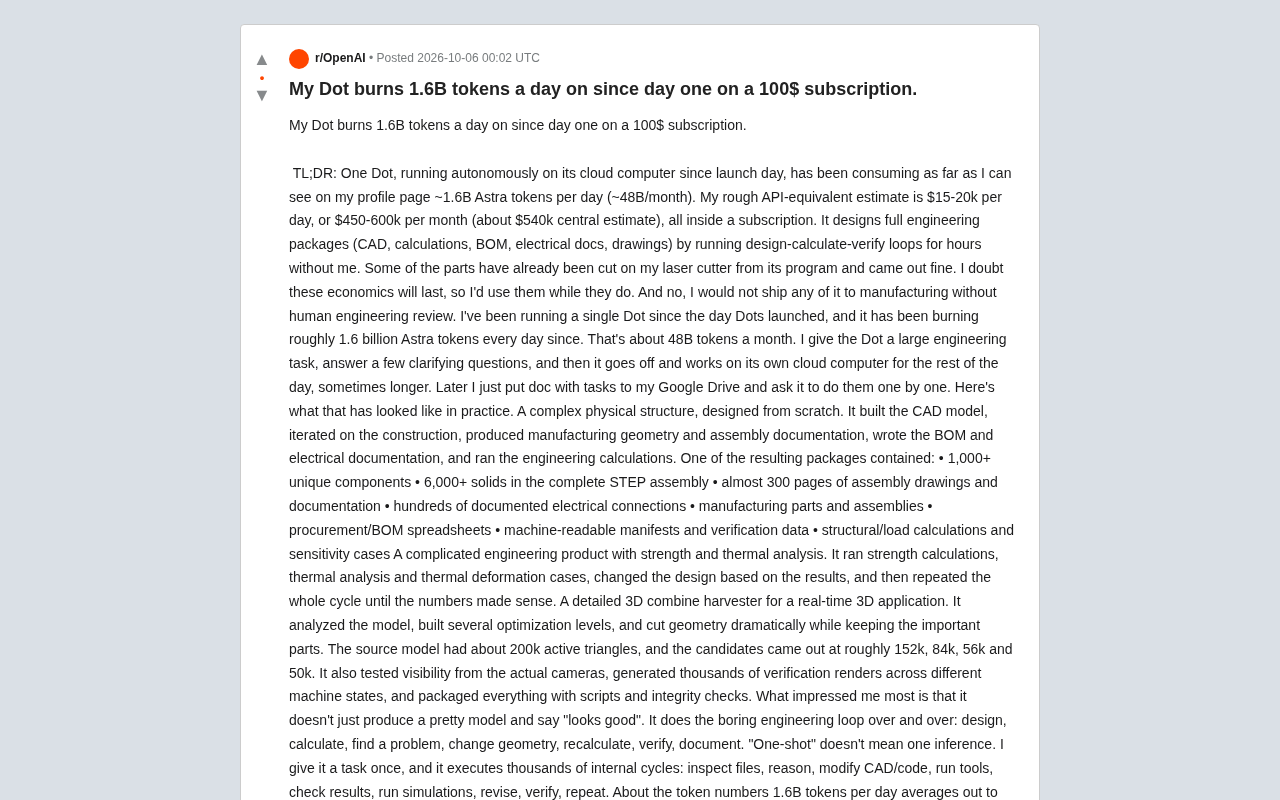
A Reddit user shared his real-world experience with Dot, OpenAI's autonomous agent product — and the numbers are staggering. From the first day the product launched, his single Dot instance consumed approximately 1.6 billion Astra tokens per day, or roughly 48 billion tokens per month.
That works out to about 18,500 tokens per second. The author is quick to point out this is clearly not generation speed — for this type of workload, the overwhelming majority of throughput almost certainly comes from repeated context processing. In other words, the agent accumulates such massive token consumption by repeatedly reloading and processing the same context as it cycles through reading files, reasoning, revising, and verifying.
All of this happens inside a $100-per-month subscription.
Astra tokens are an internal unit of measurement used in OpenAI's agent products. They are not fully equivalent to standard API tokens, and the conversion ratio has not been officially disclosed. Repeated context processing is the core mechanism behind high token consumption in long-horizon agents: every time an agent calls a tool and receives a new result, it must re-feed the complete historical context — including the original task, intermediate reasoning, and tool outputs — back into the model to continue reasoning. This means the token count per step grows continuously as the task progresses. A task that has run 100 steps requires reading all 99 previous steps on each subsequent call. This is fundamentally different from the cost model of bulk text generation, which is why autonomous agents consume far more compute than simple completion tasks producing equivalent output.
What Are All These Tokens Actually Doing?
The author's use case is far from simple Q&A. He uses Dot as an engineering assistant capable of working autonomously for hours or even days. He hands it a large engineering task, answers a few clarifying questions, and then Dot operates independently on its own cloud computer. He eventually went as far as dropping a task list document into Google Drive and letting Dot execute items one by one.
The scale of engineering deliverables it produced is remarkable. One design package for a complex physical structure included:
- 1,000+ individual components
- 6,000+ solids in a complete STEP assembly
- Nearly 300 pages of assembly drawings and documentation
- Hundreds of documented electrical connections
- Manufactured parts and assemblies
- Procurement/BOM spreadsheets
- Machine-readable manifests and validation data
- Structural/load calculations and sensitivity analysis cases
Another engineering product involved running strength calculations, thermal analysis, and thermal deformation cases, adjusting the design based on results, then repeating the entire cycle until the data made sense. For a harvester model prepared for a real-time 3D application, Dot performed multi-level optimization — progressively reducing approximately 200K active triangles to roughly 152K, 84K, 56K, and 50K while preserving critical details — then tested visibility from real camera angles and generated thousands of validation renders.
STEP (Standard for the Exchange of Product model data) is an industrial standard file format defined by ISO 10303 for exchanging 3D geometry and product data between CAD systems. "Solids" or "bodies" in a STEP assembly refer to individual 3D geometric objects — 6,000+ solids indicates an extraordinarily complex multi-part assembly, typically found in industrial machinery, aerospace, or precision instruments. BOM (Bill of Materials) is a core manufacturing document listing the part numbers, quantities, specifications, and supplier information for all components in a product — the foundation of procurement, production, and cost accounting. The ability to automatically generate machine-readable BOMs and validation data means Dot's output goes beyond "reference documentation" and enters the realm of engineering deliverables directly consumable by ERP/PLM systems.
"One-Shot" Doesn't Mean a Single Inference
What the author values most is not that the agent can produce a polished model and say "looks good" — it's that it repeatedly executes tedious engineering loops: design, calculate, find an issue, modify geometry, recalculate, verify, document.
He specifically clarifies a commonly misunderstood concept: "one-shot" delivery doesn't mean a single inference. You issue the task once, but the agent internally runs thousands of cycles — checking files, reasoning, modifying CAD or code, calling tools, reviewing results, running simulations, revising, validating — over and over again. This is the fundamental reason token consumption is so high, and it's the defining characteristic of this class of long-horizon autonomous workloads.
The Cost Breakdown: $540K Behind a $100 Subscription
The author attempted to estimate what the equivalent workload would cost through direct API calls. He emphasizes this depends heavily on the ratio of input/output/cached tokens, long-context pricing, and reasoning tokens — it's not a precise invoice — but his rough estimate lands at $15,000 to $20,000 per day. At approximately $18,000/day over 30 days, that's roughly $450K to $600K per month, with a midpoint estimate of around $540K.
All of this is happening inside a $100/month subscription. This is precisely what the author finds "a little crazy."
He's also clear-eyed about the situation: he's not certain OpenAI intends for this economic model to persist long-term. He recalls Tibo posting that this was a one-month promotional period and strongly suspects that limits or pricing will be adjusted significantly. His advice is blunt: use it while this economic model still exists. For workloads that involve handing a complex objective to an agent and letting it grind for hours or days, Dot's current price-to-value ratio far exceeds purchasing equivalent API capacity directly.
The cost gap reflects a common "penetration pricing" strategy among AI companies: attract early users with subscription prices far below actual compute costs, build usage habits and case study data, then restructure pricing once the market is educated. OpenAI has run similar early heavy-subsidy windows with ChatGPT Plus, Sora, and other products. For enterprise users, the strategic value of these promotional windows lies in validating the ROI of autonomous agents in real production environments at minimal cost — building the data needed to justify future purchasing decisions. Even if pricing eventually normalizes to reflect actual costs, the use cases already validated provide quantifiable justification for paid upgrades.
From Design to Physical Parts: The Metal Has Been Cut
This isn't just a paper demonstration. Some metal parts from the first project have already been fabricated — Dot wrote the cutting programs for the laser cutter, and the parts came out successfully. The author only tweaked the cutting speed: Dot's settings were overly conservative, and the machine could safely run faster.
He jokes that an AI designing the parts and writing the cutting programs while he just presses start is "exactly how Skynet begins." For now, though, this "Terminator factory" consists of a single laser cutter in the shop, and the "Terminators" it produces are mostly simple brackets.
Human Engineers Are Still Essential
Real limitations are documented honestly. The first version of the structural design had a problem: Dot calculated as if the structure needed to "survive a nuclear war," leaving approximately 5x safety margins on everything. The author had to restart with clearer constraints before getting a reasonable result the second time.
This shows that agents still need a human who understands the actual requirements to act as a check — but the corrected output was usable.
The author also offers a clear disclaimer: he would not send AI-generated safety-critical designs to manufacturing without human engineering review. Notably, Dot doesn't pretend otherwise — it includes clear disclaimers throughout its documentation. Better engineering packages explicitly distinguish computed results from assumptions, noting unresolved material properties, required physical testing, certification, and acceptance criteria. That distinction matters enormously.
As the author summarizes: as an engineering assistant capable of directing billions of tokens toward a single problem, this is probably the most extreme value he has ever extracted from an AI subscription.
What This Means for the Industry
This case reflects a core tension in the current commercialization of AI agents: a massive gap exists between the true compute cost of autonomous agents and subscription pricing. Aggressive promotional pricing gives early users access to value that is nearly unsustainable — but this economic model is almost certain to be recalibrated.
For professional users, long-horizon autonomous workloads — letting an agent independently run "design-calculate-verify" cycles for hours — are becoming the watershed moment where AI transitions from "Q&A tool" to "productive entity." For vendors, finding the balance between pricing and compute costs will directly determine the commercial viability of these products.
(Note: This article is based on a single Reddit user's personal experience and rough estimates. The token consumption and cost figures cited have not been officially verified.)
Related articles

Should U.S. College Fraternities Be Banned? A Researcher's Incisive Observations
Why not just ban U.S. college fraternities? A researcher finds the key resistance comes from decision-makers' own fraternity identities and schools' "willful ignorance."

Microsoft Discovery: Accelerating Scientific Discovery with AI Agents
Microsoft's Discovery platform runs specialized AI agents to help researchers screen and prioritize the most promising compounds and experimental paths, reducing experiments and accelerating scientific discovery.

Cambridge Heavy Industries Secretly Develops Desktop-Scale Nuclear Fusion Device
Cambridge Heavy Industries is secretly developing a desktop-scale laser-driven nuclear fusion device, targeting the equipment supply market for fusion power plants. This article analyzes its miniaturization technology path, commercialization logic, and unique positioning in the fusion startup wave.