A Systematic Approach to Learning Machine Learning: The Complete Path from Mathematical Derivation to Code Implementation

A complete learning path for machine learning from mathematical derivation to hands-on code implementation.
This article explores how to systematically learn machine learning by building deep understanding rather than just calling libraries. It identifies four key characteristics of quality ML courses—mathematical intuition, algorithm derivation, theory-to-code bridging, and hands-on implementation—and recommends resources like Andrew Ng's courses, Stanford CS229, and fast.ai that embody these principles.
Why You Need an "Understanding-Focused" Machine Learning Learning Path
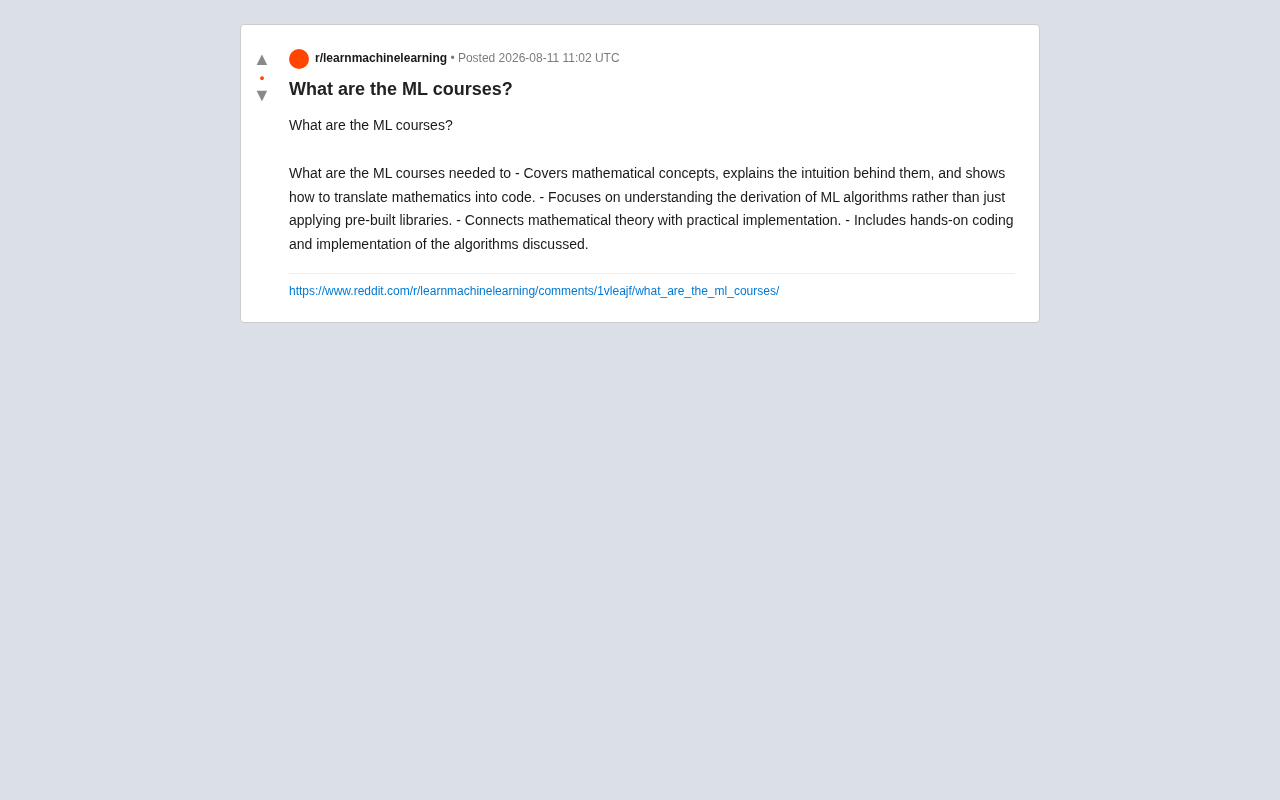
Amid the machine learning study boom, a common pitfall is: only knowing how to call ready-made libraries without understanding the principles behind the algorithms. Recently, a Reddit user raised a highly representative question—what kind of ML course truly manages to explain mathematical concepts clearly while also grounding theory into code?
This question seems simple but touches on the most fundamental tension in learning machine learning: should you aim for quick hands-on skills, or deep understanding? For learners who want to go further in this field, the answer is usually the latter. Only by understanding the derivation process of algorithms can you flexibly adjust models, diagnose issues, or even improve existing methods when facing real-world problems.
Four Core Characteristics of an Ideal Machine Learning Course
From this user's stated needs, we can distill four key characteristics that a quality machine learning course should possess. These characteristics form a complete closed loop from theory to practice.
Covering Mathematical Concepts and Explaining the Intuition Behind Them
Machine learning is fundamentally a product of applied mathematics. Linear algebra, calculus, and probability and statistics form the cornerstones of the entire field. But merely listing formulas is far from enough—truly excellent courses explain the intuition behind these mathematical concepts.
These three major branches of mathematics each play an irreplaceable role in machine learning: linear algebra provides the language for data representation and transformation—data is stored and manipulated in the form of matrices and vectors, and model parameter optimization is essentially a problem of matrix decomposition and transformation; calculus (particularly multivariate calculus) provides the core optimization tool—the gradient, which indicates the direction of fastest change in a function's value; probability and statistics form the theoretical framework for model evaluation, uncertainty quantification, and Bayesian inference. It's worth noting that these three are not isolated—for example, Principal Component Analysis (PCA) simultaneously involves eigenvalue decomposition from linear algebra and variance maximization from statistics, while Gaussian processes integrate linear algebra, probability theory, and calculus into a unified whole.
For instance, why can gradient descent find the minimum of a loss function? The core intuition can be analogized to "descending a mountain": imagine you're on a mountain shrouded in thick fog, unable to see the full landscape, only able to sense the slope of the ground beneath your feet. Taking each step in the steepest downhill direction will eventually bring you to some valley (local minimum). The learning rate determines your stride length—too large and you'll overshoot the valley floor and oscillate back and forth, too small and progress will be painfully slow. Why can regularization terms prevent overfitting? The intuition behind regularization (such as L1 and L2 regularization) is a "penalty" on model complexity: it tells the model "don't be too confident," limiting parameter magnitudes to prevent the model from over-memorizing noise in the training data, thereby improving generalization to new data. When learners understand these "whys," mathematics is no longer an abstract symbol game but a powerful tool for solving problems.
Emphasizing Algorithm Derivation Rather Than Simply Calling Libraries
This is the key point emphasized in the original post: understanding the derivation process of algorithms, rather than merely applying pre-built libraries. In today's machine learning ecosystem, tools like scikit-learn, PyTorch, and TensorFlow allow people to implement complex models in just a few lines of code. While this certainly lowers the barrier to entry, it also leaves many people at the level of "black-box usage."
These mainstream frameworks each have their positioning: scikit-learn provides a unified interface for traditional machine learning algorithms, suitable for classification, regression, and clustering tasks on structured data; PyTorch is known for its dynamic computation graphs and Pythonic design philosophy, and has become the preferred framework for academic research; TensorFlow holds an important position in industry with its production deployment capabilities and complete ecosystem (including TensorFlow Serving, TFLite, etc.). The ease of use of these tools is a double-edged sword—they allow practitioners to rapidly iterate on experiments, but also make it easy to overlook underlying implementation details, such as automatic differentiation mechanisms, computation graph construction, memory management, and parallel computing strategies.
True mastery means you can derive the normal equation for linear regression from scratch, understand the dual problem of support vector machines, and comprehend how the backpropagation algorithm propagates gradients layer by layer.
Regarding the dual problem of support vector machines, this is a classic application of optimization theory in machine learning. The primal problem is finding a maximum-margin classification hyperplane in high-dimensional space. By transforming it into dual form through Lagrangian duality, there are two key advantages: first, computational complexity depends only on the number of samples rather than feature dimensionality, which is especially important for high-dimensional data; second, in the dual form, data appears only as inner products, which provides the theoretical basis for introducing the kernel trick—by choosing different kernel functions, SVMs can achieve nonlinear classification without explicitly computing high-dimensional mappings.
Backpropagation is the core algorithm for training neural networks, essentially a systematic application of the chain rule on computation graphs. In forward propagation, input data passes through linear transformations and nonlinear activation functions layer by layer to produce predicted outputs; in backpropagation, the gradient of the loss function with respect to each parameter is propagated from the output layer back toward the input layer. The gradient at each layer equals its "upstream gradient" multiplied by the "local gradient." This efficient gradient computation method avoids performing numerical differentiation for each parameter individually, reducing computational complexity from quadratic to linear in the number of parameters. Understanding backpropagation helps diagnose vanishing and exploding gradient problems and forms the foundation for designing new network architectures.
This capability is crucial when facing non-standard problems that require custom models.
Connecting Mathematical Theory with Code Implementation
There is often a gap between mathematical theory and code implementation. Many learners can understand formulas in papers but don't know how to translate them into runnable programs; conversely, some can cobble together code but don't understand what each step means mathematically.
Quality courses actively build this bridge, demonstrating how to translate mathematics into code. For example, taking a matrix differentiation formula and step by step mapping it to NumPy vectorized operations, helping learners develop the mindset that "formulas are code."
Including Hands-On Coding and Algorithm Implementation
Finally, reading alone is never enough. Hands-on implementation of the discussed algorithms is the most effective way to solidify understanding. When you personally implement K-means clustering or neural network forward propagation using basic tools (rather than high-level libraries), your understanding of the algorithm will far surpass what you'd gain from merely reading textbooks.
Recommended Machine Learning Learning Resources
Based on the four characteristics above, the following types of resources deserve serious consideration:
Classic Courses and Textbooks
-
Andrew Ng's Machine Learning Course: Although the classic original version uses Octave/MATLAB, its explanation of algorithm derivation and intuition remains the gold standard for beginners. The newer Deep Learning Specialization is more aligned with modern practice. Andrew Ng's machine learning open course launched at Stanford in 2011 was one of the pioneering events of the MOOC (Massive Open Online Course) movement, directly catalyzing the creation of the Coursera platform. The original course used Octave/MATLAB programming, emphasizing manual algorithm implementation rather than relying on pre-built libraries. In 2022, Ng released a completely revamped Machine Learning Specialization using Python and TensorFlow, with content updated to include decision trees, recommender systems, and other modern topics. His Deep Learning Specialization covers advanced topics such as convolutional neural networks, sequence models, and structuring machine learning projects, forming a complete learning path from beginner to expert.
-
Stanford CS229: This course is known for its rigorous mathematical derivations, suitable for learners with a solid mathematical foundation who wish to deeply understand the essence of algorithms. CS229 is a graduate-level machine learning course created by Andrew Ng, with lecture notes covering everything from generalized linear models to the EM algorithm, from kernel methods to reinforcement learning. CS229 forms a complementary system with Stanford's other AI courses: CS231n focuses on computer vision and convolutional neural networks, CS224n dives deep into natural language processing and Transformer architectures, and CS234 covers reinforcement learning theory. Lecture notes and videos for most of these courses are freely available, constituting one of the world's most recognized self-study resource systems for machine learning.
-
"Pattern Recognition and Machine Learning" (Bishop) and "The Elements of Statistical Learning": These two classic textbooks systematically explain theoretical foundations from a statistical learning perspective. Bishop's PRML uses a Bayesian perspective as its core thread, with in-depth discussions of probabilistic graphical models and variational inference; ESL approaches from a frequentist perspective, covering everything from linear methods to ensemble learning, suitable for readers with a solid statistics background.
Resources Emphasizing "Implementation from Scratch"
-
fast.ai: Adopts a "top-down" teaching approach, first getting you to run a model, then progressively diving deeper into the principles, while encouraging hands-on implementation. fast.ai was founded by Jeremy Howard and Rachel Thomas in 2016, with a teaching philosophy that stands in stark contrast to the traditional "bottom-up" approach (learn math first, then applications). The first lesson has students train an image classifier achieving near state-of-the-art results, then subsequent lessons progressively "open the black box," explaining the principles of each layer. This approach borrows from the "immersive" concept in language learning—first gaining a global understanding and sense of achievement, then diving into details. fast.ai also maintains an open-source deep learning library of the same name, which provides a high-level API on top of PyTorch while retaining the flexibility to dig deeper.
-
"Grokking Deep Learning" and similar books: Guide you step by step to implement neural networks from scratch in Python, emphasizing the combination of intuition and code.
Practical Advice for Machine Learning Learners
Overall, building an effective machine learning learning path should follow a "theory—intuition—code—project" cycle:
- Build a solid mathematical foundation: Master at least the core content of linear algebra, calculus, and probability and statistics, and understand their connections to ML algorithms.
- Derive before you code: When learning each algorithm, first try to derive the key formulas yourself, then implement them hands-on, and finally compare and verify against results from mature libraries.
- Gradually let go of the "crutches": Transition from using high-level libraries to quickly validate ideas, to progressively rewriting core logic using basic tools like NumPy.
- Test your understanding through projects: Apply what you've learned to real datasets, exposing knowledge gaps in the process of solving actual problems.
Conclusion
This Reddit user's question actually articulates a universal need in machine learning education today: In an era where tools are increasingly easy to use, how do you avoid becoming a mere "library-calling engineer" and truly build deep understanding of algorithms?
The answer isn't complicated—choose courses that balance mathematical intuition, algorithm derivation, the connection from theory to code, and hands-on implementation, and study them with a rigorous attitude. Technologies will keep evolving, but understanding of fundamental principles will be your most enduring competitive advantage in this rapidly changing field.
Related articles

Should U.S. College Fraternities Be Banned? A Researcher's Incisive Observations
Why not just ban U.S. college fraternities? A researcher finds the key resistance comes from decision-makers' own fraternity identities and schools' "willful ignorance."

Microsoft Discovery: Accelerating Scientific Discovery with AI Agents
Microsoft's Discovery platform runs specialized AI agents to help researchers screen and prioritize the most promising compounds and experimental paths, reducing experiments and accelerating scientific discovery.

Cambridge Heavy Industries Secretly Develops Desktop-Scale Nuclear Fusion Device
Cambridge Heavy Industries is secretly developing a desktop-scale laser-driven nuclear fusion device, targeting the equipment supply market for fusion power plants. This article analyzes its miniaturization technology path, commercialization logic, and unique positioning in the fusion startup wave.