A Tweet That Made Us Think: In the Age of AI, Just Ask and You Shall Receive

A viral tweet captures how AI has made natural language the new interface between humans and machines.
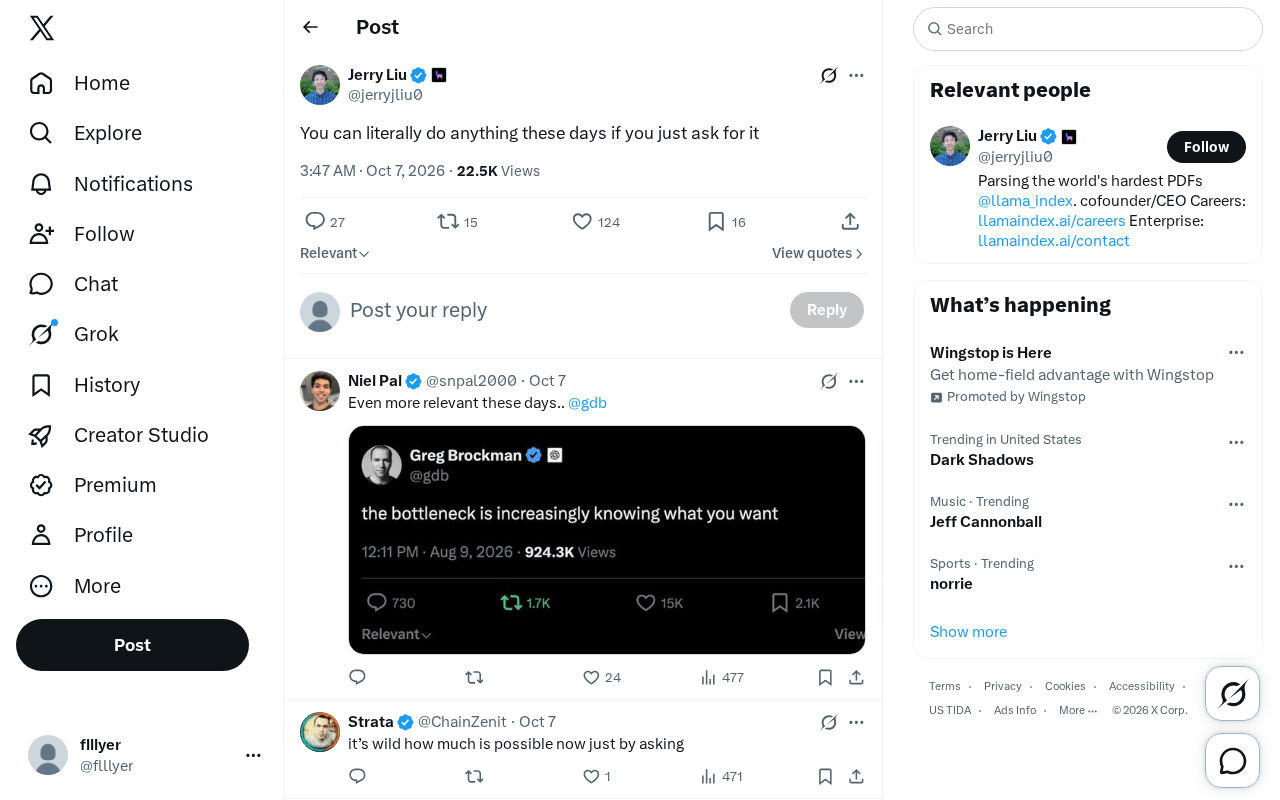
A phrase circulating on Twitter — "You can literally do anything these days if you just ask for it" — captures the core shift brought by LLMs and generative AI: the interaction logic has flipped from "learn the tool first" to "tools adapting to natural human language." The article affirms this trend while defining its real limits — output quality depends on prompt clarity, AI hallucinations require human verification, and complex tasks still demand iterative effort. The conclusion: AI amplifies those who can express their needs clearly, and the most valuable skills will shift from operational know-how to need-definition and critical judgment.
The Technological Shift Behind a Single Sentence
A short phrase making the rounds on Twitter — "You can literally do anything these days if you just ask for it" — captures in the simplest possible terms the shift that AI tools have brought to everyday users. It carries no technical details, yet it touches on something real: natural language is becoming the dominant interface between humans and machines.
In the past, completing a complex task required mastering specific software, writing code, or possessing specialized expertise. Today, more and more work can be triggered simply by "describing what you want" — just say it in plain language, and the system delivers. That's the core of what this tweet is getting at.
The Interaction Revolution: From Commands to Conversation
Traditional software logic followed a simple rule: learn the tool before you use it. Whether it was Photoshop's layer system or Excel's formula syntax, the barrier to entry came from the tool's own complexity. The rise of large language models and generative AI is flipping that logic entirely: tools are now learning to understand how humans express themselves, rather than humans adapting to tools.
The phrase "ask for it" is telling. It means the initiative has returned to the user — you don't need to know the underlying implementation path; you just need to be clear about the outcome you want. Writing articles, generating images, writing code, analyzing data — tasks that once demanded professional skills can now largely be accomplished with a well-crafted prompt.
Large language models (LLMs) are the foundational technology driving this transformation. Unlike the rule-based logic of traditional software, LLMs learn to understand and generate natural language through pre-training on massive text datasets. Their core mechanism — the Transformer architecture and attention mechanism — allows models to capture contextual relationships in language, effectively "understanding" human intent rather than merely matching keywords. Generative AI takes this further: rather than retrieving existing content, it dynamically generates new text, code, images, or even video based on the input. It is precisely this ability to "understand input, generate output" that makes "describe your need and trigger the task" possible — a far cry from the old paradigm of driving software through specific commands or rigid operational paths.
Where Does "Almost Anything" End?
For all its optimism, this tweet deserves a clear-eyed reading. "Literally do anything" is rhetorical hyperbole. AI tools have genuinely lowered the barrier for a vast range of tasks, but they are far from omnipotent:
- Quality depends on how you express yourself: The premise of "just ask and get" is that you can accurately describe what you need. The clarity of your prompt directly determines the quality of the output — and that itself is a skill that takes practice.
- Accuracy still needs verification: Generative AI is prone to "hallucination" — outputs that look plausible but contain errors. In high-stakes contexts, human review remains essential.
- Complex tasks require decomposition: Truly complex engineering, creative work, or decision-making rarely gets resolved in a single request. It typically demands multiple rounds of interaction and iteration.
In short, AI amplifies the capabilities of people who can articulate their needs clearly — it doesn't eliminate the need for expertise altogether.
AI "hallucination" is one of the most scrutinized reliability issues in current large language models. It refers to the model generating content that is factually wrong, fabricated, or unverifiable — delivered with high confidence — such as invented citations, non-existent legal provisions, or incorrect historical events. The root cause lies in how models work: LLMs are fundamentally predicting "the next most likely word," not looking up facts in a database. When relevant information is absent from training data, or a question falls outside the model's knowledge boundary, the model tends to "fill in" a plausible-sounding answer rather than acknowledge uncertainty. This makes directly using AI output for decision-making in high-risk domains — medicine, law, finance — significantly risky, and human verification remains a step that cannot be skipped.
What This Means for Everyday Users
The widespread resonance of this kind of sentiment on social platforms reflects a genuine shift in mindset as technology becomes more accessible. For most people, the question is no longer "do I know how to use this software?" but rather "do I know what I want, and can I articulate it clearly?"
This suggests that the most valuable skills going forward may gradually shift from "operational proficiency" to the ability to define needs and critical judgment — the former lets you effectively leverage AI, the latter lets you evaluate whether AI's output can be trusted.
Closing Thoughts
A short tweet resonated so widely because it precisely captured a genuine inflection point in our experience of technology. AI has turned "just ask and receive" from hyperbole into partial reality — but truly making good use of that capability still requires clear thinking and careful judgment. The more powerful the tool, the more critical the user's intent and discernment become.
Related articles

OpenAI Partners with Shield: How the Astra Agent Revolutionizes IT Troubleshooting
OpenAI and Shield launch the Astra agent, which autonomously logs into computers and legacy systems to fix IT issues in real time, 35-40% faster than traditional models, with humans involved only when judgment is needed.

iPhone Duo Battery Life Tested: One Charge a Day Is Unavoidable, and the Large Screen Is the Culprit
iPhone Duo battery test: heavy use needs at least one charge a day, and about 30% remains after 6.5 hours of screen-on time. How often the large screen is unfolded is key; a MagSafe battery pack helps, and long-term degradation is also worth watching.

Kimi K3.1 Pro Open-Sourced: 2.8 Trillion Parameters Close In on Opus
Moonshot releases the open-source MoE model Kimi K3.1 Pro, with 2.8T total parameters and 104B activated, trailing Opus 5.5 by under 1 point on Terminal Bench 4.0.