A Tweet That Sparked a Question: Can AI Serve as a Crisis Decision Assistant?

A viral joke tweet exposes the real boundaries and risks of using generative AI in high-stakes government decisions.
A satirical tweet imagining a U.S. Secretary of State consulting AI about a hypothetical plague outbreak sparked discussion about generative AI's role in high-risk public decision-making. While LLMs can summarize epidemiological knowledge, they lack real-time data access, bear no accountability, and carry significant hallucination risks — where a single bad recommendation taken seriously could prove catastrophic. The tweet's viral spread reflects public fascination with AI's rapid growth and anxiety about over-reliance by decision-makers. The article concludes with four principles for responsible use: treat AI as a supplement not a replacement, ensure source traceability, maintain clear accountability, and apply different scrutiny standards based on risk level.
The Controversy Behind a Tweet
A tongue-in-cheek tweet has been making the rounds on social media, imagining a U.S. Secretary of State-level official consulting an AI model (referred to as "muse" in the post) on how to contain a hypothetical "Russian pneumonic plague outbreak." The tweet reads more like an internet joke than anything else — but it touches on an increasingly real question: as government decision-makers begin treating generative AI as a consultative tool, what should we actually expect from it, and what should we be wary of?
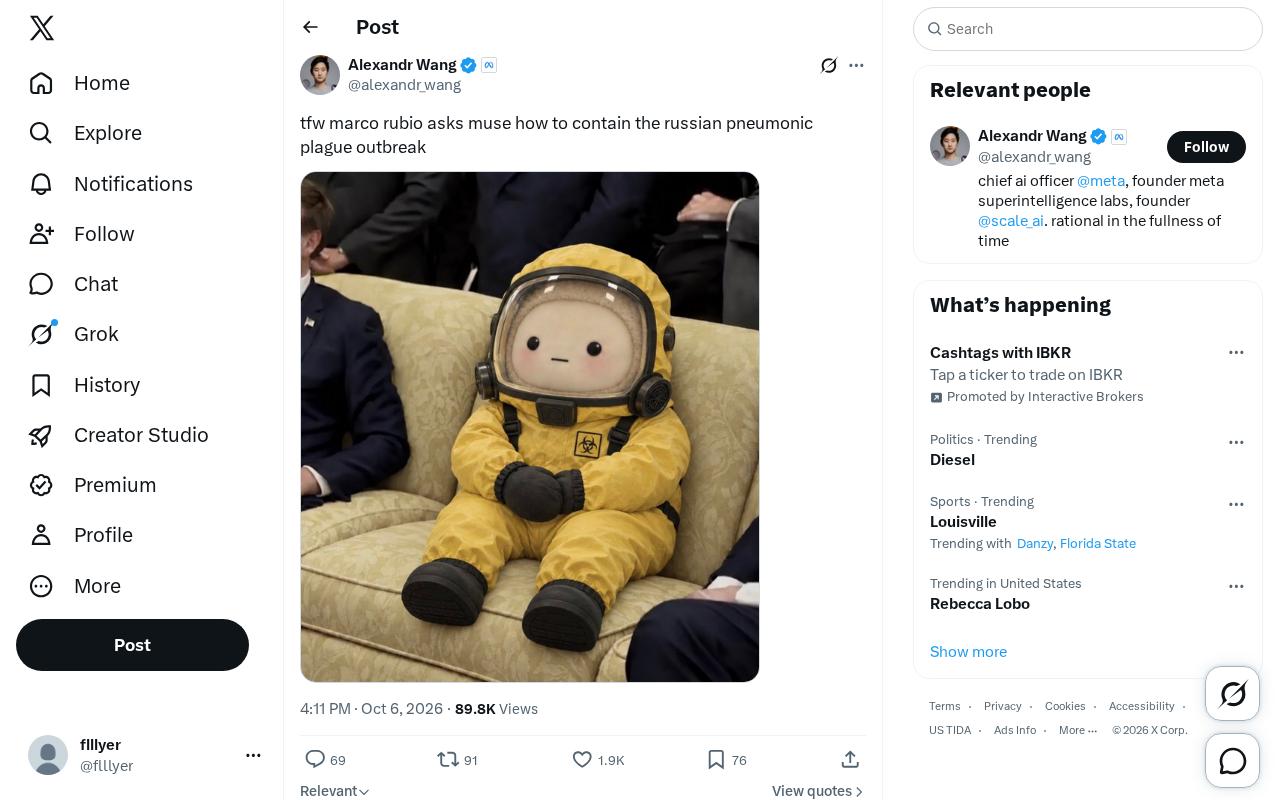
Since the source material is just a brief tweet with no verifiable factual details, this article makes no claims about its authenticity. Instead, we use it as a jumping-off point to explore AI's proper role in high-stakes public decision-making.
The Real Limits of AI as a "Decision Assistant"
Generative AI has indeed seen growing use in recent years for information retrieval, drafting proposals, and organizing knowledge. For questions about epidemic control, large language models can quickly summarize publicly available epidemiological knowledge — transmission routes and incubation periods for pneumonic plague, standard isolation protocols, antibiotic treatment regimens, and so on. This kind of "knowledge recitation" is where current models genuinely excel.
But real crisis decision-making goes far beyond knowledge queries. It involves real-time outbreak data, geopolitical judgment, resource allocation, and legal and ethical constraints — precisely the areas where general-purpose large models are weakest. Models have no access to real-world intelligence feeds, and they bear no responsibility for bad advice. Using AI output as a "reference resource" versus treating it as an "action directive" are two fundamentally different things.
Hallucination Risk Is Amplified in High-Stakes Scenarios
Large language models suffer from "hallucination" — generating content that sounds plausible but is factually wrong. In casual conversation, the cost of such errors is limited. But in high-risk domains like public health and national security, a single piece of bad advice taken at face value could have serious consequences. This is precisely why the field so strongly emphasizes "human-in-the-loop" — keeping humans in the decision chain at all times.
The root of the hallucination problem lies in how large language models actually work: they are fundamentally predicting "the next most likely token," not retrieving verified facts. When training data on a given topic is scarce, contradictory, or simply predates the model's knowledge cutoff, the model will often "fill the gap" with fluent language that sounds professional but is wrong. In public health, this risk is especially acute: the latest antibiotic resistance data for pneumonic plague, real-time medical resource availability in a given region, the most current version of a cross-border epidemic protocol — all of these are dynamic data points highly prone to triggering hallucinations. Multiple academic benchmarks from 2023 showed that even top-tier mainstream models still produced factual errors at rates of 10–30% on specialized medical and legal questions. The core value of "human-in-the-loop" is precisely to have domain experts perform mandatory fact-checking before model outputs enter the decision chain.
Why This Kind of Joke Resonates
The reason this tweet spread says something about the public's complicated feelings toward two things at once. On one hand, people are genuinely surprised by how rapidly AI capabilities are expanding, and have started imagining AI infiltrating even the most serious government contexts. On the other hand, there's an underlying anxiety about whether decision-makers might come to rely on AI too heavily. The joke itself is a gentle form of skepticism — the humor comes from the gap between a problem that should be handled by specialized agencies, epidemiologists, and emergency response systems, and the image of someone just "asking AI."
This kind of sentiment is common in tech discourse. Whenever a new tool emerges, society simultaneously generates both a "it can do everything" fantasy and an "abuse anxiety" — and this tweet managed to strike both chords at once.
A Few Principles for Responsible AI Use
Setting the jokes aside, this topic has real-world relevance. If public sector organizations do begin incorporating AI into their decision-making processes, a few basic principles are worth upholding:
- Position AI as a supplement, not a replacement: AI is well-suited for organizing information, running scenario simulations, and generating first drafts. Final judgment must rest with qualified human experts.
- Ensure data sources are traceable: Decision-grade applications should require models to cite their sources, enabling manual verification and reducing the risk of being misled by hallucinations.
- Define clear accountability: Every major decision needs a transparent chain of responsibility. AI cannot be allowed to become a "black box" that lets people dodge accountability.
- Differentiate by scenario risk level: Routine administration and life-or-death crisis response demand entirely different standards of scrutiny.
At the institutional level, some countries and international organizations have begun establishing regulatory frameworks for government use of generative AI. The EU's AI Act classifies AI applications that affect fundamental rights or public safety as "high-risk," requiring mandatory compliance assessments, human review steps, and auditable logging. A 2024 memorandum from the U.S. Office of Management and Budget (OMB) similarly requires federal agencies to designate a responsible official when using AI for decisions that affect people's rights or benefits. These regulatory efforts show that the boundaries of "AI-assisted decision-making" are moving from technical debate toward legal constraint — but detailed implementation rules and compliance capacity-building are still in early stages, and real-world effectiveness remains to be seen.
Conclusion
A jokey tweet reflects a tension that society cannot avoid as AI enters the mainstream. Technology itself is a neutral tool — what matters is how users define its limits. For issues as consequential as epidemic control, AI can be an effective information assistant, but it should never be mythologized as an all-knowing oracle. Maintaining that clarity may be the real lesson this tweet has to offer.
(Note: This article is based on a social media tweet that is satirical in nature. The scenario described has not been verified. Readers are encouraged to approach it with appropriate skepticism.)
Related articles

Gemini 4 Argon Hands-On: AI Builds Board Games, Constructs Temples, and Trains Robots Autonomously
Gemini 4 Argon hands-on roundup: AI autonomously builds a desk racetrack and temple in Blender, writes a ray tracing engine, trains a humanoid robot to sink 7 shots, plus API pricing and developer access.

The Magic Octagonal Coin: Why Only 9% of People Can Predict Its Flip?
Only 9% of people can correctly predict the Magic Octagon coin flip. This article explains its spatial rotation mechanism, common cognitive pitfalls, and a new hypothesis based on Relevance Theory, exploring the limits of human spatial reasoning.

Sam Altman: AI Is Entering the Era of Scientific Discovery — Math Breakthroughs Will Replicate in Biology and Energy
Sam Altman says AI is entering the era of scientific discovery — math breakthroughs will replicate in biology, materials science, and energy to help develop new drugs and energy sources.