A Woman Used Claude as a Diary and Got Reported to Police — AI Privacy Boundaries Spark Debate

A woman's Claude diary entries were reportedly reported to police, exposing the hidden tension between AI privacy and safety systems.
A Reddit post describing a woman's experience using Anthropic's Claude as a personal diary — only to have the contents reported to police — has sparked widespread discussion. The article uses this as a lens to examine the fundamental gap between users' expectation of AI as a private space and the reality of how AI platforms operate: conversations run on corporate servers, subject to content policies, safety reviews, and legal compliance requirements. Most major AI companies deploy safety systems to detect self-harm and other high-risk content, and reserve the right — or may even be legally obligated — to disclose information to authorities in certain circumstances, a process that remains a black box to ordinary users. The article urges users to think carefully before entering sensitive content, read privacy policies, and seek professional, privacy-protected channels for emotional support.
A Reddit Post That Sparked Heated Debate
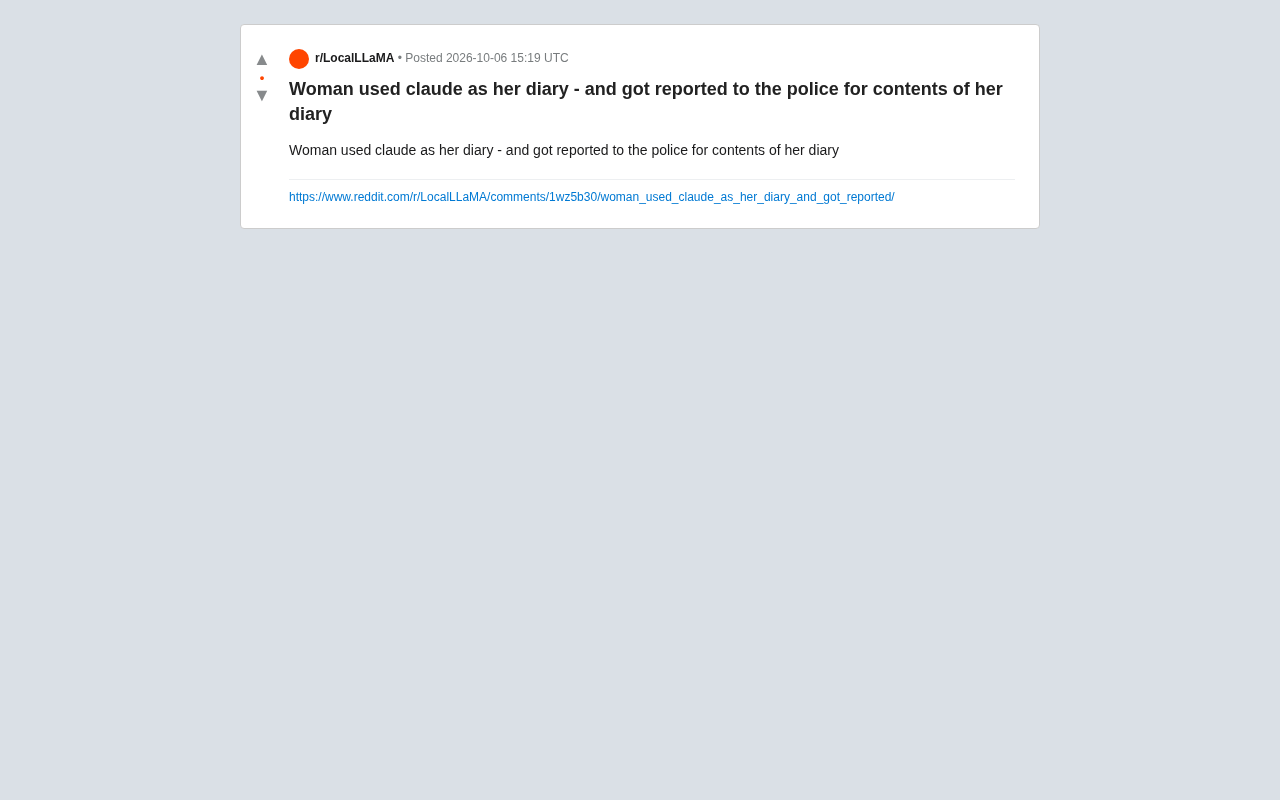
A post circulating on Reddit has ignited fierce discussion about AI privacy and safety mechanisms: a woman was reportedly using Anthropic's AI assistant Claude as a personal diary — sharing her innermost thoughts — only to find that the contents were reported to the police.
The post offers limited details, but it cuts to the heart of one of the most sensitive questions in the AI era: when we entrust our most private thoughts to an AI, who does that content belong to — and what can be done with it?
The Privacy Concerns Behind the Incident
Using AI as a diary or emotional outlet is far from uncommon. As large language models have grown more capable, increasing numbers of users have turned to tools like ChatGPT and Claude to confide anxieties, emotions, and deeply personal secrets. Compared to a traditional paper diary, AI can respond and offer comfort — and that interactivity is precisely what makes it appealing.
Yet this mode of use carries a fundamental risk: a paper diary doesn't read your entries, let alone proactively contact anyone. AI services, on the other hand, run on corporate servers, subject to content policies, safety review mechanisms, and legal compliance requirements. Every line of text a user types can, in theory, be analyzed, flagged, or reported by the system.
If what the post describes is accurate, it means Claude — or the review process behind it — triggered an intervention mechanism upon detecting certain content, which ultimately led to the police being called. At what threshold such automated or human review is activated remains almost entirely a black box to ordinary users.
Understanding this risk from a data-processing perspective helps users build a more accurate mental model. When users have conversations with AI like Claude, the text typically passes through several stages: it is transmitted to Anthropic's servers to generate a response; it may then be used for security auditing or model improvement (unless the user actively opts out); and it is retained in a database for a certain period. Unlike end-to-end encrypted messaging tools such as Signal, mainstream AI service providers are technically capable of reading conversation content. This means "privacy" in this context is closer to a contractual promise — a company's pledge not to misuse your data — rather than absolute encryption that is technically inaccessible. These are fundamentally different things, and users should be clear-eyed about this distinction when choosing where to confide.
The Tension Between AI Safety Mechanisms and Privacy
Leading AI companies universally deploy content safety systems designed to identify high-risk content involving self-harm, violence, illegal activity, and similar concerns. Anthropic has long positioned "AI safety" as a core part of its identity, with its alignment research and content safeguards widely regarded as an industry benchmark. But while these mechanisms protect users and society, they inevitably clash with users' privacy expectations.
The crux of the issue is the gap between user expectations and actual data handling. When someone uses AI as a "diary," their psychological expectation is one of absolute privacy — no judgment, and certainly no forwarding of content to third parties. But from a terms-of-service perspective, virtually every AI platform reserves the right to review, retain, and even disclose content to authorities under certain circumstances.
This gap is the root of the controversy: what is technically compliant from an operational standpoint can feel like a profound betrayal in the user's emotional reality. This is especially true when mental health is involved — whether a police welfare check is a well-intentioned act of life protection or a heavy-handed violation of privacy is a question with no easy answer.
On a technical level, AI content safety systems typically fall into two categories: first, real-time automated classification models that score input text for risk during a conversation and trigger preset responses when a threshold is crossed (such as refusing to reply or inserting crisis hotline information); second, post-hoc human review queues, where flagged high-risk conversations are reviewed by humans who decide whether further action is warranted. Anthropic's usage policies explicitly state that in extreme situations involving risk to life, the company reserves the right to disclose information to relevant parties — but the specific triggering criteria are not publicly disclosed. This connects to mandatory reporting laws in certain jurisdictions: in some U.S. states, specific institutions are legally required to report to law enforcement when they identify a person at risk of self-harm or harming others. Whether AI companies are subject to similar obligations remains legally contested, with rules varying widely by location.
What This Means for Everyday Users
Regardless of whether this particular post is entirely accurate, the discussion it has sparked carries real implications for all AI users:
- AI is not a private space. No matter how much the interface resembles a one-on-one personal conversation, the content you enter lives on a company's servers and is subject to its policies.
- Be careful with sensitive content. Before entering anything related to personal safety, the privacy of others, or illegal activity, be aware that it may be logged or reviewed.
- Read the privacy policy. Understanding your AI tool's data retention period, the scope of human review, and the conditions under which content may be disclosed is basic digital literacy in today's world.
- Emotional support still needs professional channels. AI can provide companionship, but it cannot replace therapists, crisis hotlines, and other professional support systems that are bound by genuine privacy protections.
A Boundary That Has Yet to Be Drawn
The full picture of this incident remains unclear — we cannot confirm the specific nature of the content, what triggered the police report, or Anthropic's official position. But it precisely reflects a boundary that has yet to be drawn as AI becomes more widespread: between user privacy, corporate responsibility, and public safety, how should AI companies make trade-offs?
As more and more people integrate AI into the most intimate corners of their lives, questions like these will only grow sharper. How regulation, industry standards, and user education work together will ultimately determine whether we can truly trust the intelligent tools in our hands.
Note: This article is based on community discussion from Reddit. The details of the incident have not been officially verified, and conclusions should be taken as reference only.
Related articles

AI Writes Code, Will Programmers Lose Their Jobs? The Truth About Devin's Autonomous Programming
Devin and other autonomous AI coding agents are changing software development: from Copilot-assisted coding to fully automated engineering agents, the programmer's role shifts from writing code to system design and oversight. This article analyzes the impact of AI programming on employment, code security, and junior developer training, as well as the real direction of programmer demand under the efficiency paradox.

Citigroup's 14,000 Engineers Use Devin, Slashing Tech Outsourcing Bill by 30%
Citigroup's 14,000 engineers used AI coding agent Devin to cut its tech vendor bill by 30% and speed releases 30-40%, while JPMorgan says AI gains aren't in earnings yet.

AGENTS.md in Practice: Making Coding Agents Actually Work
AGENTS.md and CLAUDE.md can boost coding agent performance, but research shows misuse raises costs 20%. Here's what to write, what to delete, the 200-line and 32KB limits, monorepo nesting rules, and a security warning.